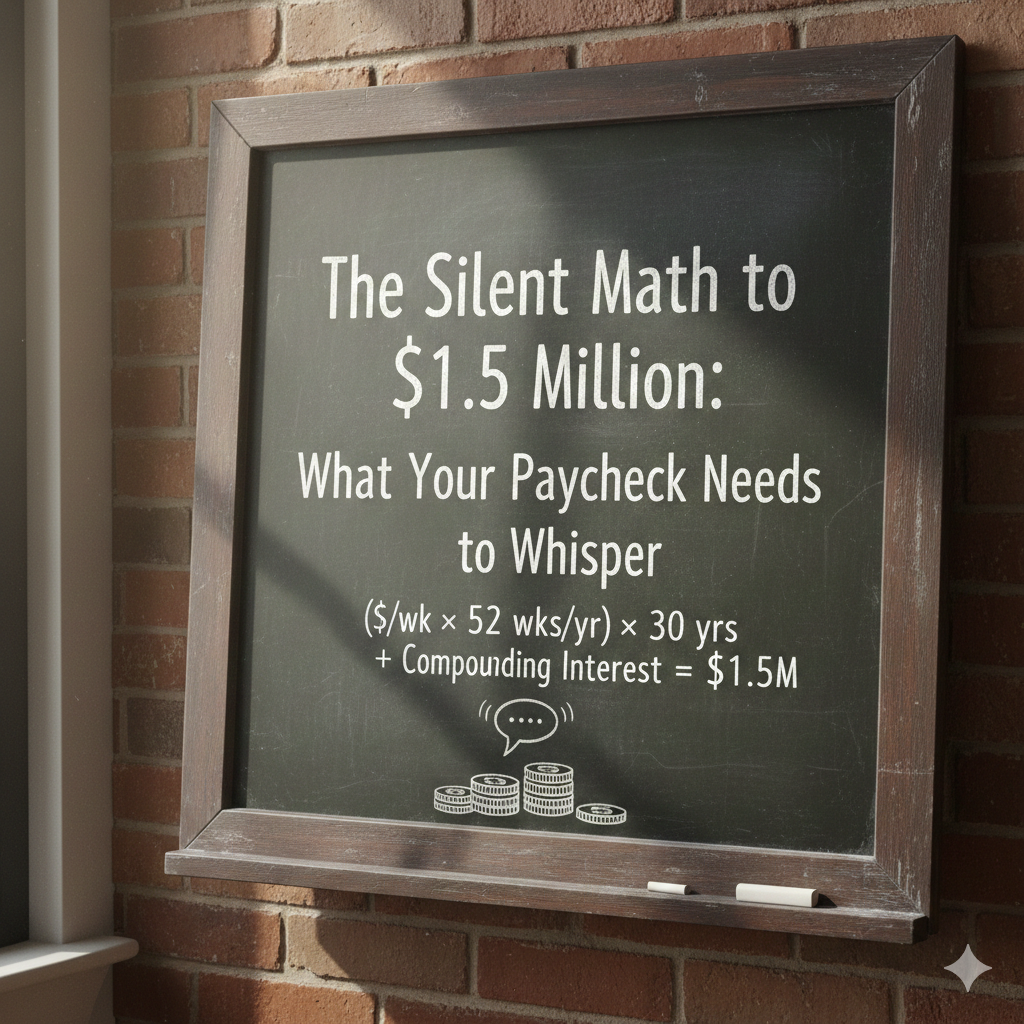
We often hear the round number—$1.5 million for retirement. It has a certain weight to it. It feels both astronomically out of reach and yet, somehow, a bare minimum for a future of comfort. The real question isn’t the nest egg itself, but the silent, daily engine required to build it: your income. If we set the parameters—starting at age 22, retiring at 70, investing with a historical average return of 10% annually, and saving a steady 20% of your income—the math reveals a quiet, non-negotiable truth about your career.
The journey spans 48 years. That’s a profound advantage. Time transforms modest, consistent actions into monumental results through the relentless magic of compounding. At a 10% annual growth rate, money doubles roughly every 7.2 years. From 22 to 70, your contributions have the chance to double nearly seven times over. This is why starting early isn’t just advice; it’s the most powerful financial lever you will ever own.
So, what does this machine require to produce $1.5 million? You are committing to save 20 cents of every dollar you earn, every year, for your entire career. The calculation, therefore, works backward. We must find the steady annual contribution that, when grown at 10% for 48 years, blossoms into that grand total. That figure is approximately $1,750 per year. That seems almost laughably small, until you remember that this represents just one-fifth of your pre-tax earnings. If $1,750 is 20%, then 100%—your required annual income—is $8,750.
Let that settle. To amass $1.5 million under these perfect conditions, you only need to earn **$8,750 per year** and religiously save 20% of it. This is the raw, theoretical power of time and compounding laid bare. A part-time job at minimum wage could theoretically get you there, mathematically speaking.
But this is where theory meets the breath and sweat of real life. The figure of $8,750 is a phantom. It ignores the very substance of our existence: inflation, taxes, and life itself. Your $1,750 saved this year will not have the same purchasing power in fifty years. The $1.5 million at the end will not be worth $1.5 million in today’s dollars. This calculation is in “nominal” terms, meaning the future dollars are lighter, less valuable. To truly have the equivalent of $1.5 million in today’s purchasing power, you must aim for a much larger nominal sum, which requires a much higher income today.
Furthermore, that 20% savings rate must be carved from post-tax income, while the target is based on pre-tax earnings. Taxes are the relentless tide that erodes our beach. And life—the rent, the groceries, the occasional joy, the unexpected medical bill—exists in the space between that gross income and the 20% you manage to save. To actually live while saving that 20%, your real income needs to be significantly higher than this bare mathematical skeleton suggests.
Therefore, the number $8,750 is not a goal; it is a lesson. The lesson is that your greatest asset is your youth. The second lesson is that a consistent savings rate, married to a solid growth investment, is a formula that borders on alchemy. The practical takeaway is this: while your actual required salary will be dictated by the cost of living, inflation, and your life choices, the process remains non-negotiable. Start immediately with whatever you have. Secure that 20% savings rate, even if it’s 20% of a humble beginning. Then, as your career grows and your earnings swell, fight the temptation of lifestyle inflation. Let your savings rise proportionally. The engine you build in your twenties, fueled by time, will do more heavy lifting than the extra fuel you try to add in your forties.
The path to $1.5 million is less about a single staggering salary and more about the steadfast discipline of a 20% savings rate, applied to a decent income, and protected by time. Find a career that allows you to live comfortably on 80% of its proceeds. Do that from age 22, and the market, given its historical patience, will likely hand you the rest. Not just $1.5 million in future dollars, but a future of genuine freedom.