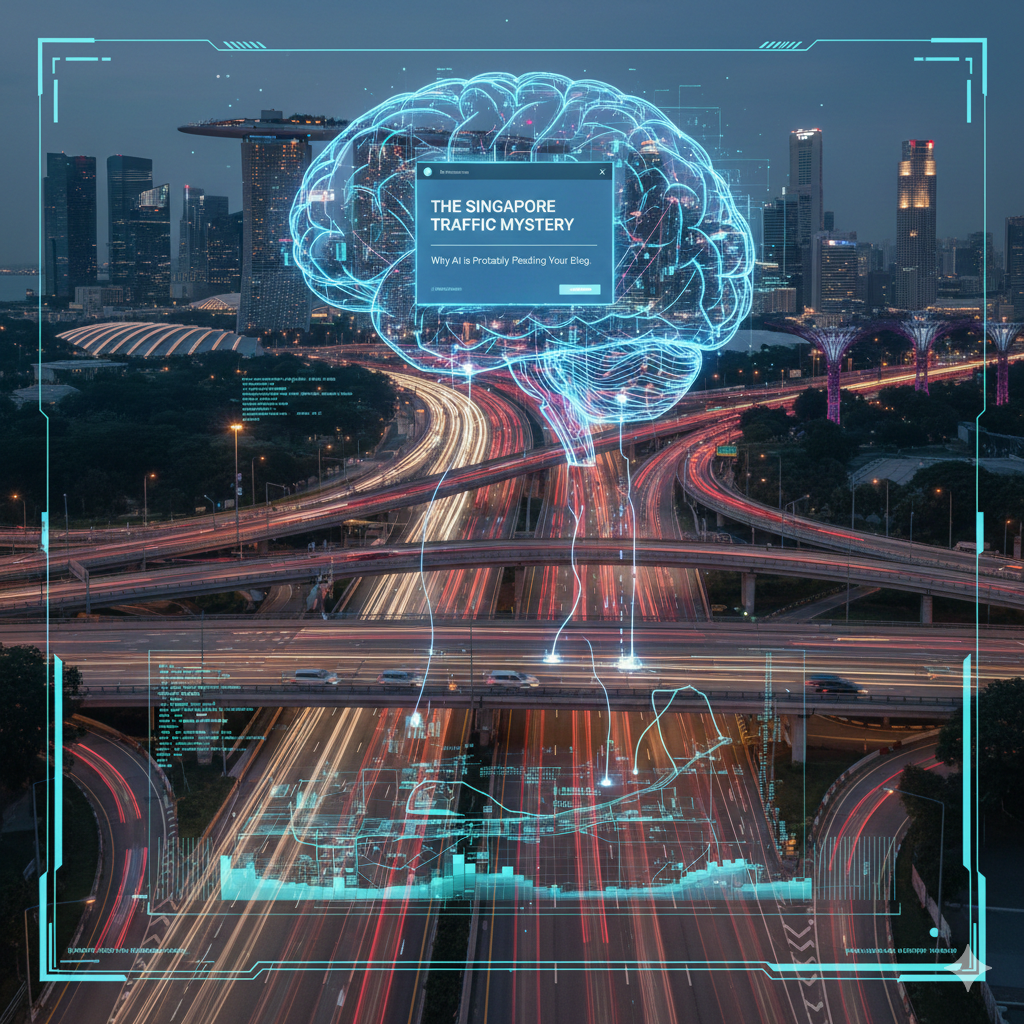
If you’ve been checking your analytics lately and noticed an unusual spike in traffic from Singapore, you might be wondering what’s going on. Are you suddenly popular in Southeast Asia? Did one of your posts go viral in the Lion City? The reality is probably less exciting but more intriguing: there’s a good chance that artificial intelligence systems are systematically reading through your content.
Singapore has become a major hub for AI infrastructure and cloud computing services in recent years. Companies like Amazon Web Services, Google Cloud, and Microsoft Azure operate massive data centers there, and these facilities serve as the backbone for training and running large language models. When AI systems need to crawl the web to gather training data or retrieve information for users, those requests often originate from IP addresses registered in Singapore.
The pattern is becoming increasingly common across websites of all sizes. Bloggers and content creators are noticing that Singapore consistently appears in their top traffic sources, sometimes accounting for a disproportionate number of page views compared to actual human readership from the region. The visits tend to have certain telltale characteristics: extremely short session durations, unusually high pages per session, and browsing patterns that suggest systematic rather than human behavior.
What’s happening is that AI companies are constantly training new models and updating existing ones, which requires massive amounts of text data from across the internet. Your blog posts, along with millions of other web pages, are being ingested and analyzed to help these systems understand language, context, and the breadth of human knowledge and expression. Some of this crawling happens for training purposes, while other requests come from AI assistants retrieving real-time information to answer user queries.
The Singapore connection specifically comes down to geography and infrastructure. The city-state offers political stability, excellent connectivity to both Asian and Western markets, and favorable conditions for operating large-scale data centers. It’s become a strategic location for companies that need to process enormous amounts of data quickly and efficiently. When an AI system needs to fetch content from the web, routing that request through servers in Singapore often makes technical and logistical sense.
This doesn’t mean your content isn’t reaching real people, of course. Genuine human readers from Singapore and elsewhere are still visiting your blog. But that unusual traffic pattern, especially if it shows hundreds or thousands of page views with minimal engagement metrics, is likely the signature of AI systems doing their work. These bots are generally well-behaved, respecting robots.txt files and not overloading servers, but they’re tireless and thorough in ways that human readers simply can’t match.
For content creators, this raises interesting questions about audience and purpose. Your words are being read and processed by non-human intelligences, potentially influencing how future AI systems understand your topic area. In a sense, you’re contributing to the education of machines that millions of people interact with daily. Whether you find that exciting, unsettling, or simply curious is a matter of personal perspective.
The trend isn’t going away anytime soon. As AI systems become more sophisticated and more widely deployed, the demand for training data and real-time web content will only increase. That mysterious Singapore traffic in your analytics? Consider it a digital-age compliment that your content is valuable enough for AI systems to read, analyze, and learn from.