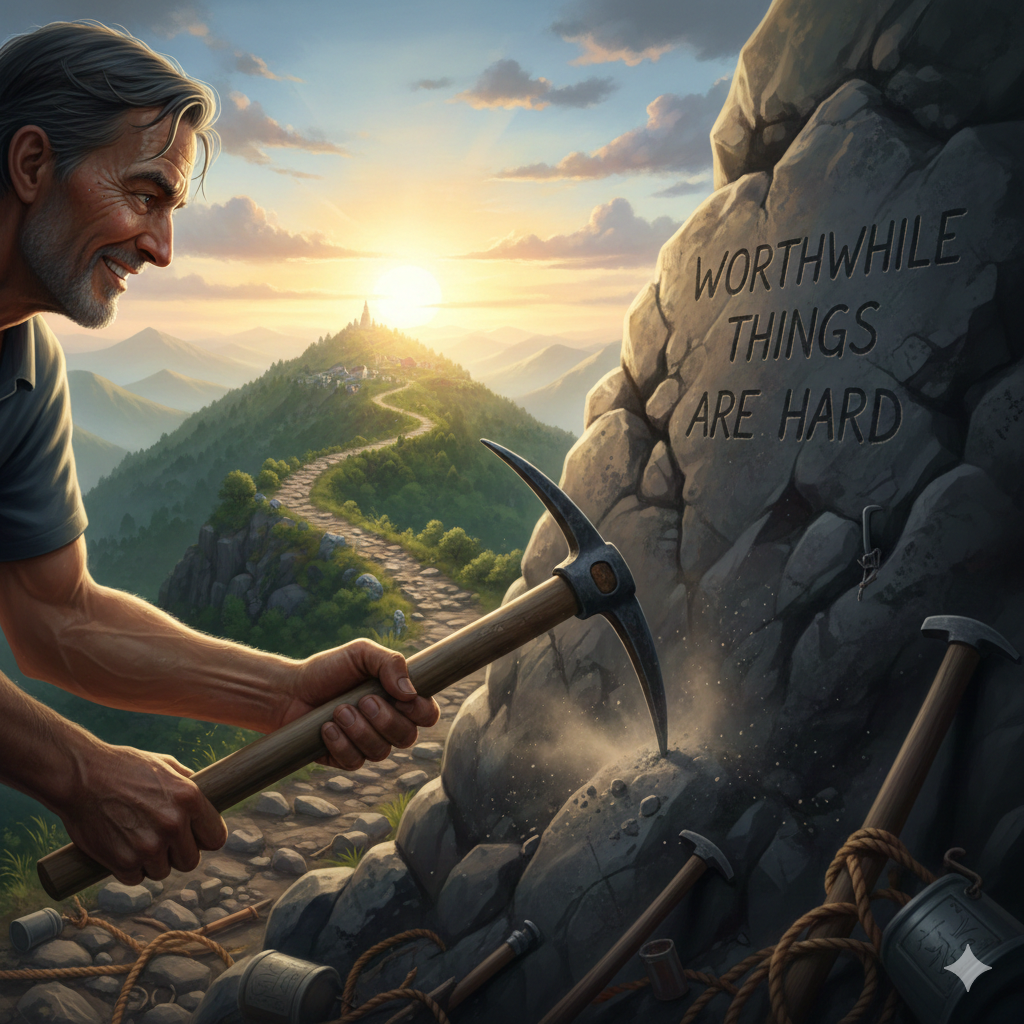
There’s a peculiar comfort in scrolling through social media, even when we know it leaves us hollow. It’s easy. Effortless. The dopamine hits come fast and predictable, like pulling a lever on a slot machine. Meanwhile, the novel we’ve been meaning to write sits untouched, the difficult conversation with a loved one gets postponed again, and the business idea that genuinely excites us remains trapped in our heads.
This isn’t coincidence. The things that actually matter, the experiences that fundamentally reshape who we are and what our lives mean, almost always require us to move through significant resistance. They demand we become uncomfortable, uncertain, and vulnerable. They ask us to risk failure in ways that matter.
Consider learning a new language as an adult. The first few months are excruciating. You sound like a child, you can’t express even simple thoughts, and every conversation is a exercise in humiliation. It would be so much easier to just stick with English, to watch movies with subtitles, to stay inside the warm cocoon of competence. But on the other side of that discomfort is an entire world of literature, relationships, and ways of thinking that simply don’t exist in your native tongue. The difficulty is the price of admission to something genuinely transformative.
The same pattern appears everywhere. Building a meaningful relationship requires the hard work of showing up consistently, having conversations that make you squirm, apologizing when you’re wrong, and staying present through conflict rather than retreating. It’s infinitely easier to keep things casual, to swipe to the next option when things get complicated, to protect yourself behind walls of irony and detachment. But the relationships that actually sustain us through life, that make us feel known and connected, are forged precisely through the difficulty of genuine intimacy.
Creating something original, whether it’s art or a company or a scientific discovery, means venturing into territory where there’s no map. You have to tolerate months or years of not knowing if you’re on the right track, of producing work that embarrasses you, of hearing “no” repeatedly. The resistance is enormous because the territory is genuinely new. If it were easy, everyone would have already done it. The difficulty serves as a filter, ensuring that only those who really care enough to persist will make it through.
Even physical transformation follows this logic. Getting genuinely strong or fit or healthy requires sustained discomfort. Your muscles have to be broken down to rebuild stronger. Your lungs have to burn. You have to feel hungry sometimes and turn down foods you enjoy. The body only changes when you push it past what’s comfortable, when you impose demands it isn’t currently equipped to handle.
What makes this particularly cruel is that our brains are wired to avoid difficulty. We evolved to conserve energy, to seek pleasure and avoid pain, to take the path of least resistance. Every fiber of our being screams at us to choose the easier option. That’s why the modern world, with its infinite array of easy pleasures and distractions, can feel like a trap. We’re surrounded by things specifically designed to be effortless, and indulging in them feels like the natural, sensible thing to do.
But here’s what we discover when we actually push through the resistance: the difficulty itself is part of what makes the achievement meaningful. When you finally have that conversation you’ve been avoiding and it brings you closer to someone you love, the relief and connection feel profound precisely because of how hard it was to initiate. When you finish writing something that required months of painful revision, the satisfaction runs deep because you know what it cost you. The struggle isn’t just an unfortunate prerequisite; it’s woven into the fabric of the accomplishment.
This doesn’t mean we should seek out difficulty for its own sake or romanticize suffering. Pointless hardship is just pointless. But when we find ourselves avoiding something because it’s hard, it’s worth asking whether that difficulty might be protecting something valuable. Often, the things we most resist are the things we most need to do.The real tragedy is how many people reach the end of their lives having optimized relentlessly for ease. They avoided hard conversations, stuck with comfortable careers that bored them, never attempted the creative project that called to them, and kept relationships at a safe distance. They were practical, sensible, and careful. And they wake up one day realizing they’ve built a life that feels small and safe and profoundly unsatisfying.
The most worthwhile things to do are hard to pull off precisely because they require us to become different people than we are now. They demand growth, courage, vulnerability, and sustained effort over time. They ask us to trade the comfort of the known for the uncertain promise of transformation. And that’s exactly why they matter.