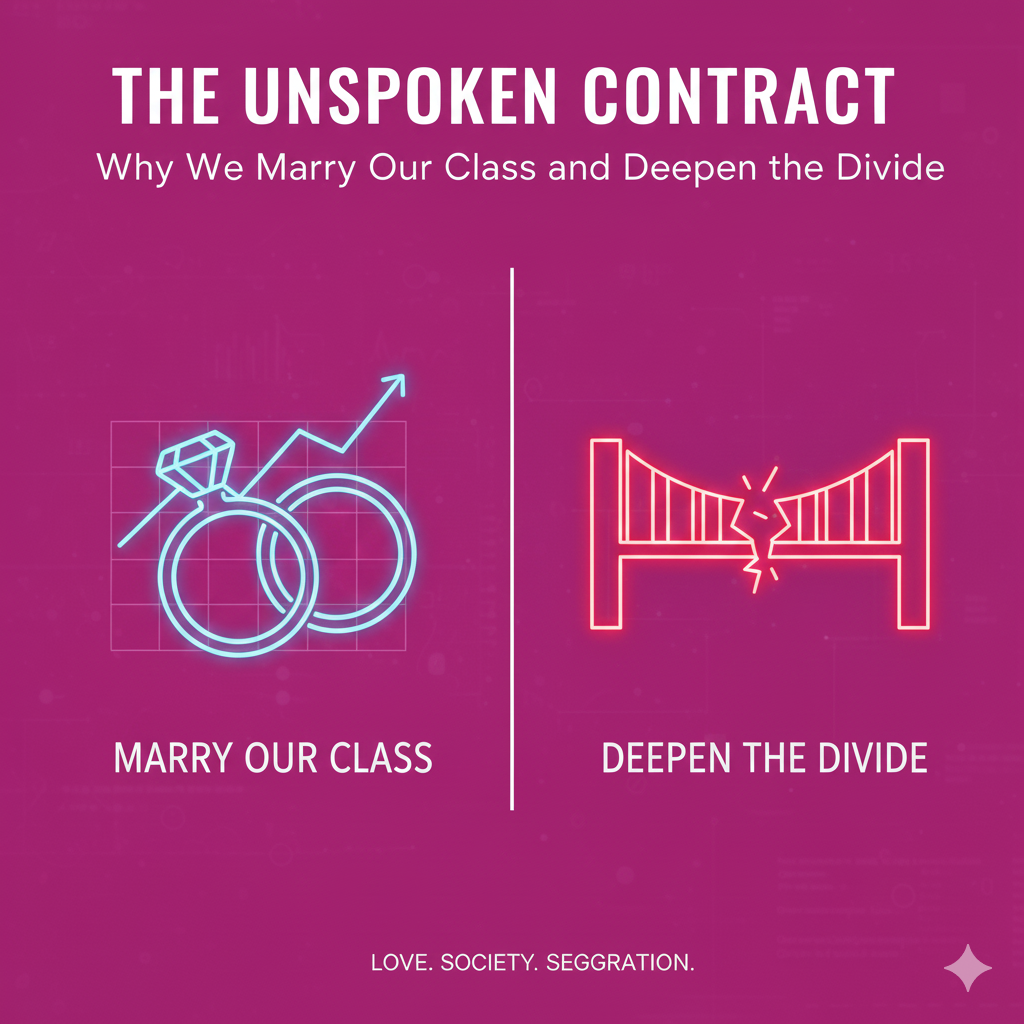
In the romantic ideal, love is blind to social standing and financial status. Yet, in the stark reality of modern economics, the choice of a life partner is one of the most powerful, and often unconscious, decisions that perpetuates the class divide. The pressure to marry within one’s social class, or homogamy, is not merely a matter of shared interests; it is increasingly an economic imperative driven by the fear of suffering a lower standard of living.
The Rise of Assortative Mating
Sociologists refer to the tendency of individuals to marry people similar to themselves as assortative mating. While this has always existed, the basis for this similarity has shifted. Today, the most significant markers for assortative mating are education and earnings potential [1] [2].
As women’s participation in the labor force has increased, the traditional model of a single male breadwinner has been replaced by the dual-earner household. This shift has transformed marriage from a social arrangement into a sophisticated economic partnership. When two high-earners marry, their combined income creates a powerful financial unit that can secure a significantly higher standard of living—a phenomenon that has been shown to contribute to rising income inequality [3].
The Economic Imperative: Securing the Standard of Living
For individuals who have achieved a certain level of financial comfort, marrying someone with a lower income or less stable career is often perceived as a direct threat to their established lifestyle. The unspoken fear is that “marrying down” will necessitate a reduction in quality of life, whether that means:•
Housing: Being unable to afford a home in a desirable school district.
Debt: Taking on a partner’s existing financial burdens or student loans.
Future Security: Jeopardizing retirement savings or the ability to provide a “family safety net” [4].
Conversely, for those from lower socioeconomic backgrounds, the economic instability that often accompanies their class can put “undue pressure on a marital relationship” [5]. The financial risk of marriage is simply too high when a partner cannot reliably contribute to the household, making a stable economic foundation a prerequisite for a successful union. In this context, choosing a partner from a similar, stable class is a rational act of financial self-preservation.
The Comfort of Cultural Capital
Beyond the purely financial calculations, homogamy is reinforced by shared cultural capital—the non-financial social assets that promote social mobility. This includes shared tastes, communication styles, educational experiences, and social networks.When partners share a class background, they often share a common understanding of how money should be managed, what constitutes a good investment, and what social activities are valuable. Marrying across class lines can introduce friction over fundamental issues like:
Spending Habits: Disagreements over saving versus spending, or prioritizing different types of purchases.
Social Networks: Feeling uncomfortable or out of place with a partner’s family or friends.
Values: Differing views on the importance of education, career ambition, or leisure time.This shared cultural comfort makes the relationship easier to navigate, further incentivizing individuals to seek partners who are not only financially similar but also culturally aligned.
The Unintended Consequence: Deepening Inequality
The cumulative effect of these individual, rational choices is a powerful mechanism of social closure [6]. By marrying within their class, couples effectively pool their economic and cultural resources, creating a formidable advantage for their children. This practice ensures that wealth, privilege, and opportunity are concentrated within the same families across generations, making it increasingly difficult for those from lower classes to bridge the gap.The choice of a spouse, therefore, is not just a personal matter of the heart; it is a profound social act that actively contributes to the persistence and deepening of class inequality. Until the economic risks of “marrying down” are mitigated by a more equitable society, the unspoken contract of class homogamy will continue to be signed, and the class divide will continue to widen.
References
[1] Assortative Mating and Wealth Inequalities Between and Within Families. Academic.oup.com.
[2] Equality in Marriages Grows, and So Does Class Divide. The New York Times.
[3] Marry Your Like: Assortative Mating and Income Inequality. Nber.org.
[4] Marrying Across Class Lines. Contexts.org.
[5] Why don’t they just get married? Barriers to marriage among the disadvantaged. Jstor.org.
[6] Upper-class romance: homogamy at the apex of the class structure. Direct.mit.edu.