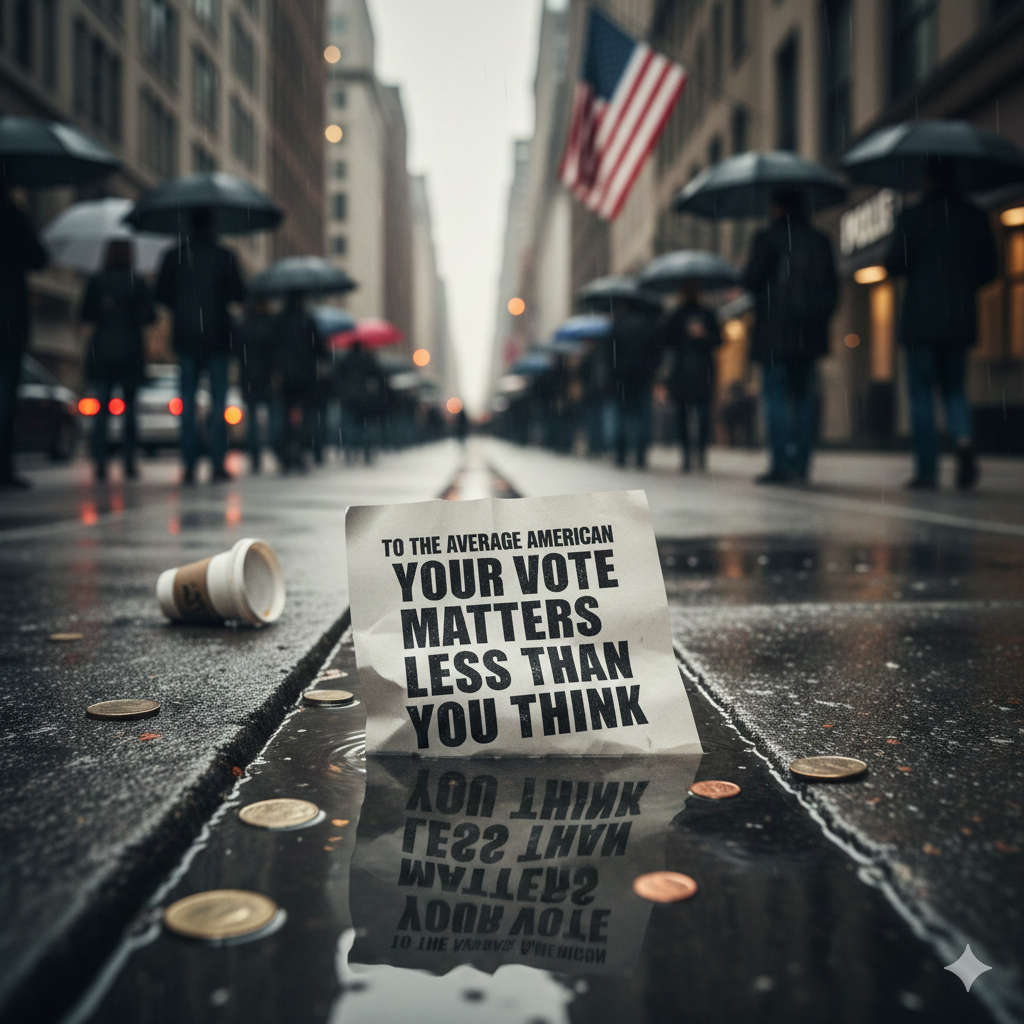
There is a ritual that plays out every two years in this country. Millions of Americans head to the polls, cast their ballots, and go home with the quiet satisfaction of having done their civic duty. They watch the returns come in, celebrate victories, mourn defeats, and convince themselves that their voice has been heard. It is a comforting story, one that underpins the entire mythology of American democracy. But beneath the surface of this reassuring narrative lies a much uglier truth. The average American’s opinion holds virtually no sway in the political realm, and the machinery of modern politics has been engineered to ensure that remains the case.
The evidence for this uncomfortable reality begins with something as simple as following the money. In the 2024 election cycle, outside spending by political groups reached a staggering $4.5 billion, with more than half of that coming from sources that do not fully disclose where their funding originates . This is not pocket change from concerned citizens. This is industrial-scale investment by corporations, billionaires, and special interests who expect a return on their money. When you have a system where a handful of individuals can pour hundreds of millions of dollars into super PACs, as Elon Musk did with his $118.6 million contribution to a pro-Trump super PAC, the idea that your twenty-dollar donation or your single vote carries equal weight becomes almost laughable .The dark money problem has grown so severe that it has fundamentally distorted whose interests are represented in Washington. During the 2024 cycle, dark money groups, nonprofits and shell companies that spend on elections without revealing their donors, plowed more than $1.9 billion into federal races . The main dark money group supporting Kamala Harris raised $613 million from donors whose identities remain secret, while its pro-Trump counterpart brought in $275 million from similarly anonymous sources . Tiffany Muller, who runs the advocacy group End Citizens United, estimated that only about 25 percent of the money spent by outside groups in elections can now be traced back to its true source . This is not transparency. It is a system designed to hide the ball, to ensure that when a politician casts a vote, they know who really paid for their seat, even if the public does not.
This financial influence extends far beyond just campaign ads. It permeates the very process of governing. Corporate lobbying expenditures at the federal level reached a record $3.7 billion in 2024, accounting for more than 86 percent of all lobbying spending . When regulations are being written, when laws are being crafted, corporations are not sitting on the sidelines. They are actively engaged, submitting comment letters, hiring armies of lobbyists, and shaping the final language of rules that will affect millions of Americans. A study of SEC rulemaking found that over 95 percent of comment letters submitted by public companies advocated for pro-management positions, seeking to reduce regulatory oversight or expand managerial discretion . More importantly, these corporate letters were significantly more likely to be cited in final rules and to lead to material changes than letters submitted by academics or individual citizens . The public comment process, ostensibly designed to incorporate a range of perspectives, has become just another tool for entrenched interests to protect themselves.
The healthcare industry provides a stark illustration of how this influence plays out in practice. The largest Medicare Advantage firms spent more than $330 million lobbying over five years, deploying more than 220 lobbyists to Capitol Hill in 2024 alone . These are not abstract policy debates. This is about whether seniors receive quality care, whether taxpayer money is spent wisely, and whether private insurance companies continue to receive billions in overpayments. The people making these decisions are not hearing from the average senior struggling with medical bills. They are hearing from well-dressed lobbyists with campaign contributions in hand.
Even when public opinion is clearly and overwhelmingly on one side of an issue, it often fails to move the needle. The case of the Affordable Care Act is instructive. Despite intense messaging wars and elite efforts to shape public perception, research found little to no effect of the law or its attendant political battles on actual public opinion . The debate was happening in a bubble, among insiders, while the views of ordinary Americans remained stubbornly stable and largely irrelevant to the outcome. The policy was shaped by negotiations between interest groups, party leaders, and industry stakeholders, not by the will of the people.The primary system, where many elections are effectively decided due to gerrymandering, further amplifies the problem. In low-turnout partisan primaries, ideological PACs funded by a handful of billionaires wield outsized influence . These groups only need to move a relatively small number of voters to sway an election, and they have the resources to do so at will. Research has shown that in partisan primaries, support from twenty ideological PACs corresponds to a 7.6 percentage-point increase in vote share . That is the difference between winning and losing, and it is a difference bought and paid for by people whose names you will never know.
The cumulative effect of all this is a political system that is remarkably responsive to the wealthy and remarkably indifferent to everyone else. When nearly 35 percent of all disclosed outside spending comes from the finance, insurance, and real estate sectors, and another 23 percent comes from ideological single-issue groups, the agenda gets set accordingly . The average American worried about paying rent, affording healthcare, or sending their kids to college is not in the room where it happens. They are outside, staring through the window, hoping that someone inside might remember they exist.
It is a bitter pill to swallow, this realization that your voice is a whisper in a hurricane of cash. But pretending otherwise, clinging to the fairy tale that every vote counts equally, only ensures that the system continues to function exactly as it was designed. The first step toward reclaiming any semblance of democratic control is acknowledging that the current game is rigged, and that the only way to change the rules is to understand, with clear eyes, who is really writing them.