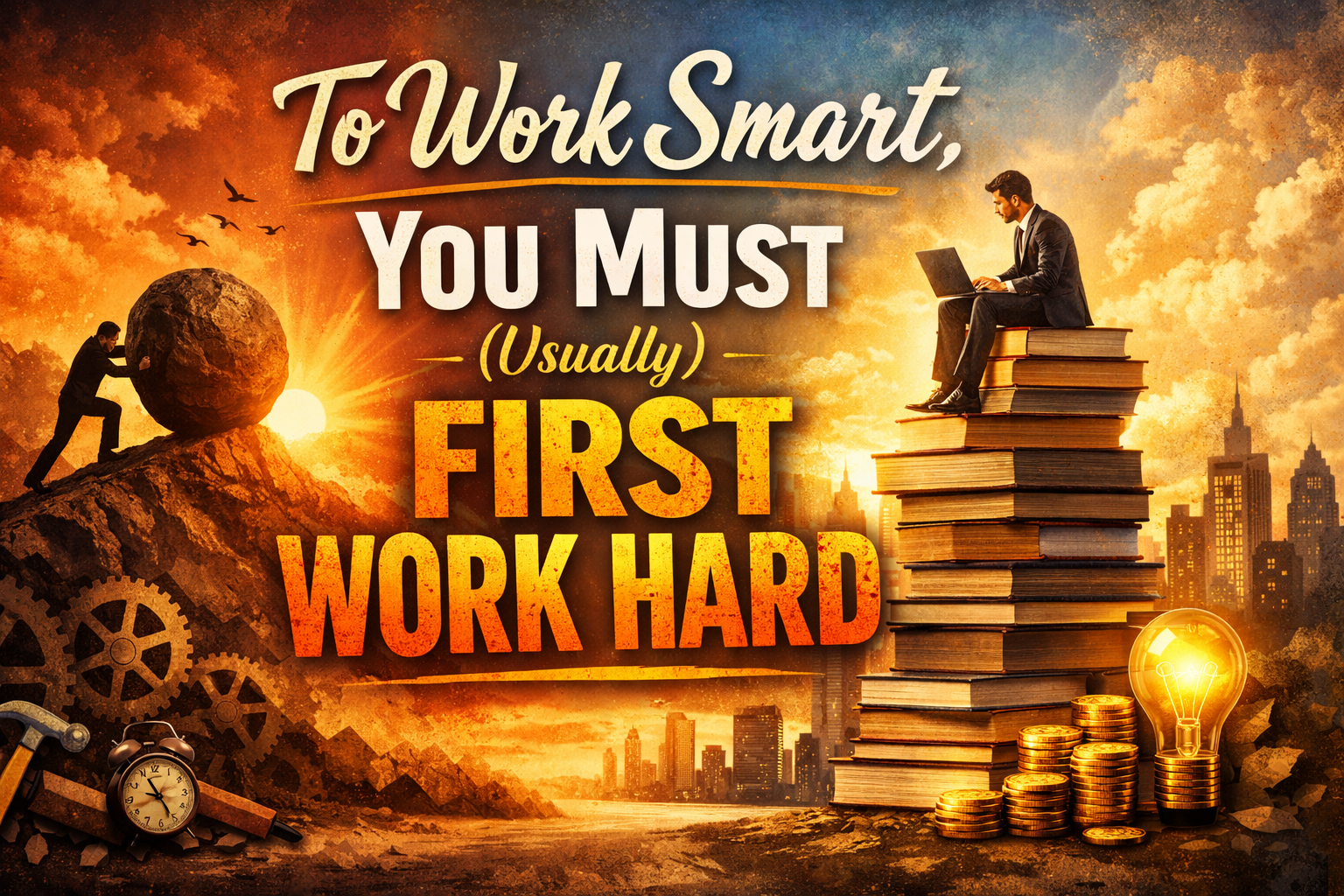
“Work smarter, not harder” is one of the most repeated phrases in business. It sounds efficient. It sounds strategic. It sounds like the shortcut everyone is searching for. But there is a piece of that advice that rarely gets mentioned
.In order to truly work smart, you must first work hard for a while.
Working smart is not a starting point. It is an evolution. It is the result of experience, repetition, and effort. Without that foundation, attempts to work smart often become excuses to avoid necessary work.When someone begins a new venture, they do not yet know what actually moves the needle. They do not know which marketing channel converts best, which client type is most profitable, which tasks can be automated, or which processes can be streamlined. They only discover those answers by doing the work. That initial phase requires intensity. It requires testing, failing, adjusting, and repeating.
Hard work in the early stages builds pattern recognition. You start to see what matters and what does not. You notice where time is wasted. You discover which actions generate revenue and which ones only feel productive. That clarity is what later allows you to simplify.
If you skip the hard phase, you lack the insight required to optimize.
Consider someone building a service business from scratch. In the beginning, they might manually send outreach emails, personally follow up with every lead, design every proposal themselves, and handle client onboarding without automation. It is not glamorous. It is often repetitive. But through that repetition, they learn what questions clients ask, where confusion arises, and what objections appear most frequently.
After enough exposure, they can create templates, scripts, workflows, and systems that eliminate unnecessary effort. Now they are working smart. But the smart system was built on top of hard-earned knowledge.There is also a psychological component. Working hard early builds discipline. It strengthens your capacity for focus. It trains you to push through discomfort. These traits become assets when you begin to streamline operations. Without discipline, tools and systems become distractions rather than leverage.
People sometimes try to jump straight to automation and delegation before understanding the work themselves. They outsource tasks they have never performed. They invest in software they do not know how to use effectively. They attempt to optimize processes that have not yet been proven. The result is wasted money and confusion.
Efficiency without understanding is fragile.
Hard work creates understanding. It forces you to confront the details. It shows you where the friction points are. It exposes inefficiencies. Only after experiencing those inefficiencies firsthand can you eliminate them intelligently.
There is also a credibility advantage to this progression. When you have done the work personally, you lead with authority. If you eventually build a team, you know what realistic output looks like. You understand the challenges involved. You can identify quality versus mediocrity. That experience prevents you from being misled or overpaying for subpar performance.
Working hard early also accelerates skill development. Repetition sharpens competence. Competence increases speed. Speed reduces effort per unit of output. What once took ten hours might later take two. From the outside, it appears as if you are effortlessly working smart. In reality, the ease was earned.
The same principle applies across industries. Writers produce better content after drafting hundreds of pieces. Sales professionals refine their pitch after countless conversations. Developers write cleaner code after years of debugging. The apparent efficiency at the top level is built on a mountain of earlier effort.
Working smart is about leverage. But leverage requires something to amplify. Systems, automation, delegation, and strategy multiply what already exists. If your skills are weak, leverage multiplies weakness. If your foundation is strong, leverage multiplies strength.
There is also a timing element that matters. In the beginning, growth often depends on volume. More outreach, more experiments, more conversations, more iterations. As patterns emerge and revenue stabilizes, the focus shifts toward refinement. You eliminate what does not work. You double down on what does. The workload may decrease, but the effectiveness increases.
That transition only happens because of the initial workload.
Many people romanticize the idea of effortless income. They want passive returns without active investment. They want optimization before exertion. But the reality is that most successful ventures require a season of intensity. That season builds the data, experience, and confidence required for intelligent simplification.
Working hard for a while is not a sign that you are doing something wrong. It is often a sign that you are in the formative stage. The key is not to remain in brute-force mode forever. The key is to extract lessons from that phase and gradually convert effort into systems.At some point, you begin to notice which activities truly drive progress. You focus on those and cut the rest. You create processes that prevent repeated mistakes. You invest in tools that save time because you now understand where time is being lost. That is when working smart becomes real.
The people who appear to have effortless operations today likely endured periods of intense effort that no one saw. They built foundations strong enough to support efficiency. They earned their shortcuts.
The path to working smart is not avoidance of hard work. It is hard work applied long enough to reveal where intelligence can replace effort. If you are in a demanding phase right now, understand that it may be laying the groundwork for future leverage.Work hard first. Learn deeply. Observe patterns. Then refine. That is how effort transforms into strategy, and strategy transforms into sustainable success.