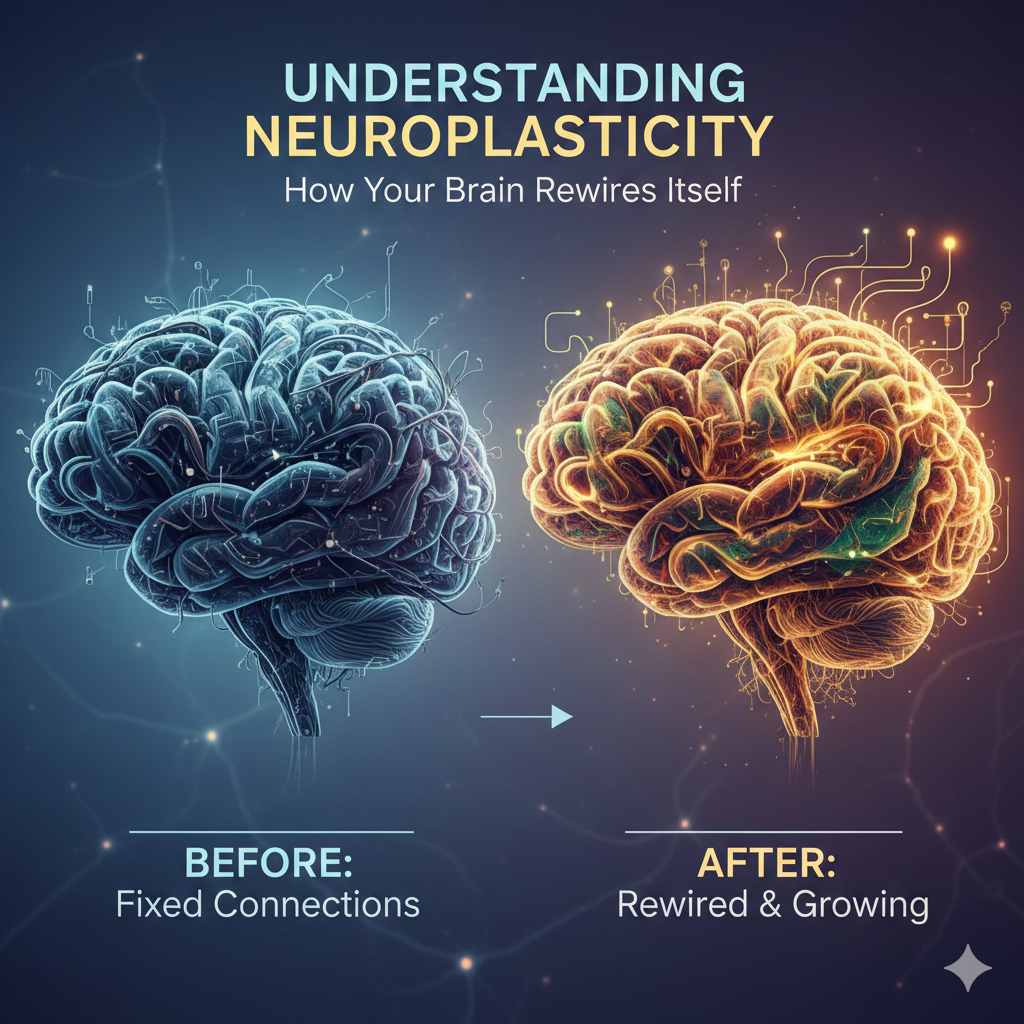
For most of the twentieth century, scientists believed that the adult brain was essentially fixed. Once you reached adulthood, the thinking went, your neural circuitry was set in stone. Any brain cells you lost were gone forever, and the connections between neurons couldn’t fundamentally change. This view painted a rather bleak picture of the brain as a static organ, declining inevitably with age.But over the past few decades, neuroscientists have discovered something remarkable that has completely overturned this understanding. The brain is not fixed at all. Instead, it’s constantly changing, adapting, and reorganizing itself throughout our entire lives. This capacity for change is called neuroplasticity, and it represents one of the most important discoveries in modern neuroscience.
The term neuroplasticity combines “neuro,” referring to neurons or nerve cells, with “plasticity,” meaning the ability to be molded or changed. At its core, neuroplasticity describes the brain’s ability to modify its own structure and function in response to experiences, learning, behavior, and even injury. Every time you learn something new, practice a skill, or adapt to a changed environment, your brain is physically rewiring itself.
This rewiring happens at multiple levels. At the most fundamental level, the connections between individual neurons, called synapses, can strengthen or weaken based on how frequently they’re used. When you repeatedly practice a piano piece or study a new language, the neural pathways involved in those activities become more robust and efficient. Conversely, connections that aren’t used tend to fade away, following a “use it or lose it” principle that neuroscientists sometimes describe as “neurons that fire together, wire together.”
But neuroplasticity goes beyond just adjusting the strength of existing connections. The brain can also form entirely new synapses, creating fresh pathways where none existed before. Neurons can even grow new branches called dendrites to reach out and connect with other cells. In some brain regions, particularly the hippocampus, which is crucial for memory formation, new neurons continue to be born throughout adulthood in a process called neurogenesis.
Perhaps most dramatically, neuroplasticity allows different brain regions to take over functions from damaged areas. When someone suffers a stroke that damages the brain tissue controlling movement in their right hand, for example, nearby regions or even areas in the opposite hemisphere can sometimes be recruited to help restore that function. This is why rehabilitation after brain injury can be effective, even though the damaged tissue itself doesn’t regenerate.
The implications of neuroplasticity are profound and touch nearly every aspect of our lives. For children, it explains why early experiences are so formative. A child’s brain is exceptionally plastic, rapidly forming new connections as they explore the world, learn language, and develop social skills. This heightened plasticity is why children typically learn new languages more easily than adults and why early intervention for developmental challenges can be so effective.
For adults, neuroplasticity offers a more optimistic view of learning and change than the old fixed-brain model ever allowed. You’re not stuck with the brain you have. Whether you’re learning to play guitar at fifty, recovering from a traumatic brain injury, or working to overcome anxiety, your brain has the capacity to change. The middle-aged person who takes up painting isn’t just acquiring a new hobby; they’re literally building new neural architecture.
This capacity for change also has important implications for mental health. Conditions like depression and anxiety are associated with particular patterns of brain activity and connectivity. Treatments like cognitive behavioral therapy work partly by helping people establish new thought patterns, which corresponds to building new neural pathways. When someone in therapy learns to respond differently to anxious thoughts, they’re not just changing their behavior; they’re rewiring their brain.
However, neuroplasticity is not uniformly positive. The brain’s ability to change means it can adapt to negative circumstances as well as positive ones. Chronic stress can reshape the brain in ways that make someone more vulnerable to anxiety and depression. Addiction involves plastic changes that make the brain hypersensitive to drug-related cues while diminishing the ability to feel pleasure from natural rewards. In these cases, the brain’s plasticity works against us, highlighting that neural change is simply a mechanism, neither inherently good nor bad.
The factors that influence neuroplasticity are varied and actionable. Physical exercise has emerged as one of the most powerful enhancers of brain plasticity, increasing the production of growth factors that help neurons survive and form new connections. Sleep plays a crucial role too, as the consolidation of new neural connections happens largely during rest. Learning new skills, particularly those that are challenging and engaging, drives plastic changes more effectively than passive activities. Social interaction, stress management, and even diet all influence how readily our brains adapt and reorganize.
Age does affect the degree of plasticity, with younger brains generally being more malleable than older ones. But the key word is “generally,” not “absolutely.” While a child’s brain might form new connections more rapidly, adult brains retain substantial plastic capacity throughout life. The difference is often more about the type and degree of change possible rather than an absolute presence or absence of plasticity.
Understanding neuroplasticity also changes how we think about practice and expertise. The ten thousand hours it takes to master a complex skill like playing violin or becoming a chess grandmaster represents ten thousand hours of brain rewiring. Expert musicians have measurably different brain structures than non-musicians, with enlarged areas devoted to processing sound and controlling finger movements. London taxi drivers, who must memorize the city’s intricate street layout, develop enlarged hippocampi compared to bus drivers who follow fixed routes. These aren’t just correlations; they’re evidence of experience literally reshaping the brain.The discovery of neuroplasticity has transformed rehabilitation approaches for stroke and brain injury. Rather than accepting permanent disability, therapists now use intensive, task-specific training to help patients rewire their brains around damaged areas. Constraint-induced movement therapy, for instance, forces stroke patients to use an affected limb by restraining the good one, driving plastic reorganization that can restore function even years after injury.As research continues, we’re discovering that neuroplasticity is even more extensive than initially thought. Studies have shown that meditation can thicken the prefrontal cortex and change activity in the amygdala. Learning to juggle increases gray matter in areas involved in visual and motor processing. Even our thoughts and attention can drive plastic changes, suggesting that how we choose to focus our minds literally shapes our brains.
This emerging understanding carries a profound message about human potential. We are not prisoners of our biology or our past. While genes and early experiences certainly matter, they don’t determine everything. The brain you have today is not the brain you must have tomorrow. Through our experiences, behaviors, and choices, we are constantly sculpting our own neural architecture. Neuroplasticity reveals the brain not as a fixed computer but as a living, adapting organ that grows and changes with us throughout our lives.