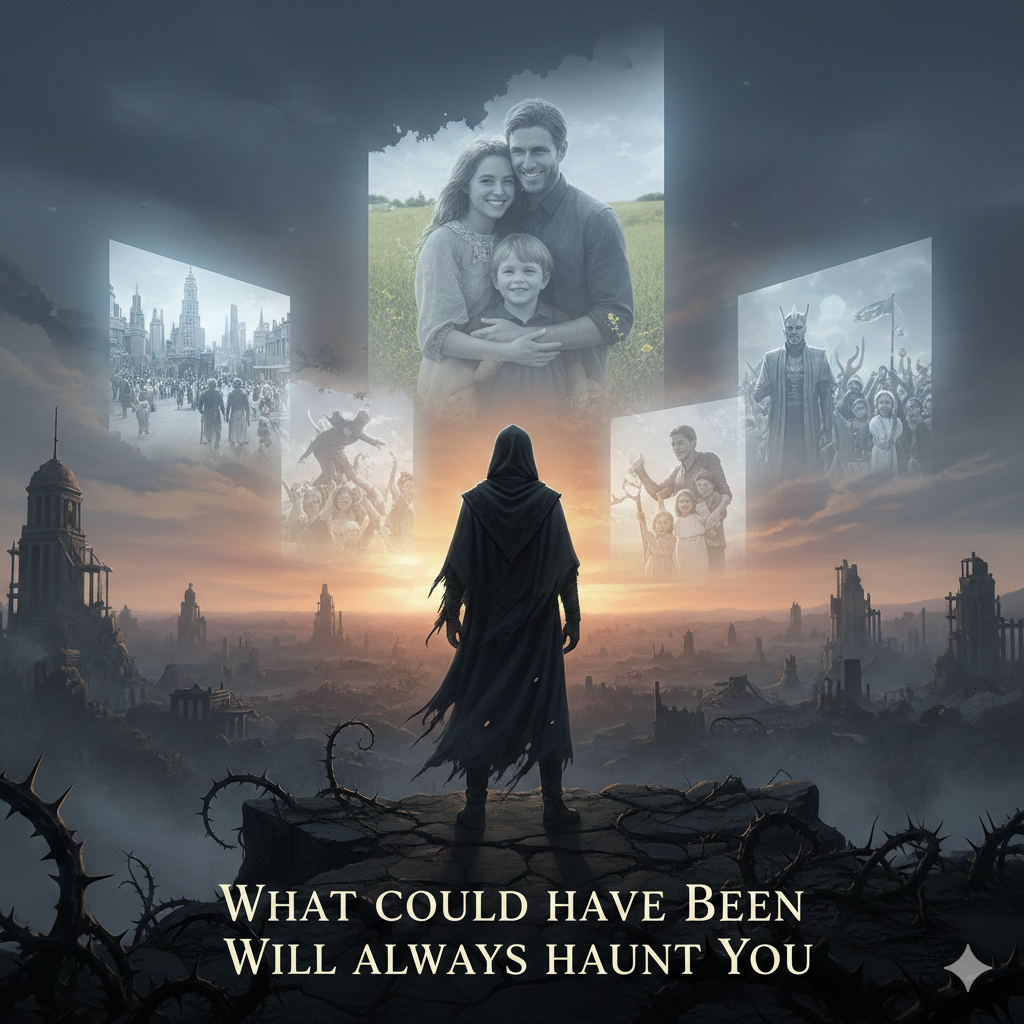
The hallway is dimmer than you remember, but the door at the end still glows with the light you left on twenty years ago. You walk toward it without taking a step; the floor tilts like a ship and carries you. This is how every haunting begins—not with chains or cold spots, but with the ordinary creak of a floorboard you once chose not to cross. We carry our unlived lives in the body the way glass carries heat: slowly, radiantly, until every edge is warm. The mind returns to them at dusk, when the day’s real events have spent their currency and the imagination begins minting counterfeit minutes. You see the version of yourself who took the other train, who answered the letter, who stayed long enough in the kitchen to hear the sentence that would have changed everything. That self is standing on a platform you can’t reach, waving. The wave looks like a question mark. Regret is a mirror that shows you only in profile; you never get to meet the eyes. What you do see is the shoulder turned away, the hand that almost lifted, the breath held between two choices like a note that never resolves. The music of it is relentless, a pianissimo ostinato under the louder concerto you actually performed. Audiences applaud the performance, but you alone hear the undertow, the softer piece that kept playing in the wings. People say the past is fixed, but that’s a lie told by clocks. The past is a watercolor left in rain; it bleeds whenever you look. Each time you remember the night you left the restaurant early, the street gets longer, her silhouette thinner, the sentence you didn’t speak more eloquent. Memory is a darkroom where negatives are developed again and again, gaining contrast, losing the blemishes that might have let you forgive yourself. The cruelest detail is how plausible it remains. You can still describe the lamppost outside his apartment, the exact flicker of its sickly sodium heart, because you were one staircase away from climbing back up. The key was in your pocket, heavy as a bullet. All the physics of that night allows the revision: the key turns, the door opens, the apology lands safely on the rug between you. The mind rehearses this scene until the carpet wears thin, until the apology learns new languages, until the key itself becomes a tiny sun you warm your hands over. Meanwhile the life you did live hardens into anecdote. Friends know the punch line: “And that’s when I got on the boat and never came back.” They laugh at the right beat. Only you hear the echo of the water slapping the hull, the moment when the dock was still near enough to jump. One stride, two, and the gap widened like a birth. You became your own twin, severed at the sternum, and each half has been looking for the other ever since. What haunts is not always spectacular. Sometimes it is the Tuesday lunch you skipped, certain you would have another chance to hear your father tell the story about the dog who walked ten miles home in a thunderstorm. The next Tuesday arrived with an empty chair and rain that tasted of metal. You replay the tiny hinge: if you had said yes to the sandwich, the anecdote would still be alive inside his mouth, and you would not be the curator of a story that ends mid-sentence with “There was this dog—” We are archivists of the almost. Every room contains a shelf of bottled breezes we did not inhale. Over the years the bottles become clouds, and the clouds gather into weather that follows you everywhere, a private climate that makes strangers ask why you shiver on sunny days. You learn to check the forecast of your own face in the mirror: chance of downpour by evening. Yet the haunting is also a kindness, the way a phantom limb aches to remind you it once was yours. The pain proves the possibility. The life you didn’t live keeps breathing somewhere, lungs made of ink and evening light, and once in a while it exhales—across a café you glance up sure you see her older, happier, the way she would have looked if you had been braver. The vision vanishes in the steam of your coffee, but for a moment the two timelines superimpose, a double exposure that makes the world briefly deeper, like a lake you could walk across if only you trusted the reflection. There is no exorcism. The ghosts don’t want your surrender; they want your company. They crowd the edges of every decision you still get to make, whispering their addresses: turn left and you’ll find me, open the envelope, stay until morning. They are not trying to drag you backward; they are trying to keep the door cracked so possibility stays alive. The terror is that one day you might stop hearing them, when the last staircase solidifies into wall, when the key in your pocket becomes just another piece of metal you carry out of habit. Until then, you walk the lit corridor, carrying the warm glass of what might have been, sipping carefully so it never spills. The level never drops. The liquid replenishes itself from the thin air of every room you enter. You understand finally that haunting is just another word for hospitality: you have offered shelter to every unborn hour, and in return they keep the light on, the one you left glowing for the self who is still on his way, still waving, still asking without words whether this time you will meet him at the station and together board the train that departs only in the mind, forever on schedule, forever just leaving the platform where you stand with an open ticket in your hand, valid for any life except the one where you never pause to wonder.
What Could Have Been Will Always Haunt You