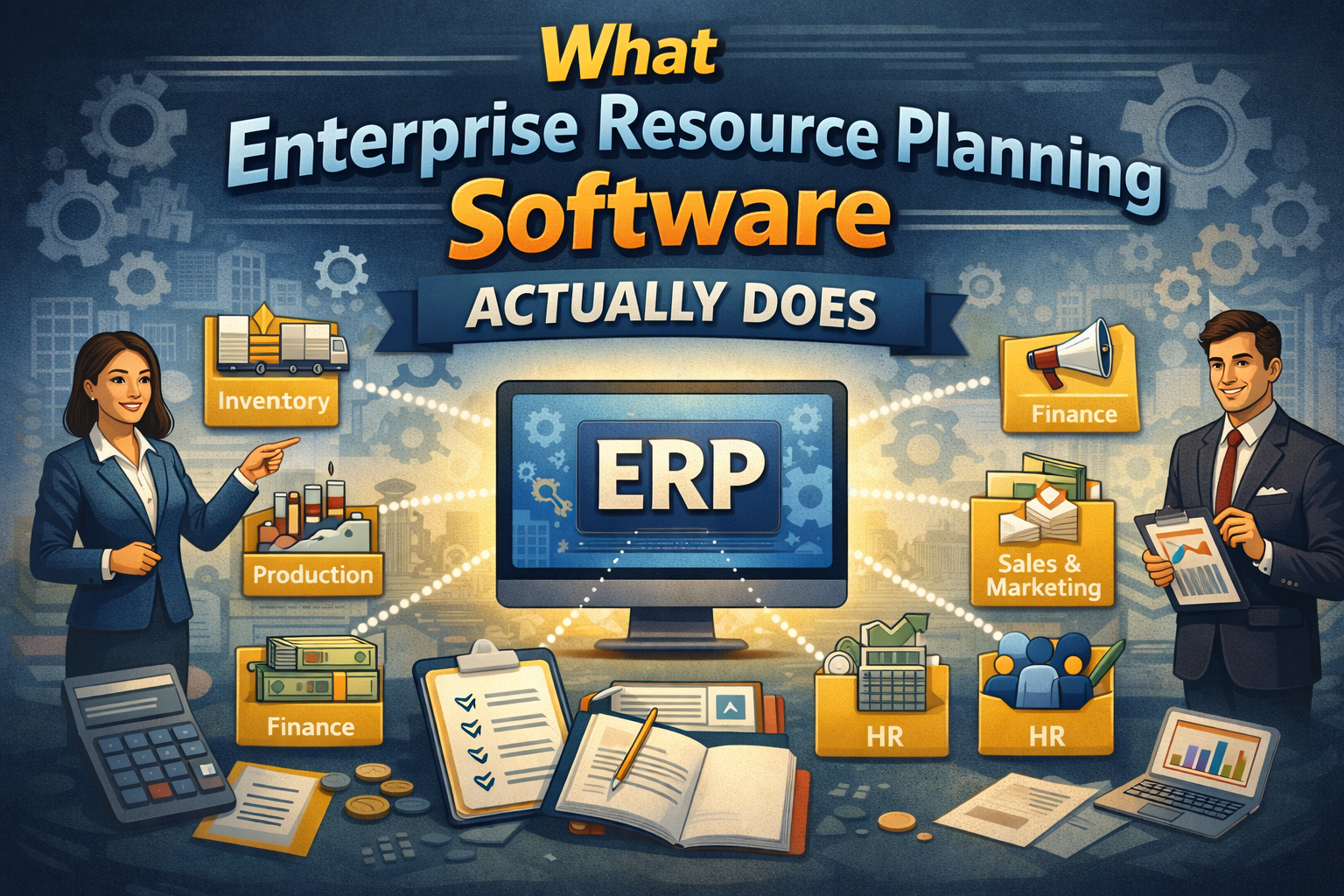
Enterprise Resource Planning software, often shortened to ERP, is one of the most important types of software used inside modern businesses. While it rarely receives the same public attention as consumer apps or flashy technology products, ERP systems quietly run the internal operations of many of the world’s largest companies. At its core, ERP software exists to bring together all of the major functions of a business into a single unified system.
Most organizations operate through several departments that each handle a different responsibility. Accounting manages finances, human resources manages employees, operations oversees production or service delivery, and sales tracks revenue and customers. In smaller companies these functions may be handled through spreadsheets, separate software tools, or manual processes. As a business grows, however, these disconnected systems begin to create problems. Information becomes fragmented, data is duplicated, and decision makers struggle to see what is actually happening inside the company.
Enterprise Resource Planning software solves this problem by integrating these functions into one centralized platform. Instead of having financial data in one system, employee information in another system, and inventory data somewhere else, an ERP system connects everything together. The result is that information flows through the company in a coordinated way rather than being trapped inside isolated departments.
A typical ERP system contains modules that represent different parts of the business. These modules allow companies to manage financial accounting, track inventory, process orders, handle payroll, manage procurement, and monitor operations. Because the modules share the same underlying database, a change made in one part of the system immediately updates the rest of the organization. When a sales order is created, inventory levels update automatically. When payroll is processed, financial records update without manual entry.
This integration dramatically reduces the amount of administrative work required to run a company. Instead of employees manually copying information between systems, the software handles the flow of data automatically. The reduction in duplication and errors allows companies to operate more efficiently and with far greater accuracy.
Another major benefit of ERP software is visibility. Business leaders rely on accurate information in order to make decisions. When data is scattered across different tools and departments, it becomes difficult to understand the true financial health of the company or the status of operations. ERP systems solve this by providing a single source of truth. Managers can see revenue, expenses, inventory levels, production output, and workforce information in one place.
This visibility becomes especially important as companies grow larger and more complex. A small business might be able to manage its operations informally, but a global organization with thousands of employees cannot rely on disconnected spreadsheets. ERP systems allow these organizations to coordinate their activities across multiple offices, countries, and divisions while maintaining consistent processes.
Large technology companies have built enormous businesses around ERP software. Companies such as SAP, Oracle, and Microsoft have developed platforms that serve enterprises across manufacturing, logistics, finance, retail, healthcare, and many other industries. Implementing one of these systems can take months or even years because the software often becomes the central nervous system of the entire organization.
Despite the complexity of these systems, the underlying idea behind ERP software is simple. Businesses run more efficiently when their information is organized, connected, and accessible. Instead of every department operating independently, the entire organization works from the same data and the same processes.
In many ways, ERP software represents the digital infrastructure of modern business. Just as roads and power grids allow cities to function, ERP systems allow large organizations to coordinate their internal operations. They may not be visible to the public, but they quietly power the everyday activities that keep companies running.