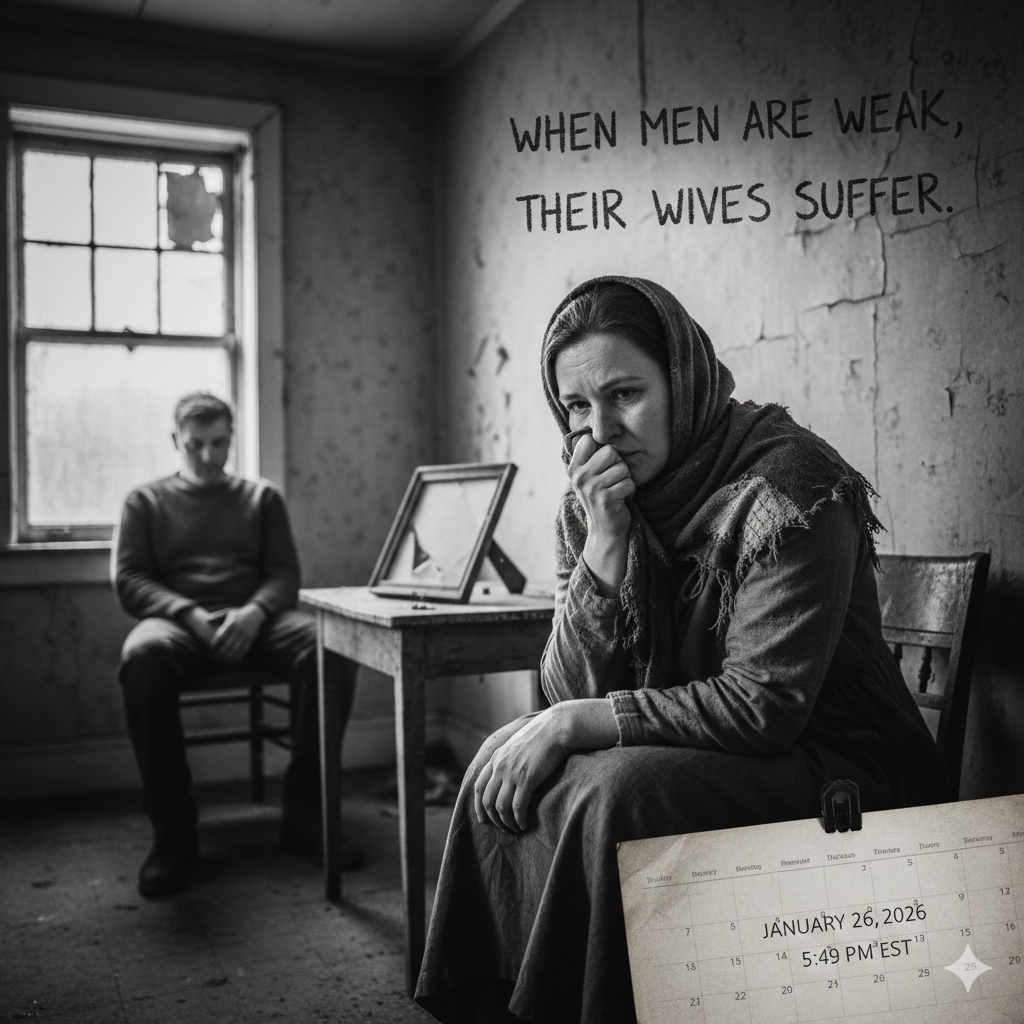
There’s an uncomfortable truth that needs to be said: when a man abdicates his responsibilities in a marriage, his wife bears a disproportionate burden of that failure. This isn’t about traditional gender roles or outdated stereotypes. It’s about the simple reality that weakness in one partner creates strain that the other must absorb.
Let me be clear about what I mean by weakness. I’m talking about emotional unavailability, the refusal to make difficult decisions, the inability to provide stability whether financial or emotional, and the failure to be a true partner when life gets hard. When a man retreats into passivity, avoidance, or self-centeredness, he’s not just failing himself. He’s actively making his wife’s life harder.
Consider the husband who won’t engage in difficult conversations about money, parenting, or the future. His wife is left making all the hard choices alone, carrying the mental load of two people while he checks out. She becomes both partners in the marriage, forced to be strong enough for two because he’s chosen to be weak. The weight of that isolation is crushing.Or think about the man who can’t regulate his own emotions, who melts down under stress or lashes out when challenged. His wife becomes his emotional manager, walking on eggshells, absorbing his moods, doing the impossible work of keeping him stable while also maintaining everything else. She loses a partner and gains a dependent.
Financial irresponsibility is another form of weakness that devastates wives. The man who won’t hold down a job, who spends recklessly, who refuses to plan for the future isn’t just hurting himself. He’s forcing his wife to compensate, to work harder, to sacrifice more, to live with constant anxiety about their security. Her dreams get deferred or abandoned entirely to cover for his failures.
Then there’s the weakness of abdicated leadership in the family. I don’t mean authoritarian control, but the refusal to step up and help guide the family unit, to be a co-captain in navigating life’s storms. When a man refuses to engage in parenting decisions, household management, or long-term planning, his wife is left as the sole architect of their family’s future. She becomes exhausted from making every decision, anticipating every need, carrying every burden.
Physical and emotional presence matters too. The husband who’s always absent, whether literally gone or just mentally checked out, leaves his wife in a constant state of loneliness within her own marriage. She suffers the unique pain of being alone while technically having a partner, and that particular brand of isolation can be more painful than actual solitude.Perhaps most insidious is the man who lacks integrity, who lies, who makes promises he won’t keep, who says one thing and does another. His wife learns she cannot trust the person who should be most trustworthy in her life. She becomes hypervigilant, unable to relax, constantly verifying and double-checking because his word means nothing. That erosion of trust is a slow poison that seeps into every corner of the marriage.
The suffering that results from male weakness in marriage is often invisible to outsiders. She may still smile at social gatherings. She may defend him to friends and family. But inside, she’s carrying a load she never signed up for, becoming harder and more exhausted by the day, losing pieces of herself to compensate for what he refuses to bring to the partnership.This creates a terrible cycle. As she picks up his slack, he has less incentive to change. As she becomes harder and more tired, the marriage becomes less warm and connected. As the marriage deteriorates, both partners suffer, but she bears the compound suffering of both his weakness and the extra burden it creates.
The solution isn’t complicated, though it’s certainly not easy. Men need to show up fully to their marriages. That means doing the hard work of self-awareness and growth. It means being emotionally available even when it’s uncomfortable. It means making and keeping commitments. It means sharing the mental load instead of treating their wives as project managers of family life. It means being financially responsible, emotionally regulated, and genuinely present.
Marriage is meant to be a partnership where both people carry the weight together, where strength in one person supports and is supported by strength in the other. When a man chooses weakness, passivity, or selfishness, he’s not just failing to hold up his end. He’s actively making his wife carry a double load, and that’s not just unfortunate or sad. It’s a betrayal of the partnership she entered into in good faith.
The question every married man should ask himself is simple: Is my wife’s life easier or harder because she’s married to me? Am I adding to her burdens or helping carry them? Am I a source of strength and stability, or is she having to be strong enough for both of us?
Because if she’s suffering under the weight of your weakness, that’s not just her problem. It’s yours to fix.

