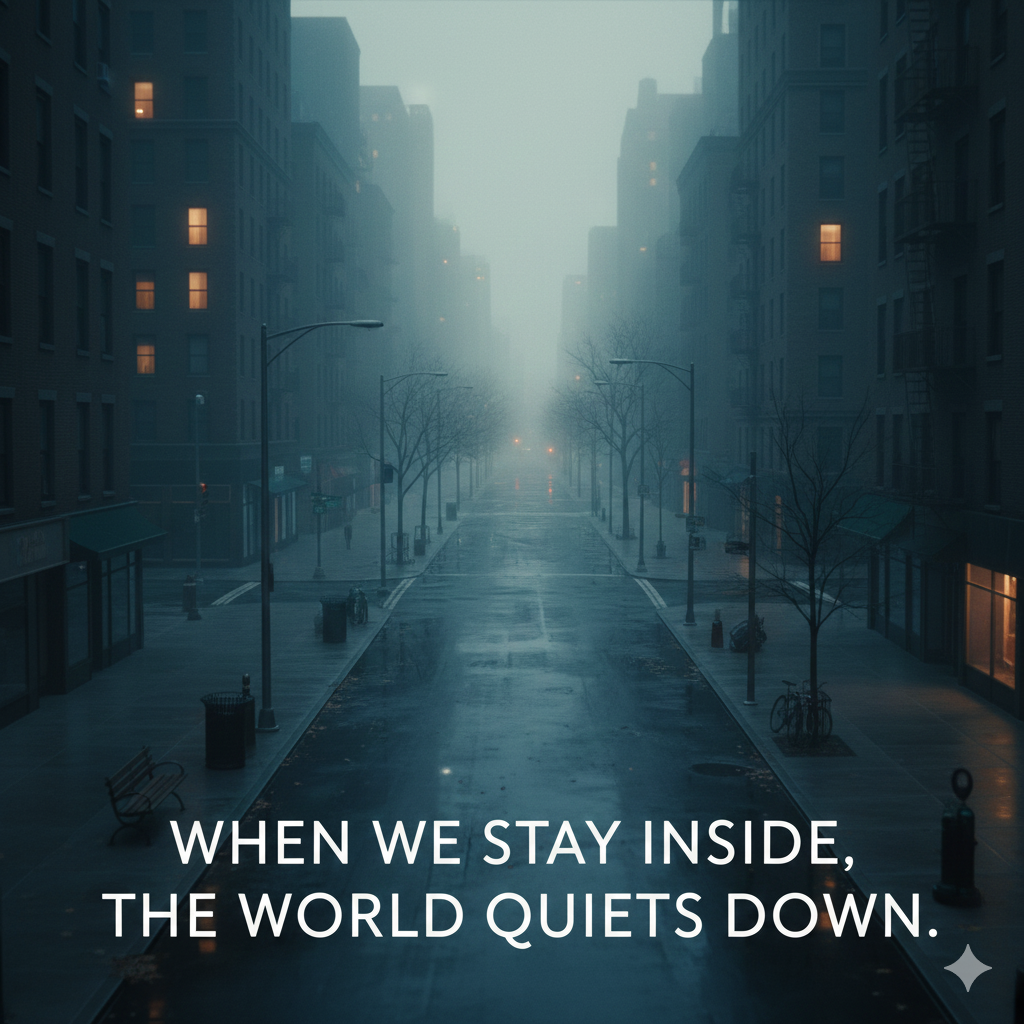
There’s a strange feedback loop in modern news coverage that nobody talks about much: the more time people spend indoors, the less actual news there is to cover.
Think about what generates news in the first place. People need to be out in the world, moving around, interacting with each other, doing things. A city council meeting happens because people show up. A traffic accident requires cars on the road. A protest needs bodies in the street. A crime spree demands both perpetrators and victims venturing beyond their front doors. Even human interest stories about chance encounters or neighborhood drama require people to actually encounter each other.
When large numbers of people retreat indoors, whether by choice during a harsh winter or by necessity during a pandemic, this engine of newsworthy events starts to sputter. Reporters find themselves with fewer accidents to cover, fewer public gatherings to attend, fewer person-on-the-street interviews to conduct. The natural churn of human activity that fills local news broadcasts and newspaper columns simply slows down.
This creates an odd problem for news organizations. They still have the same amount of airtime to fill and the same number of column inches to occupy. Audiences still expect their daily dose of information about the world. But the raw material of journalism has become scarcer. There are only so many times you can report on the same policy debate or rehash yesterday’s developments.So news organizations adapt in predictable ways. They lean more heavily on analysis and commentary, which can be generated from a desk. They focus more intensely on the handful of events that do occur, dissecting them from every possible angle. They dive deeper into ongoing stories, finding new facets to explore. They run more features and evergreen content that doesn’t depend on something happening today. Weather reports get more detailed. Sports coverage analyzes historical games. Cooking segments multiply.
The irony is that people staying inside are often consuming more news than usual. When you’re stuck at home with little to do, checking the news becomes a form of entertainment and connection to the outside world. The demand for news content actually increases precisely when the supply of newsworthy events decreases.
This mismatch can lead to a kind of inflation in news coverage. Minor incidents get treated as major stories. Small controversies get blown out of proportion. Speculation fills the gaps where reporting would normally be. A fender bender that would normally merit a brief traffic update might become a five-minute segment complete with aerial footage and expert commentary on road safety. A city council vote that would typically get two paragraphs might expand into a deep dive on municipal politics.
You can see this pattern play out during extended periods of indoor living. During harsh winters in northern cities, local news often becomes noticeably thinner, padding itself out with snow-related stories and segments about staying warm. During pandemic lockdowns, news coverage became increasingly recursive, with outlets reporting on other outlets’ reporting and analyzing the same limited set of public health developments from countless angles.
There’s nothing necessarily sinister about this process. News organizations are genuinely trying to serve their audiences, and reporters are working hard to find stories worth telling. But the relationship between human activity and news generation is real. Journalism is fundamentally about documenting what people do, and when people do less, there’s less to document.
This dynamic also reveals something about why news can feel particularly intense when people are spending lots of time indoors consuming it. The same few stories get amplified and repeated because there’s little else competing for attention. Without the usual flow of diverse events to distribute coverage across, the news cycle can become obsessive, circling back to the same topics again and again.
Perhaps the broader lesson is that news is less a mirror of reality and more a mirror of active reality. The world doesn’t stop existing when we’re all inside, but the newsworthy version of it does quiet down considerably. What happens beyond our front doors generates news. What happens within them generally doesn’t.
The next time you notice news feeling thin or repetitive during a period when you and others are staying home, you’re not imagining things. The feedback loop is real. The world needs people out in it, doing things, for there to be a steady stream of things worth reporting. Sometimes the biggest story is simply that nothing much is happening, but that’s a hard story to tell for very long.