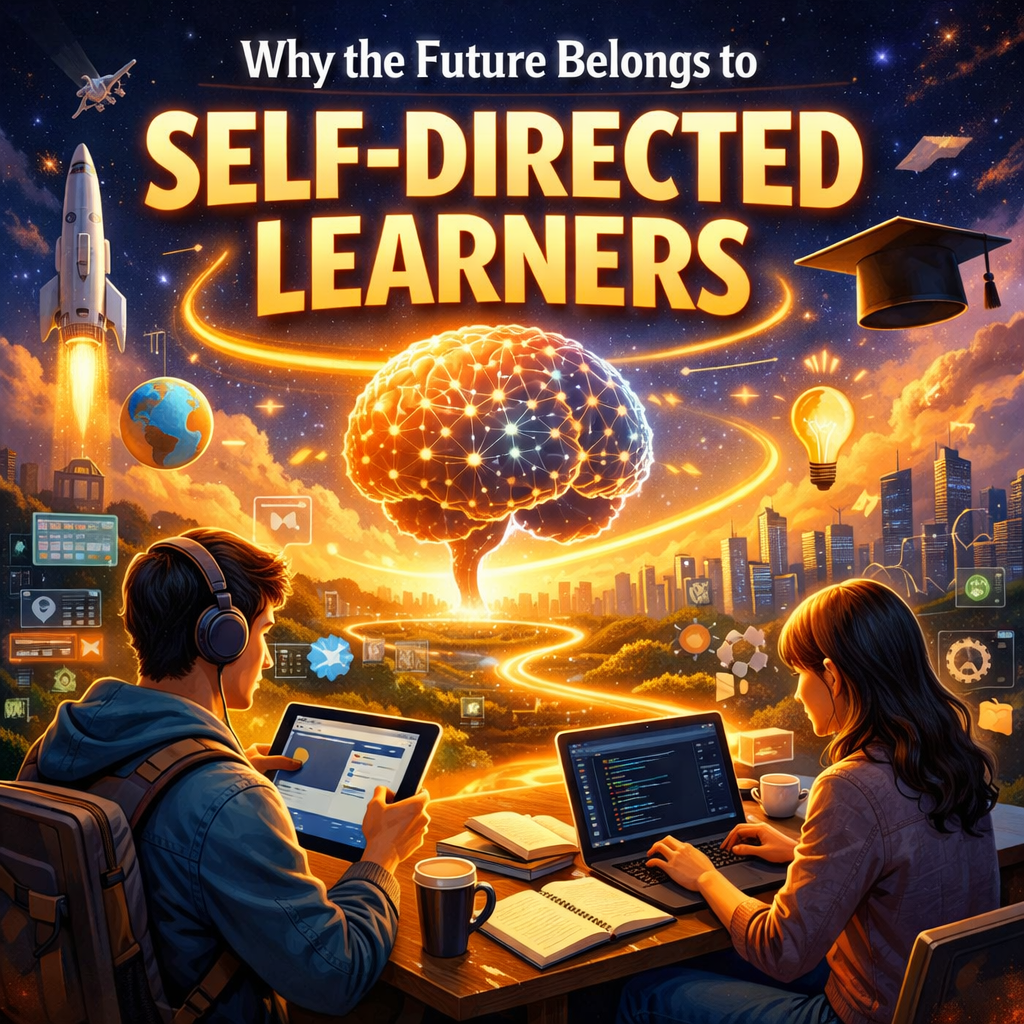
For much of modern history, education followed a predictable structure. People attended school, learned a defined body of knowledge, entered a profession, and gradually advanced through experience. Skills changed slowly, and the information someone learned early in life could often sustain an entire career. That world is disappearing. In an era defined by rapid technological change, global competition, and constant innovation, the individuals most likely to succeed are those who can teach themselves.
Self-directed learners are people who take responsibility for their own education. Instead of waiting for formal instruction, they actively seek knowledge, experiment with new ideas, and adapt to changing circumstances. They view learning not as something that ends after school but as an ongoing process that continues throughout life.
One reason this approach has become so important is the speed at which industries now evolve. New technologies, software platforms, and business models appear constantly. Entire fields can change dramatically within a few years. Traditional education systems often struggle to keep up with this pace because curricula take time to design, approve, and implement. By the time a new subject becomes widely taught, the most ambitious learners may have already explored it independently.
The internet has amplified this shift by placing vast amounts of information within reach of anyone with curiosity and discipline. Tutorials, courses, research papers, and technical documentation are available to a global audience. A motivated individual can learn programming languages, financial concepts, design techniques, or scientific ideas without needing to enroll in a formal program. The challenge is no longer access to knowledge but the willingness to pursue it.
Self-directed learners also develop a mindset that prepares them for uncertainty. Instead of relying on fixed instructions, they become comfortable experimenting, making mistakes, and refining their understanding over time. This ability to learn through exploration becomes especially valuable when working in fields where problems are new and solutions are not yet fully defined.
Another advantage of self-directed learning is adaptability. People who regularly teach themselves new skills become accustomed to starting from the beginning in unfamiliar subjects. They know how to break down complex topics, find reliable sources of information, and practice until they improve. This process can be repeated whenever a new challenge arises.In contrast, individuals who depend entirely on structured instruction may struggle when confronted with problems that fall outside their formal training. When the world changes faster than educational systems can respond, waiting for someone else to provide the next lesson can become a disadvantage.
Self-directed learning also encourages intellectual independence. When people actively search for knowledge, they develop their own perspectives rather than simply accepting information presented to them. This habit often leads to deeper understanding and creative thinking, both of which are essential in environments where innovation matters.
The future economy will reward those who can continuously expand their abilities. Careers are becoming less defined by a single profession and more by the ability to combine different skills over time. Someone might begin in one field, later acquire technical expertise, and eventually move into entrepreneurship or leadership. Each transition requires the capacity to learn quickly and independently.
Ultimately, the individuals who thrive in this environment will not necessarily be those with the most formal credentials. Instead, they will be the ones who cultivate curiosity, persistence, and the discipline to educate themselves. In a world where knowledge is widely available and change is constant, the ability to direct your own learning becomes one of the most powerful advantages a person can possess.
The future belongs to those who understand that education is not a stage of life but a lifelong responsibility. Self-directed learners embrace that responsibility, continually building the knowledge and skills needed to navigate an ever-changing world.