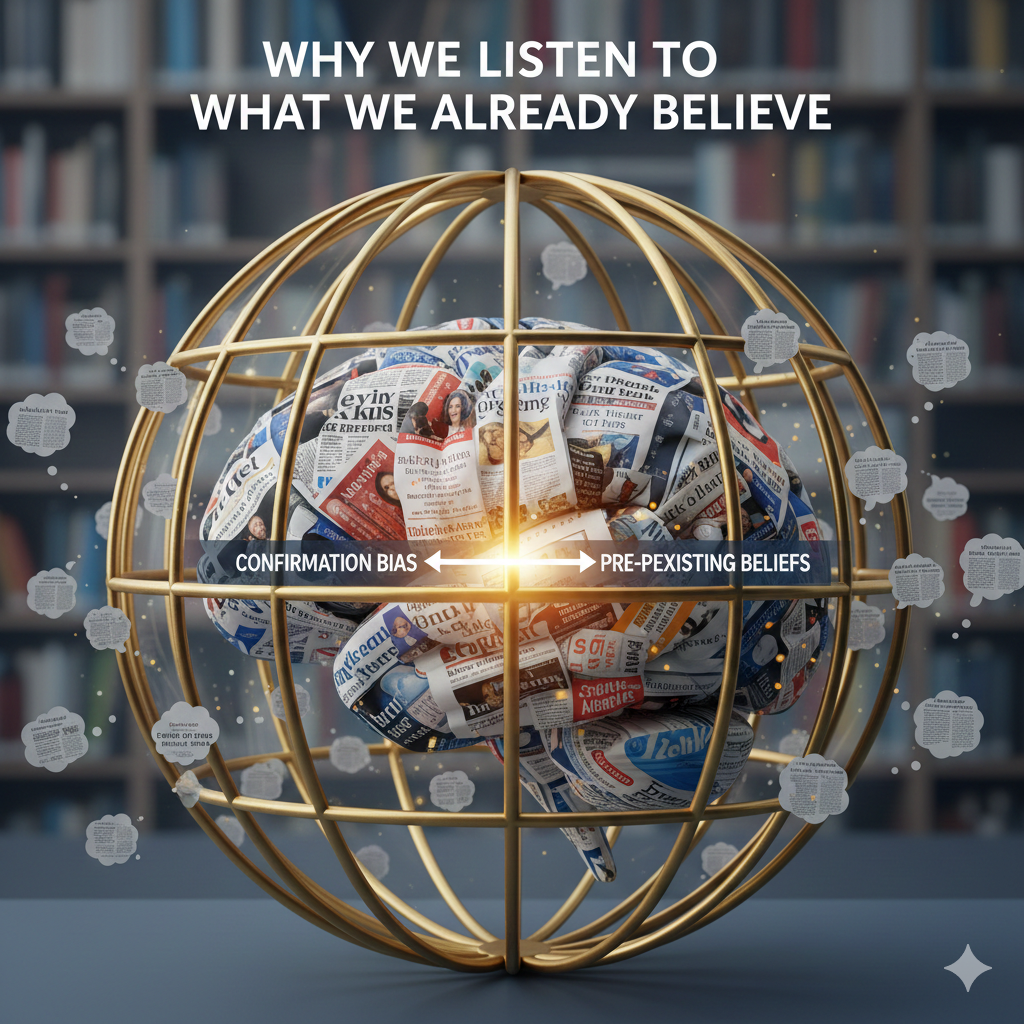
Have you ever noticed how two people can look at the same set of facts and come to completely different conclusions? Or how a news story can be hailed as “definitive proof” by one side and dismissed as “fake news” by the other? This isn’t just stubbornness—it’s a deep-seated feature of human psychology called confirmation bias.
We are, by nature, detectives of our own beliefs. We constantly sift through the vast amount of information in our world, but we’re not neutral investigators. We’re more like lawyers building a case, selectively collecting evidence that supports our pre-existing views and ignoring or dismissing anything that contradicts them.
What Is Confirmation Bias?
In simple terms, confirmation bias is our tendency to search for, interpret, favor, and recall information in a way that confirms or strengthens our personal hypotheses and values. It’s the mental shortcut that makes us feel smart, secure, and right.Think of your mind as having a filter. This filter lets in the information that “fits” and strains out the information that creates discomfort—a cognitive dissonance. This happens automatically, often without our conscious awareness.
How It Shows Up in Everyday Life
This bias is a quiet curator of our reality. In politics, we follow news sources that align with our ideology. A conservative might watch one network, a liberal another, and both will feel their worldview is being validated nightly. On social media, algorithms famously create “echo chambers” or “filter bubbles,” showing us more of what we’ve already liked and agreed with, quietly hiding dissenting views from our feed.
It invades our personal relationships, too. If you suspect a coworker is lazy, you’ll notice every time they’re late or browsing their phone, while overlooking their productive hours. You’ve built a case without seeking exonerating evidence. It even shapes our approach to health and wellness. Someone convinced a specific diet works will eagerly share success stories while unconsciously minimizing studies or anecdotes that show it failing for others.
Why Are We Like This?
It’s not a flaw in design so much as an evolutionary byproduct. Our brains are energy-efficient machines. Constantly questioning our core beliefs is exhausting and destabilizing. In our distant past, quick decisions based on established patterns (even if imperfect) were often safer than endless deliberation. Confirmation bias provided cognitive consistency and efficiency, helping us navigate a dangerous world with quick, confident judgments.In the modern world, however, this shortcut has profound consequences. It polarizes societies, entrenches misinformation, stifles innovation, and makes meaningful dialogue across differences incredibly difficult. We end up talking past each other, armed with entirely different sets of “facts” curated by our own biases.
How to Step Outside Your Own Echo Chamber
The goal isn’t to eliminate bias—that’s likely impossible. The goal is to become aware of it and deliberately counteract its pull. The first step is simply acknowledging that you have this bias, that your brain is not a perfectly objective recording device.From there, you can cultivate specific habits. Make it a practice to actively seek disconfirming evidence. If you have a strong opinion on a topic, deliberately seek out the smartest, most respectful arguments against your position. Don’t do it to mock them; do it to genuinely understand them. On social media, intentionally follow thinkers, journalists, or experts from across the ideological spectrum. Seek out the reasoned voices, not the caricatured trolls.
Before making a big decision, dedicate time to a mental exercise called “prove yourself wrong.” Assemble the best possible case against your own preferred choice. And finally, diversify your information diet with the same intention you’d diversify a financial portfolio. Don’t get all your news, perspectives, or analysis from a single source or type of source. Read long-form journalism, listen to nuanced podcasts, and engage with historical context.
The Path to Clearer Thinking
Recognizing confirmation bias is humbling. It means accepting that our sense of being right is often an illusion crafted by our own minds. But this awareness is also empowering. It’s the first step toward clearer thinking, more empathetic conversations, and a more nuanced understanding of a complex world. The challenge isn’t to stop having beliefs, but to stop letting your beliefs blindly filter your reality. The most intelligent mind is not the one that is always right, but the one that is always open to being wrong.