Posted on

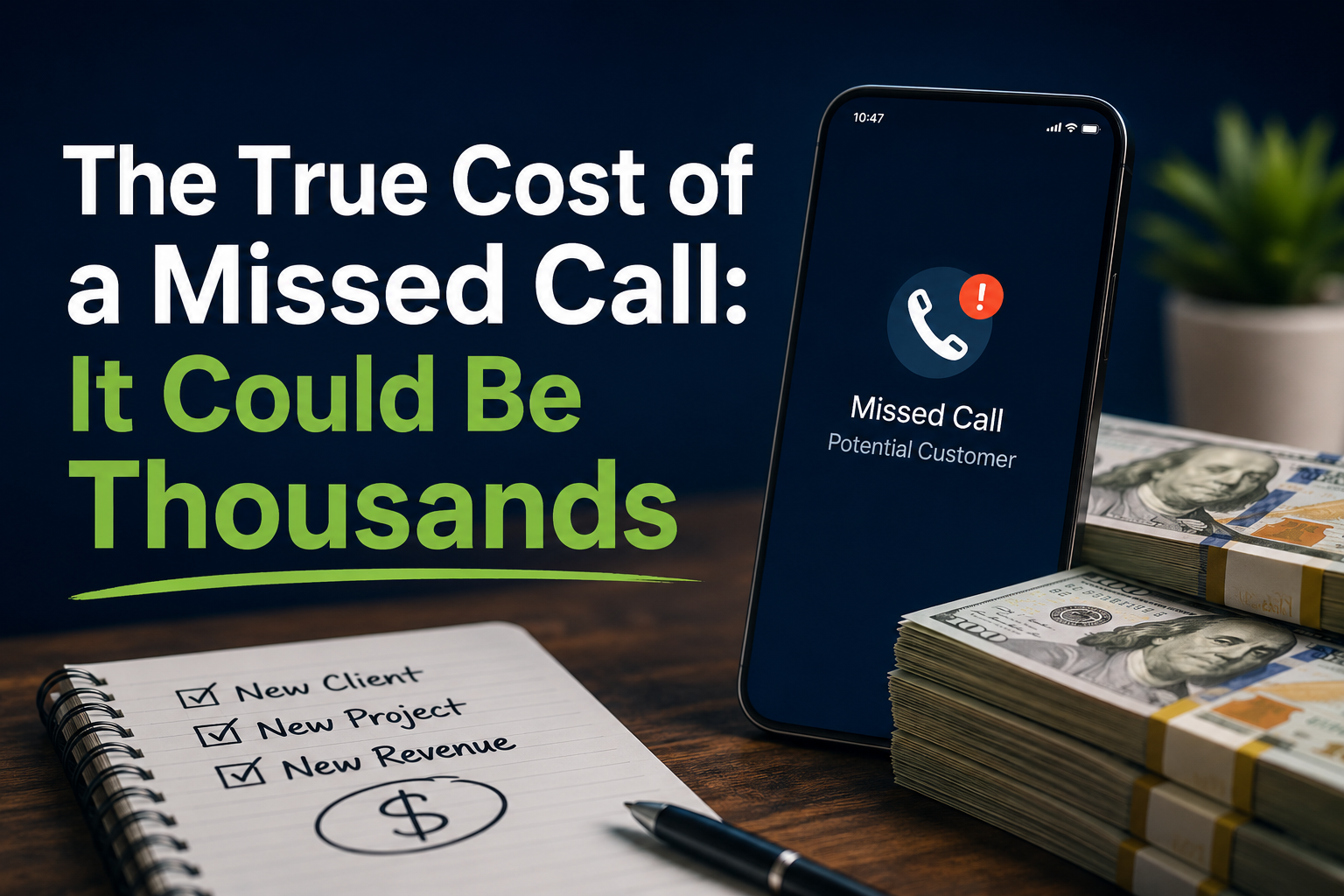
The True Cost of a Missed Call: It Could Be Thousands

Every call that goes unanswered is more than just a minor inconvenience. It’s a direct hit to your bottom line. In an era where customers expect instant connection, letting the phone ring without a response isn’t just poor service; it’s leaving money on the table. And not just pocket change—we’re talking about measurable revenue loss that compounds faster than most business owners realize.

The Hard Numbers

Let’s start with the math that should make every business owner sit up straight.

Research consistently shows that 74% of callers who reach voicemail hang up without leaving a message. That means three out of four potential customers simply vanish into the ether when they don’t get a live person. No callback number, no inquiry, no lead. Just a lost opportunity.

For a business with an average customer value of $1,000, missing just five calls per week translates to roughly $130,000 in potential annual revenue. If your average deal size is higher, say $5,000 or $10,000, that number scales dramatically.

A study by BT Business found that UK businesses lose an estimated £90 million per year from missed calls alone. In the U.S., that figure stretches into the billions when aggregated across industries. These aren’t abstract statistics; they represent real customers who called with intent to buy and found nobody home.

The Compound Effect

The damage of a missed call extends far beyond the immediate lost sale. Here’s where the real financial bleeding occurs:

Customer Acquisition Cost (CAC) Inflation
You’ve already spent money to make that phone ring through advertising, SEO, social media, or referrals. When that investment doesn’t connect with a human, your CAC skyrockets. You paid for the lead, but you didn’t get the conversation. It’s the marketing equivalent of buying a lottery ticket and not checking the numbers.

Reputation Erosion
In the age of instant reviews, a frustrated caller doesn’t just disappear. They tell friends. They post on Google. One missed call can spiral into negative word-of-mouth that costs you future customers you never even knew existed. Repairing a damaged reputation costs significantly more than maintaining a good one.

Competitive Defection
Here’s the brutal truth: 85% of missed callers will not call back. They’ll call your competitor instead. While you were in a meeting, handling another client, or simply understaffed, your competitor picked up the phone and won the business. In service-based industries—legal, medical, home services, real estate—this dynamic is especially ruthless. The first responsive provider usually gets the job.

Industry-Specific Impact

Different sectors feel the pain at different scales, but the pattern is universal:

Law Firms: A single missed call from a personal injury client could represent a six-figure case. Legal intake experts estimate that firms lose 30-40% of potential clients to unanswered calls during off-hours or busy periods.

Home Services: HVAC, plumbing, and electrical contractors often deal with emergency situations. When a homeowner’s pipe bursts at 2 AM, they call until someone answers. Miss that call, and you’ve lost a $500-$5,000 job to the company that picked up.

Healthcare: No-shows and missed appointment calls cost the U.S. healthcare system $150 billion annually. A patient who can’t reach their provider to reschedule often simply doesn’t show—or switches practices entirely.

Real Estate: In hot markets, properties move fast. An unanswered inquiry about a listing means the buyer moves on to the next agent. With commissions often in the tens of thousands, one missed call can be devastating.

The Hidden Cost of “They’ll Call Back”

Many business owners operate under the dangerous assumption that serious customers will try again. The data says otherwise.

Customers today have been conditioned by Amazon, Uber, and instant messaging to expect immediate response. Their patience is measured in minutes, not hours. A lead that goes unanswered for more than five minutes loses 80% of its conversion potential. After 30 minutes, you might as well consider it dead.

The “they’ll call back” mentality is a luxury no modern business can afford.

What One Missed Call Actually Costs

To put this in concrete terms for your own business, try this calculation:

Average Revenue Per Customer (e.g., $2,000)

Your Lead-to-Customer Conversion Rate (e.g., 25%)

Calls Missed Per Month (e.g., 20)

Monthly Cost: 20 calls × 25% conversion × $2,000 = $10,000 in lost revenue per month

That’s $120,000 annually from just 20 missed calls a month. For a small business, that could be the difference between growth and stagnation, between hiring that extra employee or running lean, between thriving and merely surviving.

The Solution Is Simpler Than You Think

The good news? This is one of the most fixable leaks in your business. You don’t need a massive budget or complex technology to stop the bleeding:

Answer Every Call, Every Time
Whether that means hiring additional staff, using a professional answering service, or implementing AI-powered call handling, the investment pays for itself almost immediately. If a call-answering service costs $300/month but saves you one $2,000 customer, your ROI is 566%.

Speed-to-Lead Is Everything
If you absolutely cannot answer live, your callback window should be measured in minutes, not hours. Set up instant notifications, assign dedicated responders, and treat inbound calls like the revenue events they are.

Track and Measure
You can’t improve what you don’t measure. Use call tracking analytics to see exactly how many calls you’re missing, when they’re happening, and what they might be costing you. The numbers will likely shock you into action.

In business, not all costs appear on your P&L statement. Missed calls are an invisible expense—silent, cumulative, and devastating. Every ring of the phone is a potential customer asking, “Are you ready to do business?”

When you don’t answer, you’re not just missing a call. You’re missing revenue, reputation, and relationships. In an economy where customer acquisition costs are rising and competition is fierce, can you really afford to let even one call go unanswered?

The phone is ringing. Pick it up. Your next high-value customer might be on the other end.

Posted on

Why Being the Best Engineers in the Room Doesn’t Mean You’ll Be Found Online

Talk to almost any cooling or power infrastructure company about what makes them different from competitors, and you’ll hear about engineering. The thermal efficiency of their liquid cooling systems, the redundancy built into their UPS design, the switchgear reliability under load conditions most providers never test for. This is a genuinely technical industry, and the companies that survive in it tend to survive because they’re good at solving hard physical problems. It’s a reasonable assumption, then, that being the best at the actual engineering should be enough to win business. If your systems perform better under the conditions that matter, word should get around.

The problem is that word getting around and being findable are two different mechanisms, and the industry’s history has quietly conflated them. For a long time, this was a relationship-driven business. Engineers talked to other engineers, integrators had preferred vendor lists, and a reputation built over years of reliable installations traveled through a fairly small, well-connected professional network. In that environment, being the best engineering team in the room really was close to sufficient, because the room was small and everyone in it eventually heard about everyone else’s work. That dynamic hasn’t disappeared, but the room has gotten much bigger, and it’s gotten bigger specifically because of the current surge in AI-driven data center construction, which has pulled in new buyers, new integrators, and new procurement teams who don’t have a decade of relationships in this space to draw on.

A buyer without an existing network doesn’t rely on word of mouth, because there isn’t any word to hear yet. They search. An engineer trying to solve a rack density problem, a procurement lead building a vendor shortlist, a data center operator evaluating cooling options for a new facility, all of them are increasingly starting that process with a search query rather than a phone call to someone they already know. If a company’s excellence lives entirely in its installed base and its engineering documentation, and never gets translated into content that shows up when someone searches for the specific problem that company solves, that excellence is invisible to exactly the buyers who have no other way to find it. The work is real. The visibility isn’t.

This creates a strange outcome that a lot of technically excellent companies don’t see coming: a competitor with meaningfully weaker engineering can win the deal simply by being the company that showed up first in the buyer’s research. This isn’t a failure of the market to recognize quality. It’s a mismatch between where quality lives and where the buying decision actually starts. A buyer can’t evaluate engineering they never encounter. If the first few results a prospective buyer sees are from competitors who’ve invested in explaining their approach to thermal management or their experience with a specific power density threshold, those competitors get the benefit of the doubt before anyone has verified whether their engineering is actually comparable. The company with the better product is competing from behind before the buyer even knows they exist.

None of this means the old relationship-driven channels stop mattering. Referrals, integrator relationships, and reputation within the professional community remain real assets, and nothing about building an online presence replaces them. What it means is that those channels alone no longer cover the growing share of buyers who have entered this market recently, don’t have an established network to draw on, and are forming their first impression of every vendor through a search result instead of a conversation. A company can be the best engineers in the room and still lose deals to someone who was simply easier to find, and in a market expanding as fast as this one is right now, that gap is only going to widen for companies who haven’t closed it yet.

Posted on

Why Local SEO Matters Even If You Serve Clients Nationwide

A lot of managed IT providers reach a point where their client base outgrows their original geography, and somewhere around that point, local SEO starts to feel irrelevant. If you started as the go-to IT company for a metro area and now have clients spread across a dozen states, optimizing for a specific city can feel like clinging to an old identity the business has already moved past. That instinct is understandable, but it’s based on a misunderstanding of what local SEO is actually doing for a service business, and dropping it too early tends to cost MSPs more visibility than they realize.

The confusion usually comes from treating “local SEO” as a synonym for “only serving local clients.” They’re not the same thing. Local SEO is a set of signals, like a Google Business Profile, location-specific pages, and citations across business directories, that tell search engines where a company is physically based and where it has a credible presence. Those signals don’t restrict who can become a client. They influence how search engines and buyers interpret trustworthiness and legitimacy, and that interpretation matters regardless of whether the client sitting across the table is down the street or across the country.

There’s also a practical reason this matters more for MSPs specifically than for a lot of other B2B categories: a meaningful share of IT buyers still search with some geographic qualifier attached, even when they’d happily hire a remote provider. Someone searching “managed IT services Austin” isn’t necessarily committed to hiring a company physically located in Austin. Often they’re using location as a proxy for a few things they actually care about, like response time expectations, familiarity with regional compliance requirements, or simply a gut sense that a company with real physical roots somewhere is more substantial than one that seems to exist only online. An MSP that has let its local signals go stale in favor of purely national content is invisible to exactly this kind of buyer, even though the buyer might have been perfectly happy to work with them.

Local presence also does quiet work on trust that generic national content can’t replicate. A page built around a specific city or region, even for a company serving clients well beyond it, gives a prospective client something concrete to evaluate: an office address, a local phone number, mentions of the local business community, maybe case studies from recognizable regional companies. That specificity reads as more credible than a page written entirely in the abstract language of “nationwide coverage” and “enterprise-grade solutions,” because vague claims are exactly what a skeptical IT buyer has learned to discount. Real, anchored details about at least one physical place are a low-cost way to make the whole company feel more real, and that credibility transfers even to prospects who will never set foot in that office.

None of this means an MSP serving a national client base should pretend to be a purely regional business, or that local content should be the entire strategy. The right approach is usually layered: national and industry-specific content that speaks to the breadth of what the company can do, sitting alongside well-maintained local signals anchored to wherever the business is actually headquartered or has real offices. Losing the local layer doesn’t make a company look more national. It just removes one of the more reliable trust signals available to a service business, at no benefit to the broader strategy it was supposedly making room for.

Posted on

The Fastest Way to SEO Traffic: Write About Your Competitors

If you’re a SaaS founder waiting for your product blog to rank for generic keywords like “project management tips,” you’re going to be waiting a long time. Those terms are dominated by media sites, established brands, and content farms with years of domain authority behind them.

There’s a faster path, and it’s hiding in plain sight: write about your competitors and the adjacent tools your customers already use.Why This WorksPeople searching “[Competitor] alternatives,” “[Competitor] vs [Competitor],” or “[Competitor] pricing” are not casually browsing. They’re actively shopping. They already know they need a tool in your category — they just haven’t picked one yet. That’s about as high-intent as search traffic gets.

Compare that to someone searching “how to manage a remote team.” They might need your product, or they might just want a listicle. The competitor searcher is already three steps further down the funnel.There’s also a supply-and-demand angle. Your competitors are unlikely to write “Us vs. [Your Product]” comparison posts — nobody wants to give oxygen to a rival. That leaves a content gap that’s easy to fill and often has surprisingly low keyword competition, even for products with big marketing budgets.

The Content Types That Work

Comparison pages (“X vs Y”)

Direct, honest comparisons of your product against a named competitor. These convert well because the reader is actively deciding between the two.Alternative pages (“X alternatives”)

People searching this are often already unhappy with a competitor — maybe due to pricing, missing features, or poor support. Meet them with a clear case for switching.”

Best [category] tools” roundups

Broader roundups that include your competitors and your own product. Yes, mentioning competitors here feels counterintuitive, but it builds trust and captures searches your dedicated comparison pages might miss.

Adjacent tool content

Write about software your customers use alongside yours, not instead of yours. A project management tool might publish “Best Slack Integrations for Remote Teams” — capturing an audience with clear overlap but zero direct competition for the click.

How to Do This Without Sounding Biased

The biggest risk with this strategy is credibility. A comparison page that reads like a sales pitch gets dismissed instantly.Be genuinely fair. Acknowledge where the competitor is actually better — cheaper plan, better mobile app, whatever it is. This is what makes the rest of the page believable.Use specifics, not adjectives. “Loads in 1.2 seconds” beats “blazing fast.” Specifics read as researched; adjectives read as marketing.

Update regularly. Competitor pricing and features change. A stale comparison page erodes trust fast — and search engines notice abandoned content too.Don’t skip the downsides of your own product. Every tool has trade-offs. Naming yours makes the whole page more credible.

Pick your top three competitors and your top five adjacent tools. Write one comparison page and one alternatives page per competitor, plus a couple of adjacent-tool roundups. That’s roughly ten pieces of content — enough to start seeing traffic within a few months while your primary keyword content builds authority in the background.

This isn’t a replacement for a broader content strategy. It’s a shortcut to the highest-intent traffic available to you, using searches your competitors can’t easily compete for.