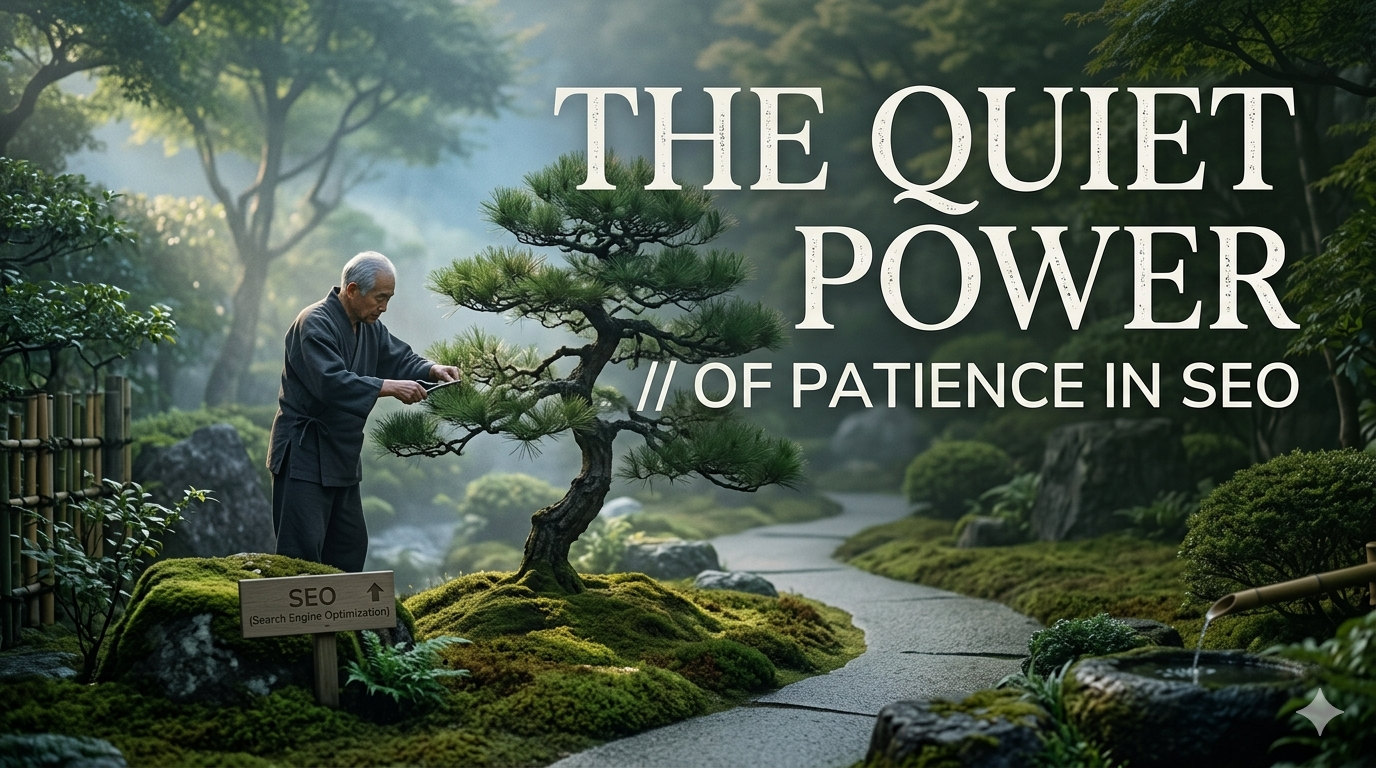
There is a peculiar tension in the world of digital marketing. Every other channel promises speed. Paid advertising delivers visitors within hours. Social media campaigns can go viral overnight. Email blasts land in inboxes in seconds. Yet search engine optimization sits in the corner, unhurried, almost stubborn in its refusal to rush. It asks something that modern business culture finds deeply uncomfortable: it asks you to wait.This waiting is not passive. It is not the waiting of someone staring at a clock, hoping something happens. It is the waiting of a farmer who has planted seeds in soil he has carefully prepared, knowing that germination happens beneath the surface long before anything green breaks through. The work is invisible for months. The doubt creeps in. Competitors seem to surge ahead with their instant traffic. Colleagues question the investment. The analytics dashboard shows a flat line where you hoped to see a curve. This is the valley every serious SEO practitioner must walk through, and it is precisely this valley that separates those who understand the game from those who abandon it too early.
What makes the waiting so difficult is that the mechanics of search engines are fundamentally opaque. You optimize a page, build a few links, improve your site speed, and then you wait for the algorithm to notice. You wait for the crawler to return. You wait for the index to update. You wait for the ranking signals to compound. There is no button to press for immediate feedback, no lever to pull that instantly moves your position from page five to page one. The algorithm operates on its own timeline, and that timeline is measured not in days but in seasons.
But beneath this apparent stillness, something profound is happening. Every technical fix you implement, every piece of content you publish that genuinely answers a question, every backlink you earn from a credible source, every improvement in user experience, these are deposits in a compound interest account. They do not evaporate when the campaign ends. They stack. They accumulate authority. They build topical relevance that becomes harder for competitors to replicate the longer it exists. A paid search ad stops working the moment you stop paying. A social media post disappears into the feed within hours. A well-optimized piece of content, however, can sit on the first page of search results for years, delivering qualified visitors while you sleep, while you vacation, while you work on other things.
The businesses that understand this dynamic approach SEO with a different psychology. They do not measure success in weekly reports. They think in terms of annual cycles. They know that the content they publish today may not reach its full ranking potential for six to twelve months, but when it does, it often becomes their most cost-effective customer acquisition channel. The lifetime value of organic search traffic, when calculated properly, dwarfs nearly every alternative because the marginal cost of that traffic approaches zero over time.There is also a defensive quality to patient SEO investment that is rarely discussed. When you have spent eighteen months building authority in your niche, you develop what amounts to a competitive moat. New entrants cannot simply outspend you to take your position. They must replicate the entire history of your earned credibility, and they must do it while you continue to strengthen your position. The algorithm favors established trust, and trust is not something that can be purchased in a hurry.
The mastery of SEO, then, is not primarily a technical achievement, though technical competence matters. It is a mastery of delayed gratification. It is the ability to continue doing the right things when there is no immediate evidence that they are working. It is the discipline to prioritize user intent over keyword density, to invest in comprehensive content when thin pages would be faster to produce, to pursue genuine relationships for backlinks when purchased links would be easier to obtain. These choices do not pay off next week. They pay off next year, and they pay off in ways that are difficult to reverse-engineer once your competitors realize what you have built.
The rewards of this patience are not incremental. They are transformative. A business that achieves dominant organic visibility in its market secures a predictable, scalable, and defensible flow of customers. The cost per acquisition trends downward over time while the volume trends upward. The brand becomes synonymous with the search query itself. The website becomes an asset that increases in value rather than an expense line that fluctuates with media costs.
So if you are in the early months of an SEO effort and the results feel meager, remember that you are not failing. You are simply in the gestation period. The seeds are underground. The roots are spreading invisibly. The algorithm is watching, learning, and waiting to reward consistency. Keep building. Keep improving. Keep publishing work that deserves to rank. The traffic will come, and when it does, it will come in volumes that make the waiting seem not just worthwhile, but strategically brilliant.