Posted on

Evergreen Content: What It Is and Why Your Site Needs It

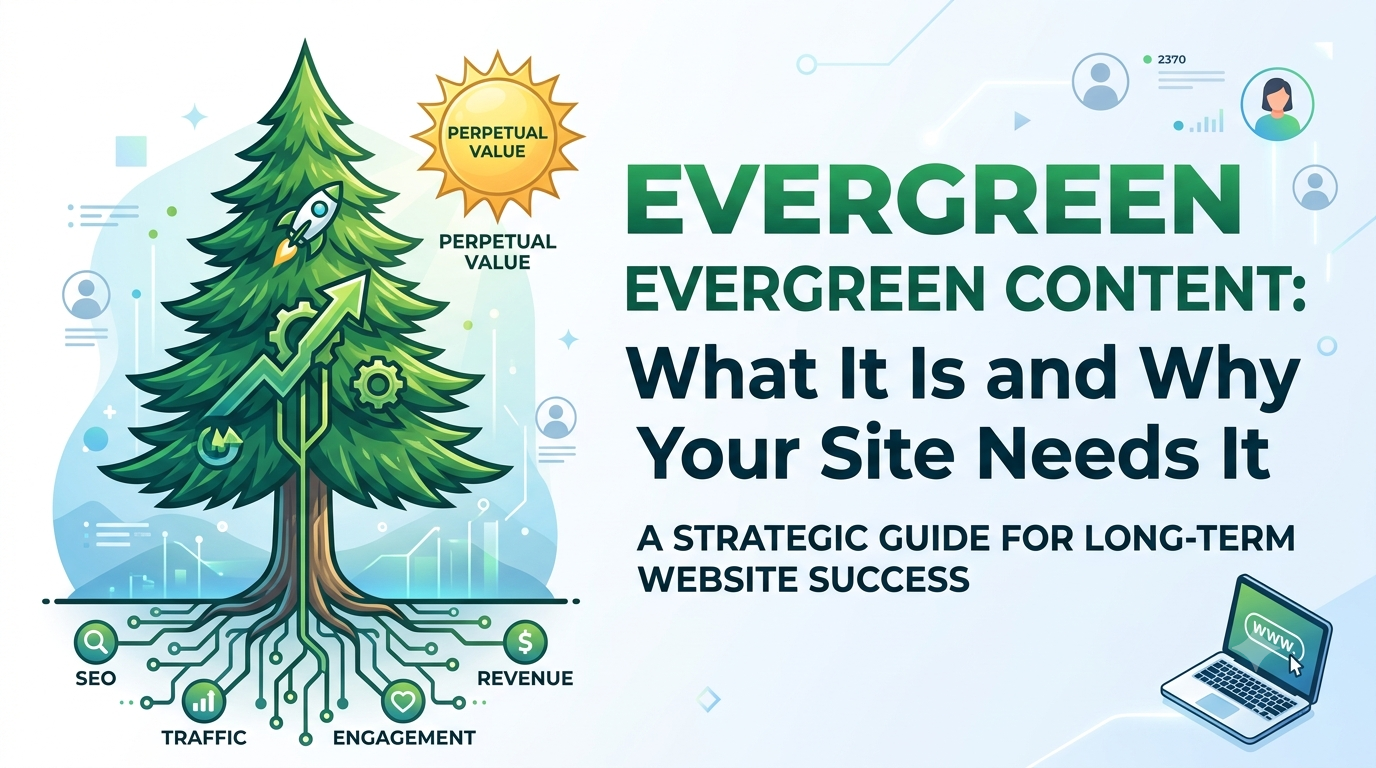
There is a kind of writing that refuses to age. It does not expire when the news cycle moves on, and does not become an embarrassing relic of a moment that has passed. This is evergreen content, and it is the quiet engine behind nearly every successful content strategy.

Evergreen content is information that remains relevant and useful long after it is published. It answers questions that people will still be asking in five years, or ten, or twenty. A guide to changing a flat tire is evergreen. A news article about yesterday’s stock market crash is not. A tutorial on how to boil an egg is evergreen. A commentary on this season’s fashion trends is not. The distinction is not about quality or depth. It is about time, and whether the passage of time destroys the value of what has been written.

The reason this matters is simple. Most content on the internet is born, lives briefly, and then dies. A breaking news story might attract a surge of traffic today and almost none tomorrow. A reaction to a viral meme might feel clever now and painfully dated in a month. Evergreen content, by contrast, accumulates. It sits quietly in search results, drawing in readers month after month, year after year. It does not require constant feeding. It works while you sleep.

Search engines love this kind of material because search engines exist to answer questions, and many of the questions people ask are timeless. Someone in 2010 wanted to know how to write a resume. Someone in 2026 wants to know the same thing. Someone in 2040 will want to know it too. If your article answers that question well, it can attract traffic for decades with only minor updates. This is the compounding interest of the content world. Small effort now, outsized return later.

Creating evergreen content demands a shift in mindset. The writer must resist the temptation to be current and instead choose to be useful. This means focusing on fundamentals rather than fads. It means explaining how something works rather than reacting to the latest development. It means choosing topics where the underlying truth is stable, even if the surface details change. The principles of healthy eating do not change much, even if the specific diet books do. The basics of personal finance do not change much, even if the economic headlines do.

That said, evergreen does not mean frozen. The best evergreen pieces are maintained. A tutorial on using software might need updating when the interface changes. A guide to legal procedures might need revising when the law shifts. But the core structure, the core question, and the core value remain intact. The content ages gracefully, like a well-built house that needs fresh paint rather than a complete rebuild.

Businesses that understand this build libraries, not newsrooms. They invest in comprehensive guides, detailed explainers, and foundational resources that serve their audience for the long haul. They recognize that one exceptional evergreen article can generate more lifetime value than a hundred fleeting posts combined. The traffic is steadier. The audience is more aligned. The conversion is higher because the reader arrived with a genuine question, not a passing curiosity.

The discipline of evergreen content is the discipline of patience. It does not deliver instant gratification. A viral hit might give you a million views in a day. An evergreen guide might give you a hundred views a day for ten years. The math favors the latter, but the latter requires faith. You must believe that usefulness outlasts novelty, that depth defeats speed, and that the questions people care about most are the ones that never go away.

So when you sit down to write, ask yourself whether anyone will care about this in five years. If the answer is no, you are writing for the moment. There is a place for that, but it is a different game with different rules. If the answer is yes, you are writing for the long term. You are planting a tree that will shade readers you will never meet, answering questions for people who have not yet learned to ask them. That is evergreen content. It is not the loudest voice in the room. It is the one that never stops speaking.
Posted on

What Is Seo? – Basic WordPress SEO

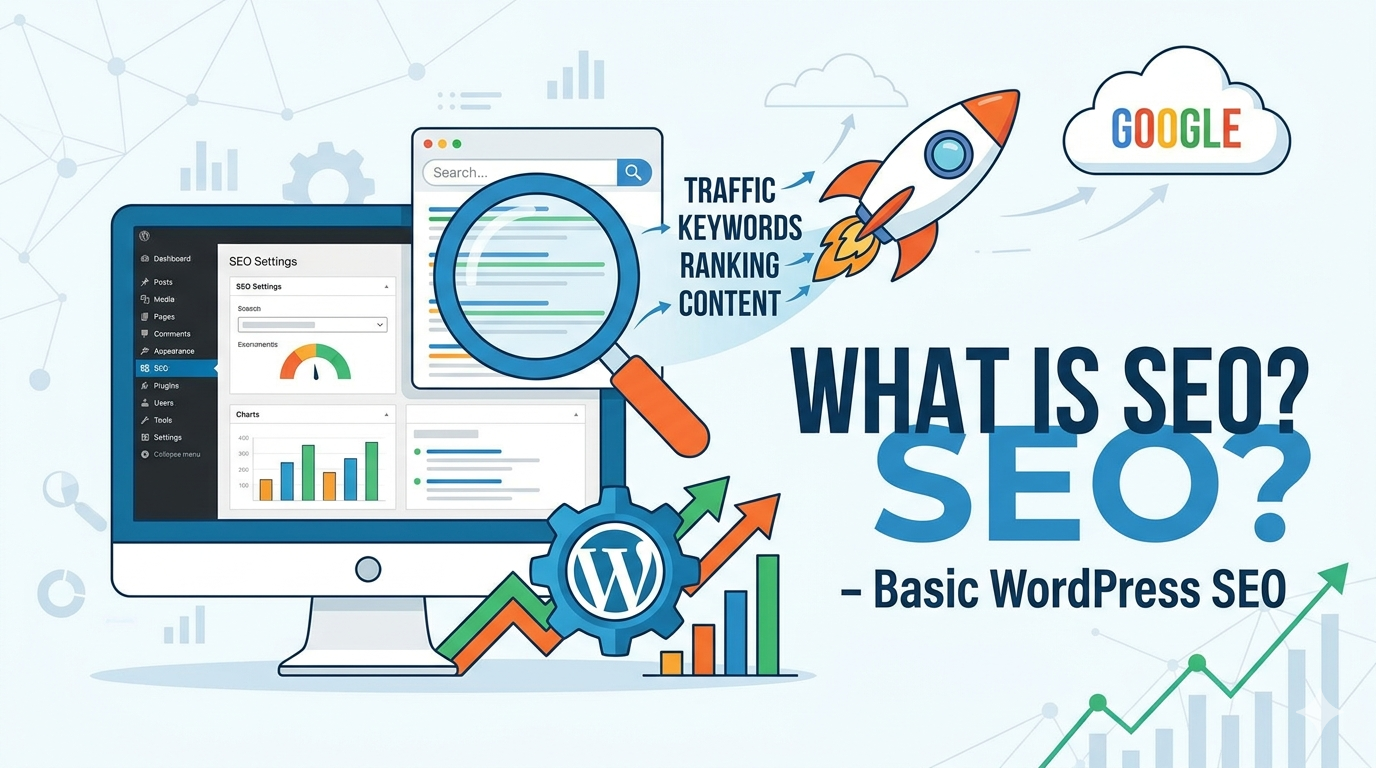
Search Engine Optimization is the practice of improving your website so that it appears higher in the results pages when people search for relevant terms on Google, Bing, or other search engines. At its core, SEO is about making your content discoverable and valuable to both search engines and human readers. Search engines use automated programs called crawlers to browse the web, index pages, and rank them based on hundreds of factors including relevance, authority, and user experience.

For a WordPress site, the foundation of good SEO starts with your hosting and site speed. A slow website frustrates visitors and signals to search engines that your site provides a poor user experience. Choose a reputable host, optimize your images before uploading them, and consider using a caching plugin to serve pages faster. WordPress makes this relatively straightforward through its plugin ecosystem, but the principle remains that performance matters.Your WordPress theme also plays a significant role in SEO. A well-coded, lightweight theme that follows semantic HTML standards helps search engines understand your content structure. Avoid themes bloated with unnecessary scripts and animations that add no value to your readers. The structure of your site should be logical, with clear navigation that allows both users and crawlers to find your most important pages within a few clicks.

Content remains the most critical element of any SEO strategy. When you write a blog post or page in WordPress, focus on creating genuinely useful information that answers the questions your audience is asking. Before writing, think about what someone might type into a search bar to find your content. These phrases are your keywords, and while you should not stuff them awkwardly into every sentence, they should appear naturally in your title, opening paragraph, and throughout the text where relevant. WordPress allows you to set a custom permalink structure, and you should use this to create clean, descriptive URLs that include your target keyword rather than random numbers and characters.

On-page optimization in WordPress involves several elements you control directly within each post or page. Your title tag, which appears in search results as the clickable headline, should be compelling and include your primary keyword near the beginning. The meta description, though not a direct ranking factor, influences whether someone clicks through to your site, so write it as a concise advertisement for your content. Use header tags to structure your content hierarchically, with one main heading followed by subheadings that break your text into scannable sections. This not only helps readers but also helps search engines understand the topical flow of your article.

Images enhance your content but can harm your SEO if not handled properly. Every image you upload to WordPress should have a descriptive file name rather than a string of numbers. Fill in the alt text field with a brief, accurate description of what the image shows, incorporating a keyword only if it fits naturally. This practice improves accessibility for visually impaired users and gives search engines context about your visual content.

Internal linking is a powerful but often overlooked aspect of WordPress SEO. When you publish a new article, look for opportunities to link to relevant older posts within your site, and update existing content to reference your new work. This distributes authority throughout your site and keeps visitors engaged longer. WordPress makes this easy with its link insertion tools, but the strategy requires intentional thinking about how your content relates thematically.

Mobile responsiveness is no longer optional. The majority of searches now happen on mobile devices, and Google uses mobile-first indexing, meaning it primarily evaluates the mobile version of your site. Most modern WordPress themes are responsive by default, but you should always preview your content on multiple devices to ensure text is readable without zooming, buttons are easily tappable, and images scale appropriately.

Security and trust signals matter for SEO as well. Search engines prefer secure websites, so ensure your WordPress site uses HTTPS rather than HTTP. Your hosting provider can help you obtain and install an SSL certificate, often at no additional cost. Regularly update your WordPress core, themes, and plugins not only to protect against vulnerabilities but also to maintain site stability, as hacked or malfunctioning sites quickly lose search visibility.

Building authority takes time and extends beyond your website itself. When other reputable sites link to your content, search engines interpret this as a vote of confidence. Focus on creating content so valuable that others naturally want to reference it. Guest posting on relevant industry blogs, participating in genuine community discussions, and building relationships with other content creators can earn you quality backlinks. Avoid the temptation to buy links or participate in link schemes, as these practices violate search engine guidelines and can result in severe penalties.

Finally, understand that SEO is a long-term commitment rather than a one-time task. Search algorithms evolve, competitor landscapes shift, and your own content ages. Use tools like Google Search Console to monitor how your WordPress site performs in search results, identify which queries bring you traffic, and spot technical issues that need attention. Google Analytics or privacy-focused alternatives can show you how visitors behave once they arrive, revealing which content resonates and where you might be losing potential customers.

Success with WordPress SEO comes from consistently applying these fundamentals while remaining patient. No plugin can replace the need for quality content and genuine user value, but WordPress provides an excellent framework for implementing sound SEO practices without needing to write code. Start with the basics, measure your progress, and refine your approach as you learn what works for your specific audience and niche.

Posted on

The Art of Being Vouched For: A Plain-English Guide to Link Building

Imagine you’ve just moved to a new city and you’re looking for a good dentist. You could scroll through a directory of every dental practice in town, or you could ask three people you trust for a recommendation. Most of us would choose the recommendation. A trusted person vouching for someone else carries more weight than any self-description ever could. Link building is, at its heart, the digital version of that same process — and understanding it could be one of the most valuable things you do for your business.

What Link Building Actually Is

When another website includes a hyperlink that points to your website, that link is called a backlink. Link building is the practice of earning, cultivating, and sometimes actively pursuing those backlinks from other sites across the internet.

Search engines like Google have, since their earliest days, treated these incoming links as votes of confidence. The reasoning is straightforward: if a reputable, well-regarded website links to your page, it is implicitly telling its own readers — and the search engine — that your content is worth their time. The more of these votes you accumulate, particularly from sources that are themselves trusted and authoritative, the more credible your own site appears in the eyes of the algorithm.

This credibility directly influences where your website appears in search results. A business with many high-quality backlinks will, all else being equal, rank higher for relevant search terms than a business with few or none. And higher rankings mean more people finding you when they’re actively looking for what you sell.

Why It Matters If You’re Selling Something

If you’re promoting a product or a service, visibility is everything. You could have the finest product in your category, priced fairly, presented beautifully — and it means nothing if the people who want it can’t find you. Most people begin their search for a product or service with a search engine, and most of those people click on results from the first page. If you’re not there, you’re functionally invisible to a vast portion of your potential customers.This is why businesses invest in search engine optimisation, and link building is one of the most powerful levers within that discipline. It’s the difference between a shop on a busy high street and the same shop tucked down an alley with no signs. The product might be identical. The foot traffic won’t be.

Beyond raw search rankings, links from respected websites carry their own direct value. When a well-known industry publication, a popular blog, or a trusted review site links to your business, their audience follows. Those readers arrive at your site already primed to take you seriously, because a source they already trust has pointed them your way. That warm introduction is something paid advertising rarely achieves as naturally.

The Difference Between a Good Link and a Bad One

Not all backlinks are created equal, and this is where many businesses go wrong. A link from a major newspaper, a respected trade journal, or a widely-read blog in your industry is worth far more than a hundred links from obscure, low-quality directories that exist purely to host links. Search engines are sophisticated enough to tell the difference, and they reward accordingly.

Worse, certain link-building practices can actively harm your rankings. Buying links in bulk, participating in link schemes, or stuffing your brand into irrelevant comment sections are tactics that search engines have become adept at detecting and penalising. What looks like a shortcut often turns out to be a trap. The businesses that build lasting search presence do so through links they genuinely earned — by producing content worth referencing, by building relationships with people in their industry, and by offering real value that others want to share.

How Businesses Actually Build Links

The most durable link-building strategy is also the most intuitive: create things that deserve to be linked to. This means writing articles that answer questions your customers are genuinely asking. It means publishing research or data that other people in your field will want to cite. It means producing guides, tools, or resources useful enough that bloggers and journalists naturally reach out to them when writing about your topic.

Beyond content, relationships matter enormously. Guest writing for industry publications, being quoted as an expert source in relevant articles, collaborating with complementary businesses on shared projects, and earning coverage through genuine public relations work are all ways that links accumulate organically over time. None of it is fast, and none of it is guaranteed — but all of it compounds. Every quality link you earn makes the next one slightly easier to get, because your site becomes more credible with each one.The Long GameLink building is not a campaign with a start and end date. It’s an ongoing commitment to building your reputation on the internet the same way you’d build it anywhere else — by doing good work, being visible in the right conversations, and earning the trust of people whose trust is worth having.

For anyone serious about promoting a product or service in the long term, this is not optional background noise. It is one of the fundamental pillars of being findable by the people who are already looking for exactly what you offer. The businesses that treat it seriously, and invest in it patiently, tend to find that search becomes one of their most reliable and cost-effective sources of new customers. The ones that ignore it often find themselves perpetually dependent on paid advertising — paying for attention that a well-built reputation would have delivered for free.The internet is not so different from any other community. People follow recommendations. Authority is earned. And the businesses that others point to with confidence are the ones that thrive.

Posted on

Why Writing More SEO Content Will Do More for Your Traffic Than Social Media Ever Will

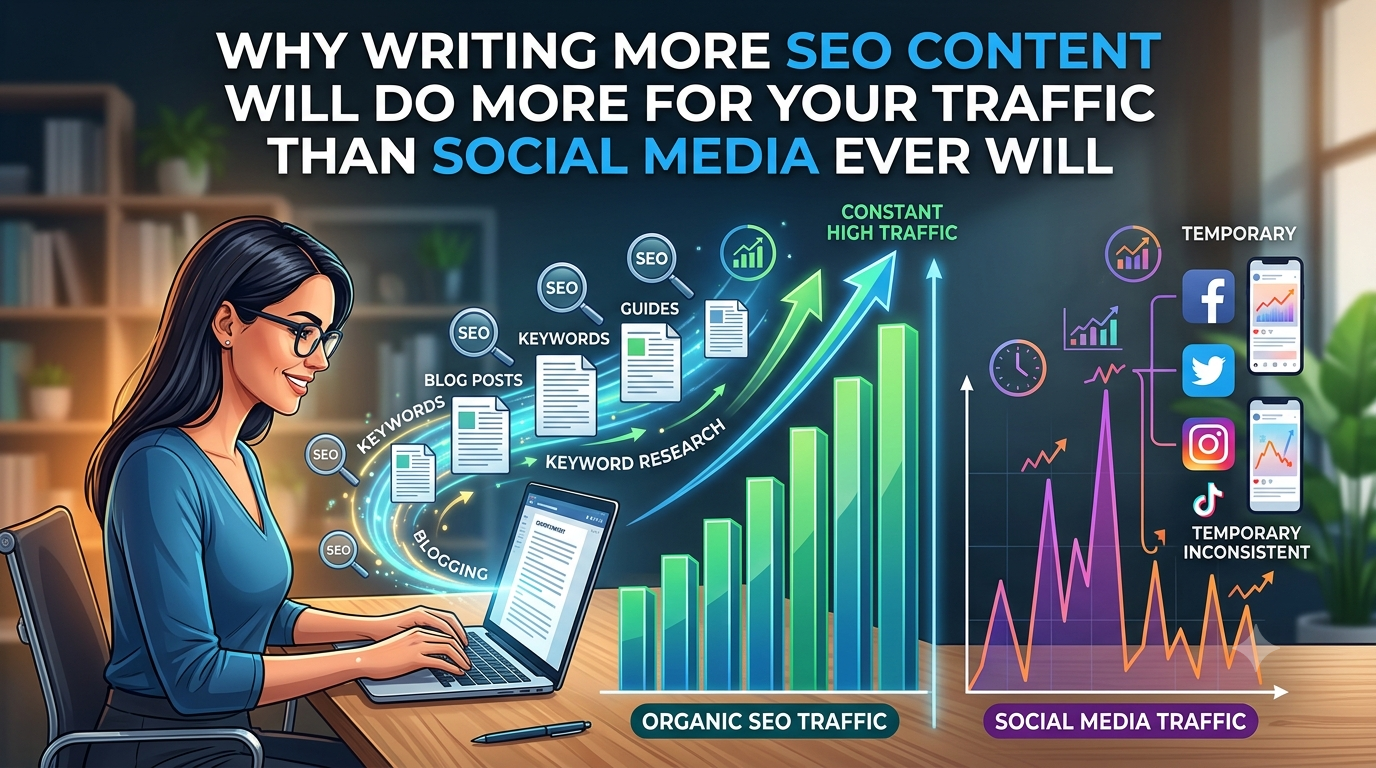
There is a temptation, especially for newer webmasters, to pour energy into social media. The feedback is immediate, the audience feels tangible, and the platforms are designed to make you feel like you are making progress. But if your goal is sustainable, compounding traffic to your website, the hard truth is that most social media activity is closer to running on a treadmill than building a road. SEO content, on the other hand, is infrastructure. And infrastructure lasts.

The Fundamental Difference: Rented Attention vs. Owned Traffic

When you post on Instagram, X, or LinkedIn, you are borrowing an audience. The platform owns the relationship, controls the algorithm, and can change the rules at any time — and they do, constantly. Organic reach on most major platforms has been declining for years as they push creators toward paid promotion. Even when a post performs well, the traffic spike is sharp and brief. Within 24 to 48 hours, most social posts are effectively dead, buried under the avalanche of new content from the millions of other accounts competing for the same eyeballs.

An SEO article is different in kind, not just degree. Once a well-optimized piece of content earns its ranking, it can generate consistent traffic every single day — for months or even years — without you touching it again. The effort you put in today does not expire next Tuesday. It compounds.

Search Intent Is the Most Valuable Traffic on the Internet

People who find your site through a Google search are not passively scrolling. They typed something into a search bar because they wanted an answer, a product, or a solution. That intent makes them vastly more likely to engage, subscribe, or buy compared to someone who saw your post in a social feed while they were killing time. Organic search visitors consistently outperform social visitors on almost every metric that actually matters: time on page, bounce rate, conversion rate, and return visits.

When you write a thorough, well-researched article targeting a specific search query, you are essentially setting a trap in exactly the right place for the exact right person at exactly the right moment in their decision-making process. No social post can replicate that precision.

The Compounding Effect That Social Media Cannot Match

The most powerful argument for investing in SEO content is mathematical. Imagine you write two articles a week for a year. Some will rank well, some won’t, but the ones that do will keep earning traffic indefinitely. By the end of that year, you might have 50, 60, or 80 pages working for you around the clock. Each one is a separate entry point into your website, a separate trap laid for a separate audience.

Social media does not work this way. Two posts a week for a year gives you 104 posts that are essentially all dead. The cumulative value of past social posts trends toward zero over time. The cumulative value of past SEO content trends upward. That asymmetry becomes enormous over a three to five year horizon, and it is the reason why sites with serious SEO strategies eventually start to feel unstoppable — they have hundreds of pages generating small but steady streams of traffic that add up to something huge.

Social Media Has a Role, But It Is a Supporting One

None of this means you should abandon social media entirely. It serves real purposes: building brand awareness, warming up audiences, distributing content to people who already follow you, and occasionally earning the kind of social shares that generate backlinks, which in turn help your SEO. But the key word there is “supporting.” Social media works best as a distribution channel for your SEO content, not as a traffic strategy in its own right.The mistake most webmasters make is treating social posting as a substitute for content creation rather than a complement to it. They spend three hours a week crafting tweets and reels, and one hour writing articles, when the return on investment strongly argues for the opposite ratio.

The Long Game Almost Always Wins

SEO is not fast. It requires patience, consistency, and a tolerance for delayed gratification that social media has trained people out of. You may write excellent content for six months before you see significant results, and that lag can feel discouraging when your Instagram post got 200 likes yesterday.

But those 200 likes did not send 200 people to your website, did not put 200 email addresses on your list, and will not send anyone to your website six months from now. The SEO article you published in January that finally hits page one in July will still be sending you traffic in the following year and beyond. That is the trade-off, and once you truly internalize it, the choice of where to spend your time becomes much clearer.Build the asset. Write the content. The traffic will follow — and unlike social traffic, it will stay.

Posted on

Where Your Readers Are Actually Coming From: A Guide to the Biggest Traffic Sources for Bloggers

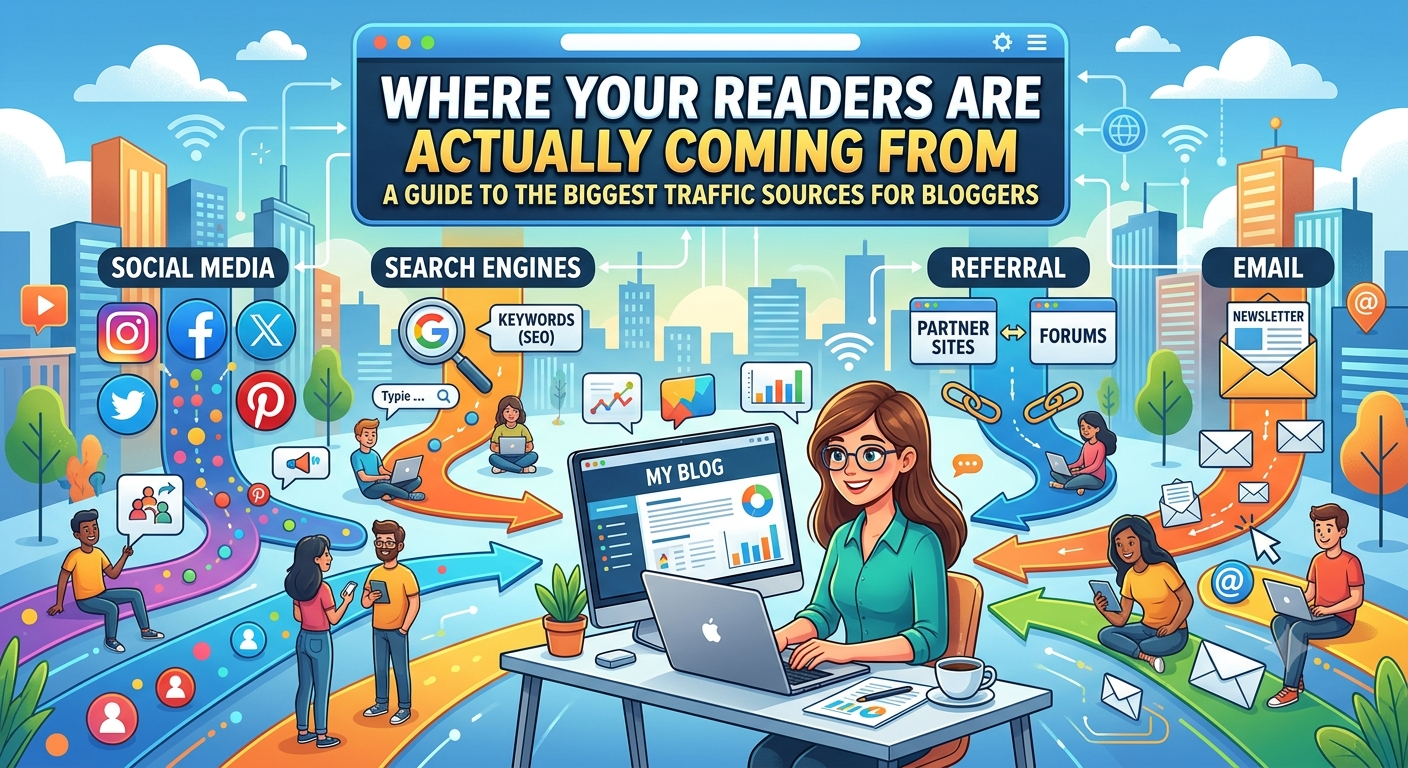
Starting a blog or website is the easy part. Getting people to actually show up? That’s where most aspiring creators get stuck. The internet is vast, and the path from publishing your first post to building a real, consistent audience can feel overwhelming. But here’s the truth: the majority of meaningful web traffic flows from a small number of well-established channels. Understanding where those channels are — and how they work — is the most important strategic advantage a new blogger can have.

Search Engines: The Long Game That Pays ForeverOrganic search traffic from Google, Bing, and other search engines is the holy grail for most website owners, and for good reason. When someone types a question into a search engine and your article appears in the results, that click costs you nothing. Unlike paid advertising, it doesn’t stop the moment you run out of budget. Unlike social media, it doesn’t disappear into a feed within hours. A well-optimized post can continue driving traffic for months or even years after it’s published.

The discipline behind earning this traffic is called Search Engine Optimization, or SEO, and it revolves around understanding what your target audience is searching for and creating content that genuinely answers those questions better than anyone else. This means researching the exact phrases and questions people type into search bars — known as keywords — and structuring your content around them. It also means earning credibility in the eyes of search engines by accumulating backlinks, which are links from other reputable websites pointing to yours.

The catch, and it’s an important one, is that organic search traffic takes time to build. A new website has no authority in the eyes of Google. It can take anywhere from three to twelve months before you begin seeing meaningful search traffic. This is why so many new bloggers get discouraged and quit before they ever see results. But for those who stay patient and keep publishing quality content, organic search becomes the most scalable and sustainable traffic source available.

Social Media: Fast Reach, Short MemorySocial media platforms represent a very different kind of traffic engine. Where search is slow and durable, social is fast and fleeting. A post on Instagram, X (formerly Twitter), Pinterest, Facebook, or LinkedIn can drive a spike of visitors to your site within hours — but that traffic often fades just as quickly as the post moves down the feed.

That said, social media is far from irrelevant for bloggers. Pinterest in particular functions more like a visual search engine than a traditional social platform, and content on Pinterest can continue circulating and driving clicks for years, making it unusually valuable for bloggers in lifestyle, food, home decor, and travel niches. Facebook Groups remain a powerful way to connect with highly specific communities and share your work with people who are genuinely interested in your topic. And Instagram and TikTok, while they don’t always drive direct clicks, build brand awareness and audience loyalty that can translate into long-term readership.

The key to making social media work for your blog is to choose one or two platforms where your audience actually spends time, rather than trying to maintain a presence everywhere at once. Spreading yourself thin across every platform is a recipe for burnout and mediocre results on all of them.

Email: The Traffic Source You Own

Of all the traffic sources available to bloggers, email is the only one that truly belongs to you. Your social media following can be decimated overnight by an algorithm change. Your search rankings can drop after a Google update. But your email list is yours — a direct line to readers who have explicitly said they want to hear from you.When you send a newsletter, you’re not competing with an algorithm or hoping that a platform decides to show your content to your followers. You’re landing directly in someone’s inbox. The click-through rates from email newsletters consistently outperform social media by a significant margin, and email subscribers tend to be a blogger’s most engaged, most loyal readers.

Building an email list should be a priority from day one, not something you think about after you’ve already grown an audience. Offering a lead magnet — a free resource, checklist, or mini-course in exchange for an email address — is one of the most effective ways to accelerate list growth. Even a small, engaged email list of a few hundred subscribers can be more valuable than tens of thousands of social media followers who scroll past your posts without clicking.

Referral Traffic: The Power of Other People’s Audiences

Referral traffic comes from other websites linking to yours. This could be a blogger in your niche mentioning your article, a journalist citing your research, or a popular forum thread where someone shared your post. Each of these links sends readers your way and, as a bonus, also signals to search engines that your content is worth paying attention to — which helps your SEO at the same time.

Building referral traffic requires you to step outside the walls of your own website and become part of a broader conversation. Guest posting on established blogs in your niche is one of the most reliable strategies. By contributing a high-quality article to a site that already has an audience, you get your name and your work in front of new readers who might then follow you back to your own site. Podcast appearances, collaborations with other creators, and simply being mentioned in relevant roundup posts all contribute to this stream of incoming readers.

The relationships you build with other bloggers and content creators in your space are often what make the difference between a site that slowly gains momentum and one that stays invisible for years.

Direct Traffic: The Mark of a Real Brand

Direct traffic — people who type your URL directly into their browser or who click a bookmark — is the purest signal that you’ve built something people genuinely value. These are your true fans, the readers who don’t need a search engine or a social media algorithm to remind them you exist.

Direct traffic tends to grow slowly in the early days, but it compounds over time. Every reader who has a memorable experience on your site, who saves your URL, who tells a friend about your work — each of them becomes a small, self-renewing traffic source. Nurturing this kind of loyalty requires consistent quality, a distinctive voice, and a site that’s genuinely worth returning to.

Putting It All Together

The bloggers and website owners who build lasting audiences don’t usually bet everything on a single traffic source. They play the long game with SEO while using social media to create immediate visibility. They build an email list from the start and nurture it carefully. They invest in relationships with other creators and look for opportunities to reach new audiences through referrals and collaborations.

No single channel will grow your site on its own. But together, these sources create a diversified traffic foundation that’s resilient, compounding, and ultimately — over time — unstoppable.