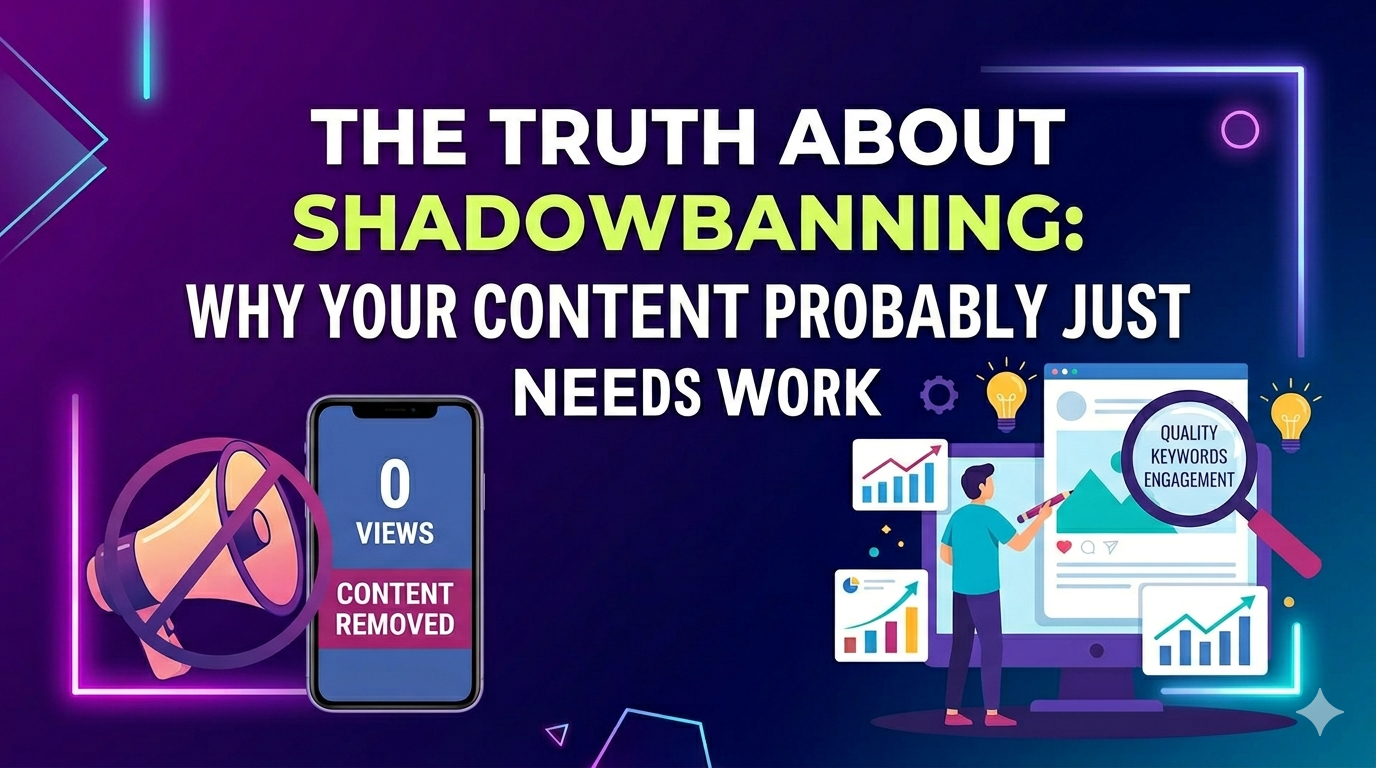
There is a persistent myth in online creator communities that shadowbanning is the invisible hand holding back careers. Spend five minutes in any forum for social media users and you will find people absolutely convinced that a platform has secretly suppressed their reach, that their posts are being hidden from followers who desperately want to see them, and that an algorithmic conspiracy is the only thing standing between them and viral success. The reality is far less dramatic. Shadowbanning is rare, and when reach does decline, the explanation usually sits squarely in the content itself.
To understand why this myth persists, you have to look at how social media platforms actually function. These companies make money through engagement. Their entire business model depends on keeping users scrolling, watching, and interacting for as long as possible. A platform that systematically hides good content from its own users is a platform that undermines its own revenue. It makes no economic sense for a company to secretly suppress creators who are driving the very engagement that pays their bills. The algorithms are designed to surface content that keeps people on the app, not to engage in petty vendettas against individual users.
The confusion often stems from a misunderstanding of how content distribution works. Algorithms do not show your posts to all of your followers. They never have. Platforms use relevance scoring, interest graphs, and engagement history to decide what appears in any given feed. If your recent posts have lower click-through rates, shorter watch times, or fewer meaningful interactions, the system responds by showing your next post to fewer people. This is not punishment. This is optimization. The algorithm is doing exactly what it was built to do: match content with users most likely to enjoy it.When creators experience a drop in views, the instinct is often to blame the platform rather than examine their own output. But content quality fluctuates. A video that felt inspired during production might fall flat with audiences. A writing style that worked last year might feel stale now. Trends shift, audience expectations evolve, and what captured attention six months ago might not work today. The algorithm did not change its mind about you. Your audience did.There are legitimate cases where accounts face restrictions, but these are typically transparent and direct. Platforms issue strikes, send warnings, and notify users when content violates community guidelines. These are not shadowbans. They are enforcement actions, and they come with documentation. True shadowbanning, defined as a secret suppression of content without notification or explanation, is an exceptional measure that platforms have little incentive to deploy at scale. The administrative overhead alone would be staggering, and the risk of discovery, lawsuit, and regulatory scrutiny far outweighs any hypothetical benefit.
The most common scenario mistaken for shadowbanning is simply audience fatigue. Followers who once engaged enthusiastically may grow tired of repetitive formats or themes. New users discovering your content for the first time might not find it compelling enough to follow. The algorithm picks up on these signals and adjusts distribution accordingly. Again, this is the system working as intended, not a covert attack on your account.Another factor is the sheer volume of content competing for attention. Every minute, hundreds of hours of video are uploaded, millions of posts are shared, and billions of pieces of content vie for limited screen real estate. Even maintaining your previous level of quality might result in declining reach if competitors are improving faster or if audience attention is fragmenting across new formats and platforms. You are not being suppressed. You are being outcompeted.
The path forward requires an honest assessment of what you are creating. Are you providing genuine value, or are you chasing metrics? Are you adapting to how consumption habits are changing, or are you clinging to what used to work? Are you building a real connection with a specific audience, or are you broadcasting into the void hoping the algorithm will do the work for you? These are difficult questions, but they are the ones that matter.Blaming shadowbanning is comforting because it externalizes failure. It preserves the ego by placing responsibility on a malicious third party rather than acknowledging that the content might not be as strong as it could be. But comfort is the enemy of growth. The creators who sustain long-term success are the ones who treat algorithmic changes and reach fluctuations as feedback, not persecution. They analyze what resonates, discard what does not, and continuously refine their craft.
If you are concerned about your reach, start by auditing your recent output with brutal honesty. Compare your best-performing content against your recent posts. Look at retention graphs if you have access to them. Read the comments, not just the numbers. Ask whether you would engage with your own content if you stumbled across it as a stranger. The answers to these questions will tell you far more than any conspiracy theory about shadowbanning ever could.The platforms want you to succeed because your success is their success. They have built multi-billion dollar businesses on the backs of creators who capture attention and keep users engaged. The idea that they would secretly sabotage the very people generating their value is not just unlikely; it is logically incoherent. Your reach is not being stolen by invisible bans. It is being earned or lost by the quality of what you create.