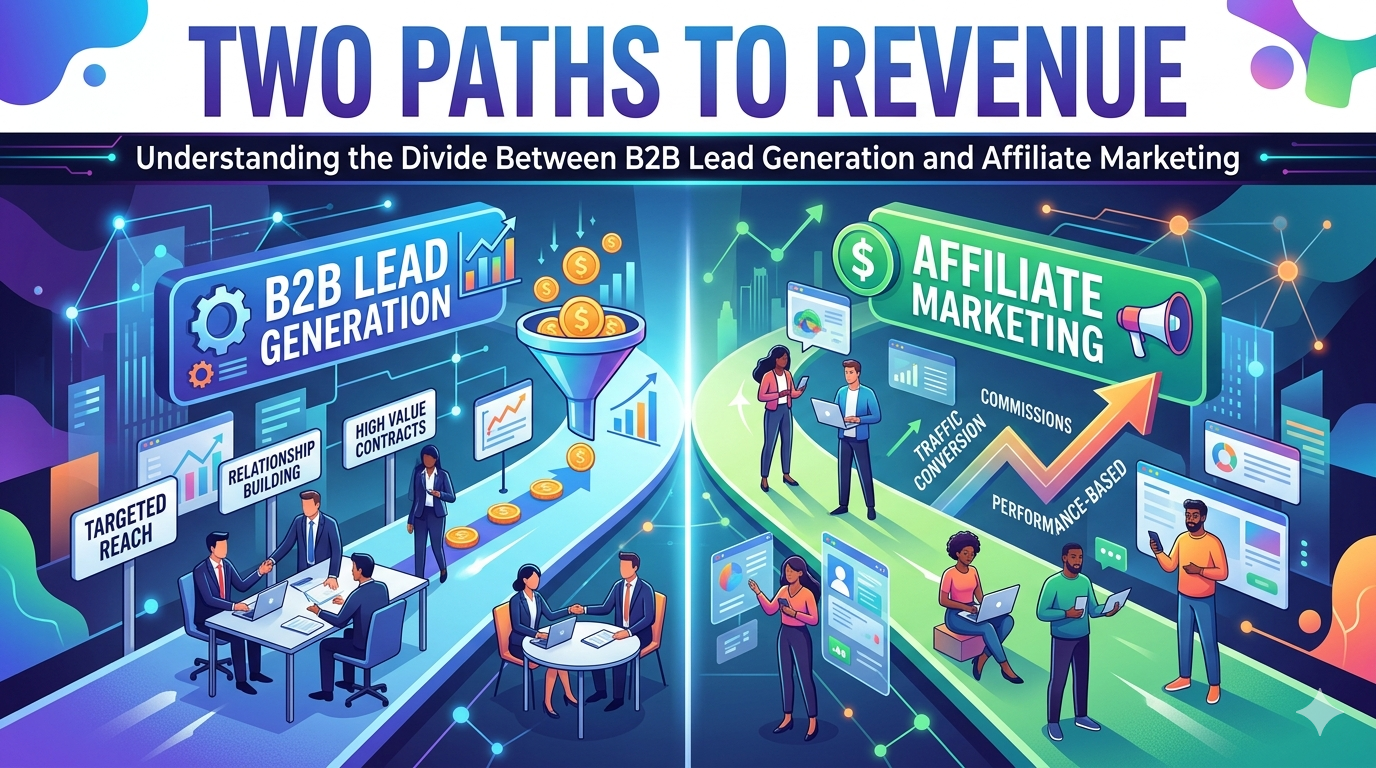
Every business needs customers, but not every business goes about finding them the same way. Two of the most common yet frequently confused approaches are B2B lead generation and affiliate marketing. On the surface, both involve connecting a potential buyer with a seller, and both can be extraordinarily profitable when executed well. But beneath that superficial similarity lies a fundamental divergence in philosophy, execution, and relationship dynamics. Understanding where these two models part ways is essential for anyone deciding where to invest their time, capital, or creative energy.
B2B lead generation is the art and science of identifying, attracting, and qualifying potential business clients who might benefit from a product or service. It is a process deeply rooted in relationship building, trust cultivation, and often a considerable investment of time before any transaction occurs. A company selling enterprise software does not expect a visitor to land on their website, read a single blog post, and immediately enter their credit card information. Instead, they offer a whitepaper, a webinar, or a free consultation in exchange for contact details. That exchange marks the beginning of a nurturing journey. Sales development representatives follow up with personalized emails. Account executives schedule discovery calls. Demos are tailored to the specific pain points of the prospect’s industry. The sales cycle might stretch across weeks or months, involving multiple stakeholders, procurement reviews, and legal negotiations before a contract is ever signed. The lead generator, whether an in-house team or an external agency, is compensated for producing qualified opportunities, not necessarily for the final sale itself. Their success is measured by the quality of the pipeline they build, the accuracy of their targeting, and their ability to move prospects from awareness to consideration.
Affiliate marketing operates on an entirely different rhythm. Here, the affiliate acts as an independent promoter who earns a commission for driving a specific action, typically a sale but sometimes a lead or a click. The affiliate does not own the product, handle customer service, or manage fulfillment. Their sole responsibility is to place the right offer in front of the right audience at the right time and persuade that audience to take action. The relationship between affiliate and merchant is transactional and performance-based. If the affiliate generates no conversions, they earn nothing. If they generate thousands, they earn proportionally. There is no nurturing sequence in the traditional sense, no six-month courtship. The consumer sees an advertisement, a review, or a recommendation, clicks through, and either buys or does not. The entire cycle can unfold in minutes. The affiliate’s toolkit consists of persuasive copy, search engine optimization for buyer-intent keywords, paid traffic arbitrage, email lists, and social media influence. Their craft is conversion optimization, not relationship management.The structural differences between these models create distinct risk profiles. In B2B lead generation, the company investing in leads assumes significant upfront risk. They pay for content creation, advertising spend, sales team salaries, and technology infrastructure before they see a return. A single enterprise deal might justify that investment, but the path is long and uncertain. The lead generator must deliver prospects who are not merely interested but who have budget authority, timeline urgency, and a genuine fit for the solution. A lead that checks none of those boxes is worthless, no matter how many there are. Quality trumps quantity absolutely. Affiliate marketing, by contrast, distributes risk differently. The merchant only pays when a sale is made, making it a low-risk customer acquisition channel from their perspective. The affiliate, however, bears the full burden of traffic generation and conversion. They might spend heavily on advertising or invest months building an audience only to find that the offer does not convert. Their risk is concentrated in their own promotional efforts, while the merchant enjoys a stream of revenue with minimal upfront commitment.
The nature of the customer relationship also diverges sharply. In B2B lead generation, the company acquiring the lead intends to own that relationship for years. The goal is not a single transaction but a long-term partnership characterized by renewals, upsells, and expansions. Customer lifetime value is the metric that matters most, and that value is realized over time through ongoing engagement. The lead generation process is therefore designed to attract the right kind of customer, one whose needs align with the company’s capabilities and whose growth trajectory suggests future opportunities. Affiliate marketing rarely concerns itself with lifetime value from the affiliate’s perspective. The affiliate’s interest concludes when the commission is earned. They have no stake in whether the customer returns, whether they are satisfied, or whether they churn. Some sophisticated affiliates do consider repeat purchase rates when selecting offers, but the fundamental structure of the model incentivizes volume over longevity. The merchant may hope for loyal customers, but the affiliate’s compensation is tied to the initial conversion, not the relationship that follows.
The skills required to excel in each domain further illuminate their differences. A B2B lead generation specialist must understand complex sales processes, industry-specific pain points, and the psychology of organizational decision-making. They need to craft content that speaks to multiple personas within a target account, from the end user who will experience the product daily to the CFO who must approve the expenditure. They must be fluent in marketing automation platforms, CRM systems, and lead scoring methodologies. Their work is analytical and strategic, requiring constant calibration of messaging based on where a prospect sits in the buying journey. An affiliate marketer, while no less skilled, draws on a different set of competencies. They must master traffic acquisition at scale, whether through organic search, paid media, or social platforms. They need to understand conversion rate optimization, split testing, and the psychology of impulse buying. Their success depends on speed, adaptability, and the ability to identify profitable offers before the competition saturates the market. Where the B2B specialist thinks in quarters and years, the affiliate often thinks in days and weeks, pivoting rapidly as algorithms change and consumer behavior shifts.
Regulatory and ethical considerations also separate these two worlds. B2B lead generation operates within a framework of data privacy laws, telemarketing regulations, and increasingly strict requirements for consent and transparency. A lead generated through misleading claims or without proper opt-in mechanisms can expose a company to legal liability and reputational damage. The emphasis on qualification and consent reflects the high stakes of the transactions involved and the long-term nature of the relationships being formed. Affiliate marketing has faced its own regulatory evolution, particularly around disclosure requirements. Regulators have mandated that affiliates clearly inform consumers when they are being compensated for a recommendation, a response to the historical opacity of the model. The ethical affiliate embraces transparency because trust is their only sustainable asset, but the model’s low barrier to entry has attracted bad actors who prioritize short-term commissions over honest representation. The regulatory scrutiny in both fields is intensifying, but the specific risks and compliance obligations differ in accordance with their distinct operational realities.
There are, of course, areas where these models converge or borrow from one another. Some B2B companies operate affiliate programs, paying commissions for referred business clients. Some affiliates specialize in generating leads for B2B services, bridging the two worlds by earning a bounty for each qualified opportunity rather than a percentage of the final sale. These hybrid approaches can be effective, but they require a clear-eyed understanding of which principles from each model apply. A B2B affiliate who treats lead generation as a purely transactional numbers game will deliver low-quality prospects that waste sales resources. An affiliate who attempts to apply B2B nurturing techniques to a consumer offer will find that the economics collapse under the weight of unnecessary complexity.
The choice between pursuing B2B lead generation and affiliate marketing, whether as a career, a business model, or a growth strategy, depends on one’s temperament, resources, and objectives. B2B lead generation rewards patience, strategic thinking, and the ability to navigate complex organizational dynamics. It offers the satisfaction of building something durable, of watching a carefully cultivated relationship transform into a partnership that spans years. Affiliate marketing rewards agility, creativity, and the capacity to operate at scale. It offers the thrill of rapid feedback loops, of campaigns that can be launched, tested, and optimized within hours. Neither is inherently superior. Both demand excellence. But they are not the same, and treating them as interchangeable is a recipe for wasted effort and missed opportunity.In the end, the distinction comes down to a simple question of what you are optimizing for. B2B lead generation optimizes for the quality of the connection, the depth of the relationship, and the lifetime value of the customer. Affiliate marketing optimizes for the efficiency of the transaction, the volume of conversions, and the immediacy of the return. Both can build substantial businesses. Both can fail spectacularly. The difference lies in knowing which game you are playing and committing to the details that define success within that particular arena.