Posted on

Why Ethical Marketing in Consumer Healthcare Requires Offering Real Solutions

Marketing consumer healthcare products carries a responsibility that many other industries do not. When people purchase products related to their health, they are not simply looking for convenience or entertainment. They are often trying to solve problems that affect their quality of life, their comfort, or their long-term well-being. Because of this, ethical marketing in the healthcare space requires a fundamentally different mindset.

The core principle is simple: if you are promoting healthcare products, you must focus on meaningful solutions rather than superficial promises.

Many consumers turn to health products when they are frustrated, worried, or struggling with persistent issues. Someone searching for relief from chronic pain, digestive problems, sleep difficulties, or stress is usually not browsing casually. They are actively seeking something that might improve their situation. This means the stakes are higher than they are in most other types of marketing.

Ethical marketers understand that this audience deserves honesty and clarity. Instead of exaggerating minor benefits or presenting quick fixes, responsible marketing focuses on products that genuinely address significant health concerns. The goal should be to connect people with tools that meaningfully improve their lives, not simply to persuade them to make an impulse purchase.

This is why successful healthcare products often focus on large, well-defined problems. Products that help people sleep better, support cardiovascular health, manage weight responsibly, or improve mobility tend to resonate more strongly than products built around vague or cosmetic benefits. When a product targets a major challenge people face in their daily lives, it becomes easier to explain its value in a straightforward and transparent way.

Offering big solutions also builds long-term trust. Consumers quickly recognize when marketing messages are exaggerated or unrealistic. If someone tries a product based on inflated claims and sees little benefit, the relationship between the marketer and the audience is damaged. Over time, repeated experiences like this erode credibility.

In contrast, when a product consistently delivers noticeable improvements, trust grows naturally. People who experience real results often share their experiences with others, and that word-of-mouth effect becomes one of the most powerful forms of marketing available.

Another reason ethical healthcare marketing should focus on meaningful solutions is that the healthcare industry is closely watched by regulators and medical professionals. Claims about health benefits must be handled carefully to avoid misleading consumers. Products that genuinely address real needs are far easier to present honestly than products that rely on exaggerated marketing language.

This approach also aligns with the long-term interests of businesses operating in the healthcare space. Companies that build their reputations around reliable solutions tend to develop loyal customer bases. Instead of relying on constant advertising to attract new buyers, they benefit from repeat customers who trust their products and recommend them to others.

In the end, ethical marketing in consumer healthcare is not simply about avoiding misleading claims. It is about recognizing the seriousness of the problems people are trying to solve and responding with products that offer real, meaningful improvements.

When marketers focus on connecting people with genuine solutions to significant health challenges, they create value not only for their businesses but also for the consumers who rely on them. In an industry where trust is essential, offering big solutions is the foundation of responsible and sustainable success.


Posted on

Why APIs and Integrations Create Endless Blogging Opportunities

One of the most overlooked realities of modern software is that almost nothing operates alone anymore. Today’s digital tools are designed to connect with each other, share information, and automate workflows across entire businesses. These connections are made possible through APIs and integrations, and they quietly power much of the modern internet economy.

For bloggers who write about technology, entrepreneurship, or online business, this interconnected world creates an enormous number of content opportunities. Every time two pieces of software connect, a new set of questions appears. Business owners want to know how the integration works, whether it is reliable, what problems it solves, and which tools work best together. Each of those questions can become a valuable topic for an article.

An API, or application programming interface, allows one software platform to communicate with another. Instead of operating as isolated tools, platforms can send data back and forth automatically. A CRM system might receive leads from a website form, a marketing platform might send campaign data into analytics software, or a payment processor might trigger accounting entries the moment a transaction occurs. These kinds of automated interactions happen millions of times every day across the digital economy.

Because businesses rely heavily on these connections, people constantly search for ways to integrate the tools they already use. Someone might want to connect their CRM with their email marketing platform, their website builder with their payment processor, or their analytics platform with their advertising tools. Each of these integration challenges creates a practical problem that people want to solve quickly.

That demand for solutions creates fertile ground for blogging. When a blog explains how two systems work together, it becomes useful to readers who are trying to build efficient workflows. Articles that explore how different software platforms interact often attract readers who are already running businesses or managing complex systems. These readers are highly motivated because solving integration problems can save them time and increase their revenue.

Another reason APIs and integrations generate endless content ideas is the sheer number of software tools available today. The global software ecosystem now includes thousands of platforms across marketing, finance, customer management, analytics, cybersecurity, and operations. Each platform may integrate with dozens or even hundreds of others. The number of possible combinations grows rapidly, creating a nearly limitless set of topics to explore.A blog that focuses on integrations also tends to remain relevant over time. As new software tools appear, businesses immediately begin asking how those tools connect with the systems they already use. When new APIs are released or existing integrations improve, fresh content opportunities emerge naturally. Instead of running out of topics, the blogger gains access to an expanding universe of possible articles.

These kinds of articles also tend to attract valuable audiences. People researching software integrations are often decision makers inside companies. They are responsible for selecting tools, improving workflows, and making systems work together efficiently. Content that helps them solve those problems becomes highly trusted and frequently shared within professional communities.

The deeper reason APIs and integrations are so rich as blogging topics is that they reflect how modern businesses actually operate. Companies no longer rely on a single piece of software to run their operations. Instead, they build digital ecosystems made up of many specialized tools that communicate with each other. Understanding those connections has become a critical skill for entrepreneurs and professionals alike.

For bloggers interested in technology and online business, this interconnected environment offers an endless source of material. As long as new software platforms continue to appear and companies continue trying to make those platforms work together, there will always be new integration questions to answer and new workflows to explain.In a world built on connected software systems, every integration is a story waiting to be written.

Posted on

The Industries That Offer the Greatest Opportunities to Make Money Online

When people begin exploring ways to make money online, they often assume that success comes from clever tactics or trendy platforms. In reality, the biggest factor determining how much money someone can make is the industry they operate in. Certain fields naturally produce more revenue than others because the problems being solved are expensive and important.

The internet is ultimately a marketplace for solving problems at scale. The more serious and valuable the problem, the more money flows through the market that surrounds it. This is why a small number of industries consistently dominate the online economy. These fields involve issues that affect people’s health, financial stability, business growth, digital security, and housing. Because the stakes are so high, the money circulating in these markets is enormous.

Health is one of the most powerful industries in the online world because people are deeply motivated to improve their physical and mental well-being. Individuals spend significant amounts of money on solutions that promise better fitness, better nutrition, improved sleep, and longer life expectancy. This demand creates a large ecosystem of products, services, and educational content. Online businesses that operate in the health space often benefit from a constant flow of consumers who are actively searching for ways to improve their quality of life.

Finance represents another enormous opportunity because money itself is the subject of the industry. People want to learn how to earn more, invest wisely, reduce debt, and build long-term financial security. Financial services, investment platforms, and educational resources all thrive online because the internet allows people to access tools and information that were once restricted to professionals. When the topic revolves around money management and wealth creation, audiences are highly motivated to find reliable solutions.

Business-to-business software has become one of the fastest-growing areas of the digital economy. Companies increasingly rely on software tools to manage their operations, track customers, automate marketing, analyze data, and coordinate teams. These platforms are often sold through subscriptions that generate recurring revenue, and businesses are willing to pay significant monthly fees for tools that help them operate more efficiently or generate more sales. Because these tools directly affect a company’s revenue and productivity, the software industry has grown into a massive global market.

Cybersecurity has emerged as another highly valuable field as businesses and individuals move more of their lives online. Every organization that stores digital information faces the risk of cyberattacks, data breaches, and system failures. As a result, companies spend large amounts of money protecting their networks and sensitive data. The increasing complexity of digital infrastructure means that security tools, services, and education are in constant demand. This creates opportunities for online businesses that focus on protecting digital systems and helping organizations reduce risk.

Real estate has also become deeply connected to the internet. Buying, selling, and investing in property now involves online platforms, digital marketing, and remote research. Investors analyze markets online, buyers search listings from their phones, and agents build their reputations through digital channels. Because property transactions often involve large amounts of money, the ecosystem surrounding real estate generates substantial economic activity. Educational content, lead generation platforms, and investment tools all exist within this space.

What these industries share is the scale of the problems they address. Health affects the quality and length of people’s lives. Finance determines long-term stability and wealth. Software drives the operations of modern businesses. Cybersecurity protects valuable digital assets. Real estate represents one of the largest forms of wealth in the world.

When someone builds an online business within one of these industries, they position themselves in markets where large amounts of money are already flowing. The internet then becomes a distribution channel that allows them to reach people who are actively searching for solutions.

Success online rarely comes from chasing the newest trend or platform. It comes from aligning your efforts with industries where the problems are important and the economic incentives are strong. When you operate in a field where people are highly motivated to solve expensive problems, the opportunities for building a profitable online presence increase dramatically.

Posted on

Why Becoming a Salesforce Consultant Can Be a Powerful Career Move

Many people who want to increase their income or enter the technology industry assume they need to become programmers. While software development is one path, it is far from the only one. One of the most overlooked opportunities in the modern tech economy is becoming a Salesforce consultant.

Salesforce is one of the largest enterprise software platforms in the world. More than 150,000 companies use it to manage their customers, sales pipelines, and internal operations. Businesses rely on it to track leads, close deals, analyze performance, and automate processes that would otherwise require large teams of employees. Because every company operates differently, Salesforce almost always needs to be customized to match the way a business actually works.

This is where consultants come in.

A Salesforce consultant helps companies configure the platform so it supports their sales process, customer management, and reporting needs. Instead of writing large amounts of code, many consultants focus on understanding how a business operates and translating those needs into the structure of the software. They design workflows, automate repetitive tasks, build dashboards, and ensure that teams can easily manage their customers inside the system.

The demand for this type of expertise is extremely strong because Salesforce is such a widely adopted platform. Companies frequently need help implementing the system for the first time or improving an existing setup that has become inefficient. A well-configured CRM system can dramatically improve how a company manages its revenue, so businesses are willing to invest significant resources to get it right.

For individuals, this demand creates a compelling career opportunity. Salesforce professionals often earn strong salaries even at the entry level, and experienced consultants can command high hourly rates. Independent consultants regularly charge hundreds of dollars per hour, while larger consulting firms build entire businesses around implementing and maintaining Salesforce for clients. Because companies depend heavily on the platform once it is installed, consultants often develop long-term relationships with clients who need ongoing improvements and support.

Another appealing aspect of the field is accessibility. Many technology careers require years of formal education, but Salesforce provides a structured pathway for people who want to learn the platform on their own. The company created a free online training system called Trailhead, which allows anyone to study the fundamentals of Salesforce through interactive lessons and practical exercises. These lessons teach how data is organized inside the platform, how sales pipelines are structured, and how automations and reports are built.

As learners progress through the training, they gain experience working with the same types of tools companies use every day. Eventually many people prepare for Salesforce certifications, which demonstrate that they understand how to configure and manage the system. The Salesforce Administrator certification is often the first milestone, and it signals to employers and clients that the holder understands the platform’s core functionality.

Once someone has a solid grasp of the system, practical experience becomes the next step. Some people gain experience by working in companies that already use Salesforce internally. Others help small organizations configure their systems or volunteer on projects that allow them to practice their skills. Over time, this experience builds the knowledge needed to handle larger implementations and more complex business problems.

As consultants grow more experienced, they often begin specializing in particular areas of the Salesforce ecosystem. Some focus on sales automation, others on analytics or integrations with other software systems. Specialization allows consultants to solve more complex problems, which increases their value to clients.

For people interested in entrepreneurship, Salesforce consulting can also become a business rather than simply a job. Many consultants eventually build small firms that help companies adopt and improve Salesforce systems. These firms serve multiple clients at once, generating recurring revenue as businesses continue to expand their use of the platform.

The broader reason this career path is attractive is that it sits at the intersection of technology and business. Companies depend on software to manage their operations, but they also need people who understand how business processes actually work. Salesforce consultants operate in that middle ground, translating real-world business needs into digital systems that support growth.

In an economy where companies increasingly rely on software to manage customers and revenue, the ability to configure and optimize those systems has become a valuable skill. For individuals willing to learn the platform and understand how businesses operate, Salesforce consulting offers a pathway into the technology industry that can lead to stable, high-income work and long-term opportunities.

Posted on

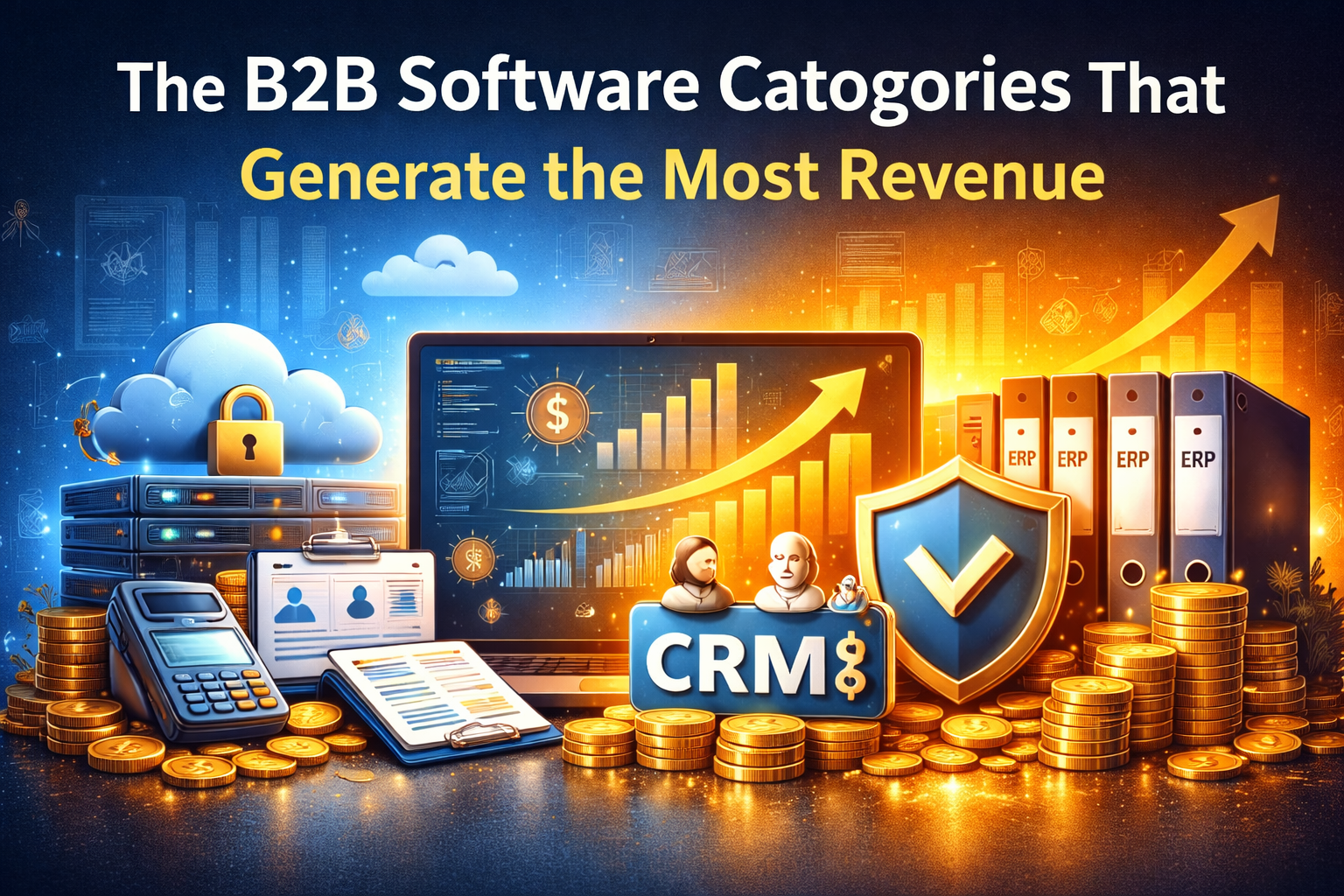
The B2B Software Categories That Generate the Most Revenue

The global market for business-to-business software has grown into one of the largest sectors in the technology industry. According to multiple industry reports, the global enterprise software market now exceeds $700 billion annually, and it continues to expand as more companies digitize their operations. Within that massive market, a few specific categories dominate revenue generation because they sit at the center of how businesses operate.

Cloud infrastructure software is one of the largest and most profitable segments. Companies rely on cloud platforms to run their applications, store data, and power internal systems. Amazon Web Services alone generates more than $90 billion in annual revenue, while Microsoft Azure and Google Cloud together produce tens of billions more each year. These platforms charge businesses based on computing power, storage, and usage, which means revenue scales directly with the size of the customer. Large enterprises often spend millions of dollars per year on cloud infrastructure, making this category one of the most lucrative in all of software.

Customer relationship management software is another enormous revenue generator. CRM platforms help companies manage leads, track customers, and automate sales pipelines. Salesforce, the largest CRM company in the world, produces more than $34 billion in annual revenue. Industry analysts estimate that the global CRM software market alone is worth over $80 billion, and it continues to grow rapidly as businesses focus more on customer data and sales automation. Many mid-sized companies spend $10,000 to $100,000 per year on CRM systems, while large enterprises often pay far more.

Financial software also represents a major source of B2B revenue. Accounting systems, payment processors, payroll platforms, and financial compliance tools handle the flow of money inside organizations. The global fintech and financial software market generates hundreds of billions in revenue annually. For example, payment processing companies such as Stripe and PayPal each process hundreds of billions of dollars in payments per year, earning revenue through transaction fees. Enterprise accounting platforms and payroll systems can cost businesses thousands to tens of thousands of dollars annually, depending on the size of the company.

Cybersecurity software has become one of the fastest-growing sectors in B2B technology. As businesses move more data and operations online, protecting digital systems has become a priority. The global cybersecurity market is expected to exceed $200 billion in annual spending, with projections suggesting it could reach $300 billion within the next decade. Security companies such as Palo Alto Networks, CrowdStrike, and Fortinet generate billions in yearly revenue by providing threat detection, network monitoring, and vulnerability protection. Large organizations frequently spend hundreds of thousands or even millions of dollars per year on cybersecurity tools.

Enterprise resource planning software is another category that produces massive revenue. ERP systems help businesses manage operations such as supply chains, inventory, manufacturing, and workforce planning. Companies like SAP and Oracle dominate this market. SAP alone generates more than $30 billion in annual revenue, largely from enterprise software subscriptions and support services. ERP systems often cost companies tens of thousands to hundreds of thousands of dollars annually, particularly when implemented across large organizations.

Across all of these categories, the same economic pattern appears repeatedly. The software that generates the most revenue tends to sit closest to the most important functions inside a business. Infrastructure software runs the systems companies depend on every day. Financial software controls the movement of money. CRM platforms help generate sales. Security software protects valuable data. Operational software coordinates complex internal processes.

Because these systems are deeply embedded in how companies function, businesses are willing to pay substantial recurring fees to maintain them. This is why the largest B2B software companies routinely generate tens of billions of dollars in annual revenue and why enterprise software has become one of the most profitable sectors in the global technology economy.

Posted on

Why Increasing the Value of Your Offer Is Often Easier Than Increasing Your Conversion Rate

Many entrepreneurs assume that the best way to grow their revenue is by increasing their conversion rate. They imagine that if they could just tweak their landing page, rewrite a headline, or adjust their call to action, they could double their results.

While improving conversion rates can certainly help, it is usually much harder than people expect. In many cases, it is actually easier to increase the total value of the product being sold than it is to significantly improve the percentage of visitors who convert.

Conversion rates are constrained by human behavior. People are naturally cautious online. They have been exposed to countless advertisements, exaggerated claims, and low-quality products. Because of this, even well-designed offers often convert only a small percentage of visitors. Moving that percentage meaningfully higher requires a deep understanding of psychology, messaging, audience targeting, and product positioning.

Even small improvements can take months of experimentation.

Entrepreneurs frequently spend enormous amounts of time testing page layouts, adjusting copy, and experimenting with different calls to action. Sometimes these efforts produce results, but often the gains are incremental. A conversion rate might move from one percent to one and a half percent, or from two percent to two and a half percent. While these improvements matter, they rarely transform a business overnight.

Increasing the value of the offer is often far more straightforward.

Instead of trying to convince more people to buy the same product, you simply make the product more valuable. This can happen in several ways. The price of the product might increase. Additional features or services might be included. The offer might be bundled with complementary resources that raise the overall perceived value. Sometimes the product can simply be positioned for a higher-value audience that is willing to pay more.

When the value of the offer rises, revenue increases even if the conversion rate stays exactly the same.If the same number of customers purchase a product that is worth twice as much, the business earns twice the revenue without needing more traffic or better conversion optimization. The effort required to accomplish this is often lower than the effort required to persuade significantly more visitors to buy.

This is one of the reasons why experienced entrepreneurs frequently move toward higher-ticket offers over time. They recognize that selling something more valuable can dramatically change the economics of a business. A product that generates meaningful revenue from a small number of buyers can be far more powerful than a low-priced product that requires thousands of conversions.

Understanding this principle shifts how you think about growth.

Instead of obsessing over tiny improvements in conversion rate, you begin asking a different question. You start looking for ways to create more value. When the offer itself becomes stronger, the entire business becomes easier to scale.

In the long run, improving conversions will always matter. But in many cases, the fastest path to higher revenue is not persuading more people to buy. It is giving them something worth far more when they do.

Posted on

Traffic Is Easy. Conversions Are Hard

One of the most common misconceptions in online business is that traffic is the hardest part. New entrepreneurs often believe that if they could just get more visitors, their problems would disappear. They imagine that once people start arriving on their website, sales will follow naturally.In reality, the opposite is usually true.

Traffic is often easier to generate than conversions. The internet is built to distribute content. Social media platforms want posts to spread, search engines want pages to be discovered, and communities constantly share links with each other. With consistent posting, basic SEO, or even simple outreach, it is usually possible to get at least some people to visit a website.

Getting someone to convert is a completely different challenge.

A conversion requires trust. It requires attention. It requires someone to believe that what you are offering is valuable enough to justify giving you their money, their email address, or their time. That is a much higher bar than simply clicking a link.

Most people browsing the internet are not in buying mode. They are scrolling, reading casually, or passing time. Even if they are interested in a topic, they are naturally skeptical of offers because they have seen thousands of advertisements before. This means that turning a visitor into a customer requires far more precision than simply attracting them in the first place.

This is why many websites with large amounts of traffic still struggle to make money. The visitors arrive, skim the page, and leave. Nothing about the offer is strong enough to move them from curiosity to action.Conversion requires alignment between the problem someone is experiencing and the solution being presented. The messaging must be clear, the offer must feel credible, and the value must appear obvious. If any part of that chain breaks, the visitor leaves without converting.

That process takes skill.It requires understanding your audience deeply enough to know what they want, what they fear, and what would motivate them to act. It requires writing that communicates value clearly. It requires offers that feel compelling rather than generic. It often requires testing different approaches until something finally resonates.

When you view online business through this lens, the priorities begin to change.

Instead of obsessing over traffic numbers, you start focusing on the quality of your offer and the strength of your messaging. A small number of visitors can produce meaningful income if even a tiny percentage of them convert. On the other hand, massive traffic with weak conversion will produce very little.

This is why experienced entrepreneurs spend so much time refining their offers. They understand that the real leverage in online business is not simply getting attention. It is turning that attention into action.

Posted on

Why Authority Matters in Affiliate Marketing

Affiliate marketing is often presented as a simple equation. Promote a product, share a link, and earn a commission when someone buys. While this description is technically correct, it leaves out one of the most important elements of successful affiliate marketing: trust. People rarely purchase products from someone they do not trust, especially when there are countless other options competing for their attention. This is where authority becomes extremely valuable.

Authority is the perception that you know what you are talking about. It is built gradually through consistent communication, useful information, and visible expertise in a particular topic. When people view someone as knowledgeable and credible, they are far more likely to follow their recommendations. In affiliate marketing, this trust can make the difference between a link that gets ignored and one that generates consistent commissions.

A blog is one of the most powerful tools for building this kind of authority. Writing regularly about a specific subject allows you to demonstrate knowledge over time. Each article becomes another piece of evidence that you understand the topic and have spent time thinking about it. As readers encounter your content repeatedly, they begin to associate your name or brand with that subject. This familiarity creates confidence, and confidence is what ultimately leads to purchases.

Social media plays a similar role, but in a slightly different way. While a blog often contains deeper and more structured content, social media allows you to maintain a steady presence in front of your audience. By sharing insights, responding to questions, and discussing the tools or services you use, you reinforce the idea that you are actively engaged in the field. This visibility helps transform you from a random internet account into a recognizable voice.

When a blog and social media work together, they create a reinforcing cycle. The blog demonstrates depth of knowledge, while social media maintains frequency and connection with the audience. Over time, this combination can turn a simple content creator into a trusted source of recommendations. Once that trust exists, affiliate marketing becomes much more effective because the audience is already predisposed to take your suggestions seriously.

Without authority, affiliate marketing often feels like shouting into the void. Links are shared, but few people click them, and even fewer make purchases. With authority, the dynamic changes. Recommendations feel more like guidance than advertising. Readers and followers begin to see the affiliate not as a salesperson, but as someone helping them make better decisions.

This is why many of the most successful affiliate marketers spend a large portion of their time building content and engaging with their audience. They understand that commissions are not created by links alone. They are created by trust, and trust is built through consistent demonstrations of knowledge and value.

In the long run, authority becomes one of the most reliable assets an affiliate marketer can possess. A blog filled with thoughtful articles and a social media presence that reinforces expertise can continue generating influence for years. Once that foundation exists, recommending products becomes far easier because the audience already believes that the recommendations are coming from someone worth listening to.

Posted on

Hustle Porn Doesn’t Teach You How to Make Money

There is a category of content on the internet that is extremely popular but surprisingly unhelpful when it comes to actually making money. It is often called “hustle porn.” These are the motivational clips, speeches, and posts that glorify grinding, waking up at 4 a.m., working endlessly, and sacrificing everything in pursuit of success. The problem is that while this content can feel energizing in the moment, it rarely teaches the actions that actually produce income.

Hustle porn focuses heavily on intensity rather than direction. It promotes the idea that working harder is the key variable that determines success. In reality, income is not just a function of effort. It is a function of performing actions that have economic value. Someone can work fourteen hours a day on tasks that do not generate revenue and still end the month with nothing to show for it. Meanwhile, another person might spend only a few hours performing high-value tasks and produce far greater financial results.

The difference lies in the type of work being done. Hustle porn rarely explains how money actually moves through the economy. It does not teach how businesses acquire customers, how products are positioned, how deals are negotiated, or how distribution works. These are the mechanics that determine whether an activity is lucrative or not. Without understanding these mechanisms, motivation alone cannot create income.

This is why many people who consume large amounts of motivational content feel busy but remain financially stuck. They are constantly told to push harder, wake up earlier, and grind longer, but they are not being shown the specific actions that generate revenue. They are given emotional fuel without a steering wheel.

Making money is much more practical than motivational content makes it seem. It usually involves identifying a problem that people are willing to pay to solve and then consistently performing the activities that connect your solution to those buyers. That might involve selling, marketing, building systems, negotiating partnerships, or improving a product. These activities are directly tied to revenue because they influence how value is exchanged.When someone learns to perform these kinds of actions, the need for constant motivation begins to disappear. The work becomes more focused and predictable. Instead of chasing energy or hype, the person is simply executing processes that have historically produced income.

This is why people who eventually succeed in business often reduce the amount of motivational content they consume. They realize that inspiration is not a substitute for skill. What matters is learning how markets operate and then participating in those markets in a way that creates measurable value.

Hustle porn sells the feeling of progress, but feelings are not the same as results. Real financial progress comes from mastering the activities that the market rewards. Once someone understands this distinction, the path to making money becomes much clearer. It is no longer about how hard you appear to be working, but about whether the work you are doing actually produces value that someone is willing to pay for.

Posted on

Your True Potential Only Reveals Itself After Years of Mastery

Most people underestimate what they are capable of achieving because they judge themselves far too early in the process. They attempt something difficult for a short period of time, encounter resistance, and quickly form conclusions about their limits. When this happens, what they are really measuring is not their potential, but their patience.

Human ability compounds over time. The first months of learning almost anything are usually slow and frustrating. Skills feel awkward, progress appears minimal, and the results rarely match the effort invested. This early phase can create the illusion that improvement will always be this difficult. In reality, the beginning is simply where the foundations are being built.

Once a person commits to learning something deeply for years rather than weeks, the entire experience changes. Small improvements begin to stack on top of each other. Knowledge that once felt abstract becomes intuitive. Tasks that once required intense concentration become automatic. The individual who once struggled with the basics gradually becomes someone capable of handling complexity with confidence.

This long period of development is where potential begins to reveal itself. It is impossible to know how good you can become at something when you are still standing at the starting line. Potential only becomes visible after thousands of hours of practice, experimentation, and correction. What felt impossible early on often becomes routine after sustained effort.

Another reason potential remains hidden for so long is that the brain adapts to challenge. When you push yourself to operate at a higher level consistently, your mind slowly reorganizes itself to handle that level of difficulty. The person you become after years of disciplined learning is not the same person who first started. Your thinking becomes sharper, your judgment improves, and your tolerance for complexity increases.

Because of this transformation, many people surprise themselves after enough time passes. Someone who once doubted their ability to speak confidently may later become an excellent communicator. Someone who once struggled to understand a technical subject may eventually master it. What looked like a hard limit early in the journey was often just a temporary stage of development.

The mistake many people make is quitting before this transformation has time to occur. They judge their capabilities after a few months and assume that their performance at the beginning represents their permanent ceiling. In reality, they simply never stayed long enough to see the deeper layers of ability that emerge with experience.

Excellence is rarely a sudden breakthrough. More often it is the result of years spent refining a skill, correcting mistakes, and steadily raising standards. Those who stay committed long enough eventually reach a point where their capabilities exceed anything they originally imagined.

For this reason, the most important decision is not whether you are talented at the start. The more important question is whether you are willing to remain committed long enough to discover what you might become.The truth is that no one knows the full extent of their potential on day one. It only reveals itself to those who spend years learning to excel.