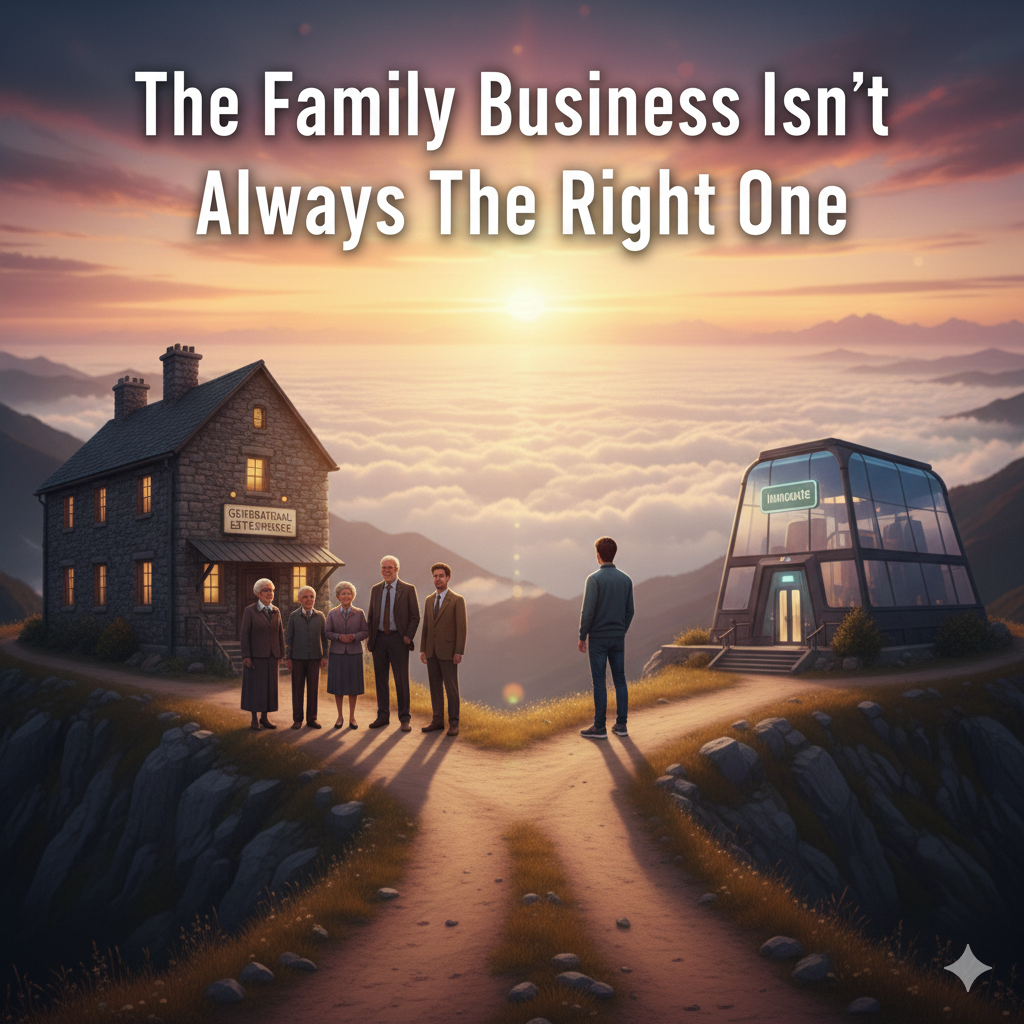
The smell of the place hit you before the balance sheet did: a mixture of machine oil, burnt coffee, and the faint sweetness of cardboard that has sat in the same warehouse since your grandfather’s first delivery. You were six when you decided that scent meant safety, and eighteen when you decided it meant fate. The family business was never presented as a choice; it was the default setting, the background hum that had financed every birthday, every vacation, every quiet Christmas Eve. Somewhere between the scholarship letter you didn’t open and the major you never declared, the path narrowed until walking it felt like honoring your elders and straying felt like betrayal. So you stayed, and the years began to echo one another like identical corridors in a building you were told you would someday own but have never quite managed to leave.
Ownership, however, is not the same as authorship. The sign above the door carries your surname, but the hours inside carry your life, and the two are negotiated in different currencies. Money can be inherited; mornings cannot. Every sunrise you spend inside a role that was chosen for you is a sunrise subtracted from a version of yourself who might have woken up curious instead of obligated. The family ledger shows a healthy margin, yet nowhere in the columns does it record the cost of a Tuesday that begins with someone else’s emergency and ends with your own silence. Profit is a poor measure when the expense is measured in identity.
Your cousin, the one who left, sends postcards from places where no one knows the company name. She waits tables, teaches yoga, sleeps in a studio apartment that smells of eucalyptus instead of diesel. The family whispers that she is drifting, that she will come back once the novelty wears off, that she has no safety net. The safety net they mourn is the same one that kept you from jumping. You picture her waking up without the weight of ancestral expectation and feel something that resembles envy but tastes like grief, because envy implies two equally possible lives and you were never shown the second option.
The myth is that blood guarantees alignment: that shared DNA equals shared desire, that loyalty and longevity are the same virtue. The reality is that a business is a living organism with its own appetites, and it will consume whoever stands closest, regardless of surname. It will take your Saturdays, your lower back, your willingness to dream about anything that does not fit inside a spreadsheet cell. It will reward you with stability that feels like a velvet-lined coffin: comfortable, dark, and exactly your size. The money will arrive on schedule, and you will learn to translate every private longing into its cash equivalent just to prove the sacrifice was worthwhile. By the time you notice that the numbers never quite balance against the parts of you that have gone missing, the exit will look like an act of violence against the very people who love you most.
Loving them back does not require self-burial. Gratitude for the childhood the business provided does not obligate you to provide your adulthood in return. The founders, your grandparents, built the company because the world they were born into offered them no safety net at all; they constructed one out of sheet metal and overtime. Their genius was survival, but survival is not a hereditary craft. You were born into surplus, and surplus invites a different question: not how to stay alive, but how to live. Answering that question inside a house someone else designed is possible only if the architecture happens to match the shape of your private hunger. When it does not, the kindest act is to admit the mismatch before the walls finish closing.Leaving feels like amputation because in some ways it is: you are severing a narrative that began before your birth. But amputation is sometimes the price of mobility. The phantom ache will linger, and family gatherings will echo with the sound of a story that continues without your character. Let the story continue. Stories are allowed to revise themselves. The company will adapt, hire, perhaps even sell. Your parents will discover that the entity they built is more resilient than they feared, and you will discover that your absence does not collapse the world you left. What collapses is the illusion that love and labor must share the same address.
The money you walk away from is real, and the security it buys is real, and the fear that replaces it at three in the morning is realer than both. Yet on the other side of that fear is a morning that begins without the metallic taste of inherited obligation. You will still wake up worried, but the worry will belong to you, earned by choices you authored. There is a peculiar pleasure in paying rent with money you made doing work no ancestor anticipated. The pleasure is not in the amount but in the alignment: the same person who decided what to do also decided why to do it. That congruence is a form of wealth the family balance sheet never tracked, because it cannot be transferred, only chosen.
Perhaps the business will call you back in a decade, not as the heir who stayed but as the adult who returns with new skills, new boundaries, a negotiated role that fits like tailored cloth instead of ancestral hand-me-down. Or perhaps you will build something entirely separate, a life whose scent your own children will one day associate with safety, even if it smells nothing like machine oil. Either path remains possible so long as you refuse to mistake DNA for destiny. Blood can open a door, but it cannot force you to keep walking once you realize the corridor bends away from the horizon you privately pursue. Step outside. The air is unfamiliar, and the ground feels unsteady, but the sky is large enough to hold a name that belongs only to you.