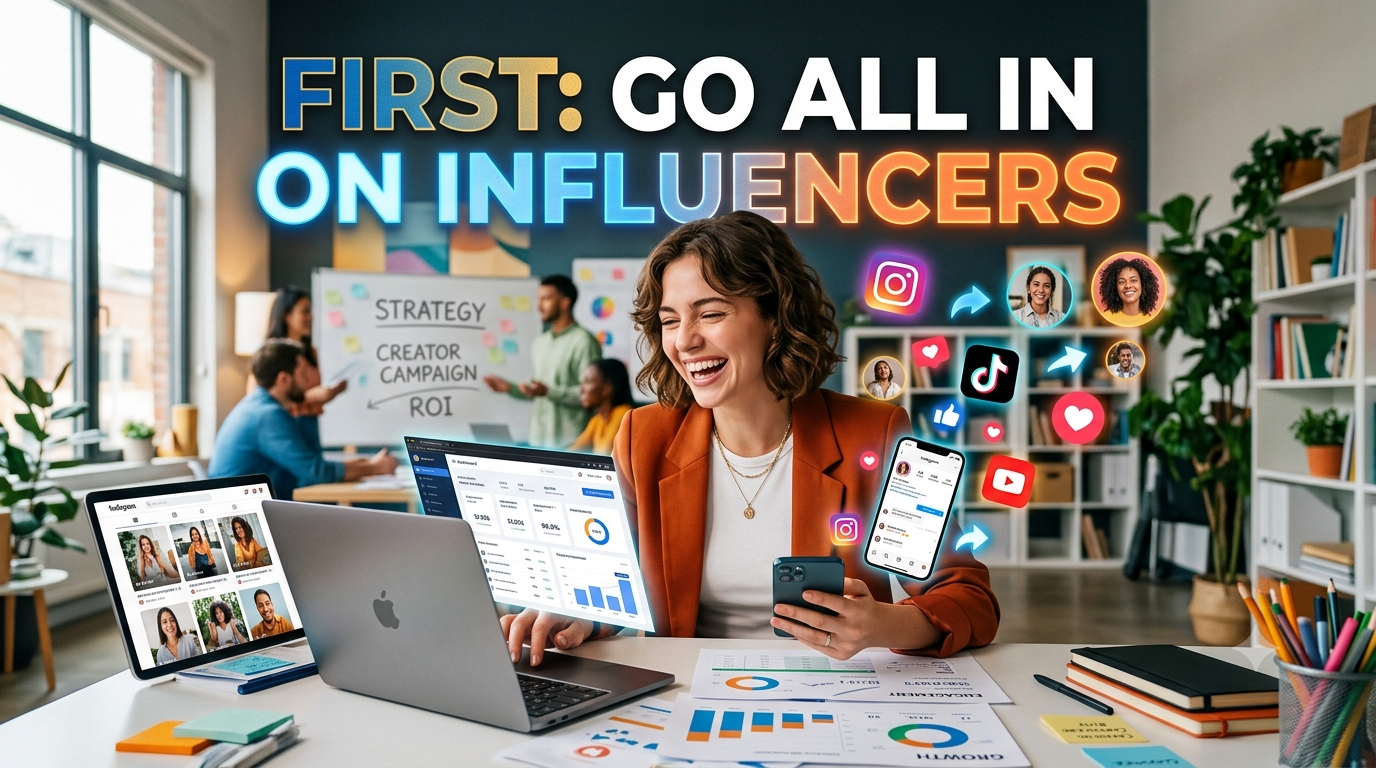
Influencer marketing and digital ads are often presented as competing strategies, but in reality they operate on very different mechanics. One is built on borrowed trust, the other is built on paid attention. When people argue about which has a higher return on investment, they are usually comparing two systems that don’t measure success in the same way, which is why the answer is more nuanced than most headlines suggest.
Digital ads are essentially a direct transaction with attention. You pay a platform to place your message in front of a user, and the platform optimizes delivery based on predicted likelihood of engagement or conversion. This system is extremely efficient at scale. It can be measured precisely, adjusted quickly, and expanded almost infinitely as long as budget allows. The tradeoff is that the relationship between brand and customer is minimal. You are interrupting attention rather than being invited into it. Over time, users also become more resistant to ads, which can reduce performance unless creative quality and targeting continuously improve.
Influencer marketing works differently because it operates through pre-existing trust relationships. Instead of buying attention directly, you are aligning your message with someone who already has attention. That attention is not neutral; it is emotionally invested. Followers listen to influencers not just because they appear in a feed, but because they have built credibility over time through consistent content. When an influencer recommends a product, it feels less like an advertisement and more like a social signal.
This difference is where the perception of higher return on investment often comes from. In many cases, influencer campaigns can produce stronger conversion rates per impression because the audience is already primed to trust the messenger. A recommendation delivered through a trusted creator can bypass skepticism that would normally filter out a traditional ad. This is especially true in niches where communities are tight and recommendations carry social weight, such as fitness, beauty, software tools, gaming, or personal finance.
However, it is important to understand that influencer marketing is not inherently more efficient in every scenario. It can also be unpredictable. Performance depends heavily on the quality of the influencer-audience relationship, the alignment between product and audience, and the authenticity of the integration. Two influencers with similar follower counts can produce dramatically different results. One might generate strong engagement and conversions, while another produces almost no meaningful action. This variance makes influencer marketing harder to standardize compared to digital ads.
Digital advertising, by contrast, provides more control and repeatability. If a campaign works, it can usually be scaled by increasing budget or refining targeting. The feedback loop is structured and measurable. You can track impressions, click-through rates, conversion rates, and return on ad spend with relative precision. This makes digital ads especially powerful for optimization-driven businesses that rely on predictable acquisition models.
The comparison becomes more interesting when you look at where each system tends to perform best. Digital ads are often strongest in environments where demand already exists and users are actively searching or browsing with intent. Influencer marketing tends to perform better in environments where demand needs to be created or shaped, or where discovery plays a larger role than search behavior. In other words, ads capture existing intent while influencers help generate or redirect it.
There is also a psychological difference in how users respond. Ads are typically processed with a degree of skepticism because users are aware they are being targeted. Influencer content, when done naturally, blends into the content stream users already consume voluntarily. This reduces resistance and can increase persuasive impact. But that same subtlety can also backfire if audiences perceive the promotion as inauthentic or overly commercial, which can damage both the influencer’s credibility and the brand’s reception.
When people claim influencer marketing has a higher return on investment than digital ads, what they often mean is that the marginal return per campaign can be higher under the right conditions. A well-matched influencer partnership can generate outsized results relative to its cost, especially in early-stage brand building or product launches. But this does not automatically translate into consistent superiority. It is more accurate to say that influencer marketing has higher variance with potential for higher peaks, while digital ads offer more stable and controllable returns.
For businesses deciding where to allocate resources, the choice is not simply about which is better, but about what stage the business is in and what kind of growth it is seeking. Early-stage products often benefit from influencer marketing because it creates awareness quickly and injects social proof into the market. Established products often rely more heavily on digital ads because they can efficiently scale proven conversion funnels.There is also a compounding effect when both systems are used together. Influencer marketing can create awareness and credibility that improves the performance of later advertising campaigns. At the same time, retargeting through digital ads can capture users who were initially introduced through influencer content but did not convert immediately. In this way, the two channels reinforce each other rather than compete.
Ultimately, the idea that one channel universally outperforms the other oversimplifies how modern marketing actually works. ROI is not just a function of channel choice, but of audience fit, creative quality, timing, and product-market alignment. Influencer marketing can absolutely outperform digital ads in certain contexts, particularly where trust and narrative matter more than direct response optimization. But digital ads remain indispensable for scale, measurement, and control.
A more accurate way to think about it is that influencer marketing is a trust amplification system, while digital ads are a distribution engine. One leverages human relationships to transfer credibility, while the other leverages infrastructure to deliver precision targeting at scale. The strongest marketing strategies are usually the ones that understand how to use both systems at different points in the customer journey rather than treating them as mutually exclusive choices.