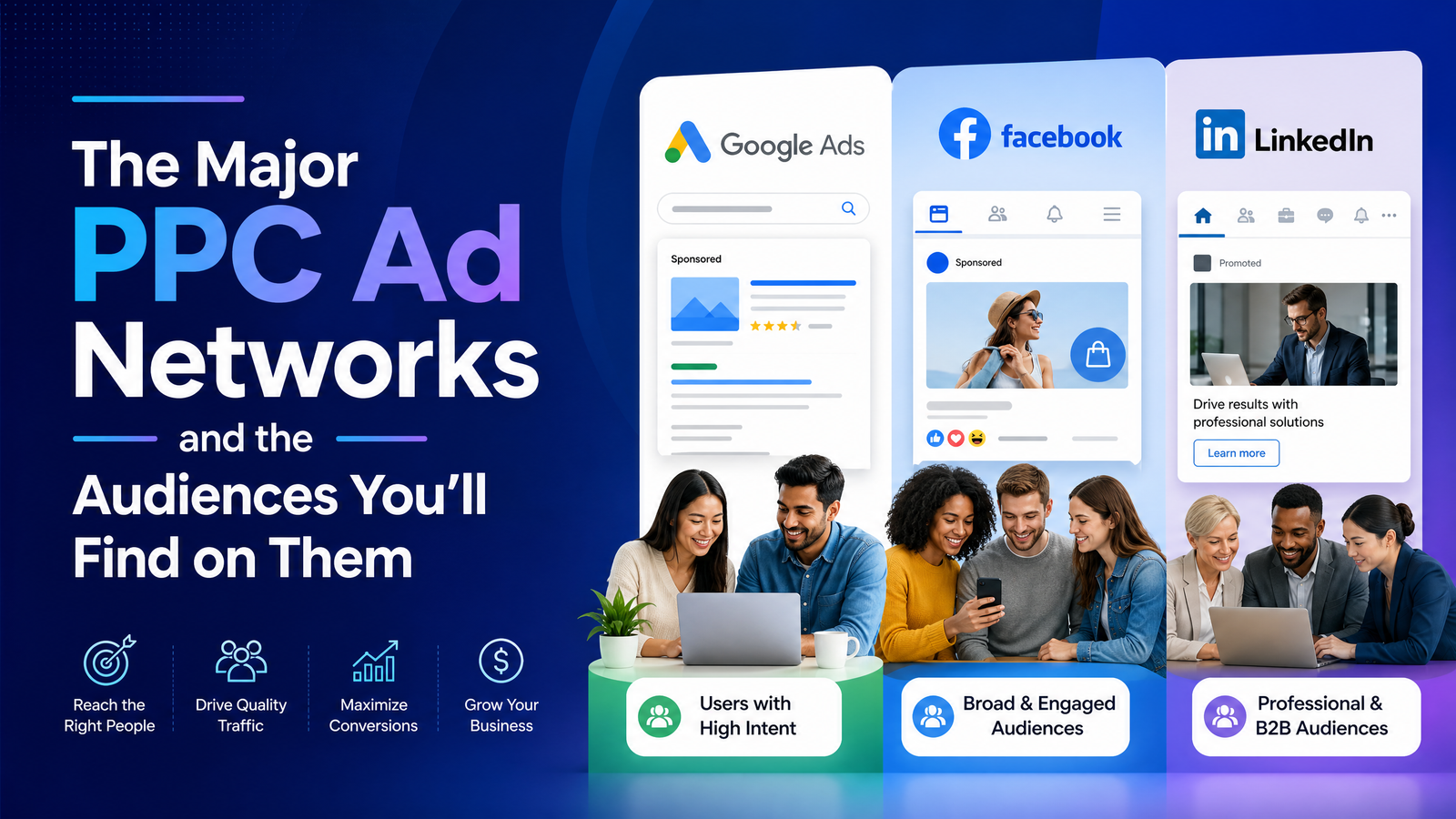
Pay-per-click advertising is one of the most direct ways to put your product or service in front of people who are ready to act. But not every PPC network reaches the same person at the same moment in their day. Knowing which platform attracts which kind of customer is the difference between a campaign that pays for itself and one that quietly drains your budget. Here’s a tour of the biggest PPC networks in the world and the audiences that live on each of them.
Google Ads: The Search Giant with Unmatched IntentGoogle Ads is the undisputed heavyweight of PPC advertising, capturing roughly 28% of all global digital ad spend. It operates primarily through two channels: Search, where text ads appear alongside Google search results, and Display, where image and text ads appear across Google’s vast network of partner websites.
What makes Google Search Ads uniquely powerful is purchase intent. When someone types “best running shoes for flat feet” or “emergency plumber near me” into Google, they are not passively browsing — they are actively looking for a solution. This makes Google Search the natural home for businesses whose customers already know they have a need. It works exceptionally well for local service businesses like plumbers, dentists, and contractors; for e-commerce stores selling products with clear, searchable names; for software companies targeting buyers who comparison shop online; and for any business whose category has strong search volume.
The Google Display Network extends reach to over two million websites and apps, placing visual ads in front of users as they read articles, check their email, or watch YouTube videos. The Display network trades the laser-focused intent of search for sheer scale and the ability to reach people earlier in the buying journey. It’s where brands build awareness, re-engage past website visitors through remarketing, and stay visible during long B2B sales cycles.
The customers you find through Google tend to skew older than social media audiences — people who grew up using search engines as their primary research tool. They are often in problem-solving mode, which means they respond well to direct, benefit-forward messaging.
Microsoft Advertising (Bing Ads): The Underestimated AlternativeMicrosoft Advertising runs ads across Bing, Yahoo, and DuckDuckGo, and while its market share is a fraction of Google’s, it reaches a genuinely distinct audience. Bing’s user base tends to be older, with a higher median household income, and skews more heavily toward desktop usage. A significant portion of Bing’s traffic comes from corporate environments where Microsoft Edge and Internet Explorer are the default browsers, meaning professionals in regulated industries like finance, healthcare, and legal services are disproportionately represented.
For advertisers, this means less competition and lower cost-per-click on Bing than on Google — often 20 to 35 percent lower — while reaching an audience that frequently has real purchasing power. B2B marketers in particular find strong performance on Microsoft Advertising because their target buyers are often corporate professionals using Windows machines. Luxury goods, financial products, and home improvement services also tend to perform well here.The platform now integrates with LinkedIn data, allowing advertisers to layer in targeting by job title, company, or industry — a capability that doesn’t exist anywhere else in search advertising.
Meta Ads (Facebook and Instagram): Social Intent at Massive ScaleMeta’s advertising platform spans Facebook, Instagram, Messenger, and the Audience Network, giving advertisers access to over three billion monthly active users. Unlike search platforms, Meta Ads operate on interest-based and behavioral targeting rather than keyword intent. Users on Facebook and Instagram are not searching for your product — they are scrolling through content from friends, family, and creators. That difference shapes everything about how Meta campaigns should be structured and what audiences they can reach.
Facebook’s median user is older than many people assume — the platform skews toward adults in their 30s, 40s, and 50s, many of whom are homeowners, parents, and established professionals. This makes Facebook an excellent channel for home goods, parenting products, financial services, insurance, healthcare, and anything else marketed toward financially stable adults. Facebook’s unparalleled targeting depth — interests, life events, income brackets, homeownership status, purchase behavior — allows for highly precise audience construction.
Instagram draws a younger, more visually oriented crowd. Brands in fashion, beauty, food and beverage, travel, fitness, and lifestyle perform exceptionally well here because the format rewards beautiful creative. Instagram is where brands build desire before demand exists. A customer might not be searching for a new skincare brand, but a perfectly crafted Instagram ad can create the want from scratch.Meta also remains the dominant platform for direct-response e-commerce advertising, particularly through dynamic product ads and catalog campaigns, which show users products they have already viewed on a brand’s website.
Amazon Ads: Commerce Intent at the Moment of PurchaseAmazon Advertising has quietly grown into the third-largest digital ad platform in the world, and it holds a structural advantage no other network can match: its users are already shopping. Someone browsing Amazon is not just aware they might want something — they have their credit card on file and their shipping address saved. The friction between ad impression and completed purchase is lower on Amazon than anywhere else in digital advertising.
Amazon’s Sponsored Products, Sponsored Brands, and Sponsored Display formats target customers at the very bottom of the purchase funnel. The audience is broad in one sense — Amazon reaches hundreds of millions of active buyers — but self-selecting in a crucial way: every person who sees your ad is on the world’s largest shopping platform, actively looking at products. This makes Amazon Ads the go-to channel for consumer packaged goods, electronics, supplements, home goods, toys, apparel, and virtually any physical product sold at retail.
Beyond the obvious e-commerce applications, Amazon’s DSP (Demand-Side Platform) allows advertisers to reach Amazon shoppers off the platform, across the web, using Amazon’s own purchase behavior data. A competitor to Google Display, it targets audiences based on what they have actually bought or browsed on Amazon — a signal far more predictive than passive browsing behavior.
LinkedIn Ads: The B2B Premium NetworkLinkedIn is the only major PPC platform built around professional identity. Its 900 million users have filled in their job titles, industries, seniority levels, company sizes, and professional skills — and LinkedIn’s advertising platform puts all of that data to work for B2B marketers. No other network lets you specifically target “Director of IT at a manufacturing company with 500 to 5,000 employees in the Midwest.”
The trade-off is cost. LinkedIn’s CPCs are among the highest of any PPC platform, often ranging from $5 to $15 or more per click. That pricing is justified for high-value B2B products where a single closed deal is worth tens of thousands of dollars, but it makes LinkedIn uneconomical for low-margin or consumer-facing products.
The customers on LinkedIn are business decision-makers, procurement professionals, HR leaders, engineers, developers, marketers, and executives. Enterprise software, professional services, recruiting tools, financial services aimed at businesses, and industry conferences all find strong audiences here. LinkedIn is also the primary channel for thought leadership content marketing — longer-form sponsored content that positions a company as an authority in its field.
TikTok Ads: Youth Attention at Unprecedented Scale
TikTok’s advertising platform has matured rapidly from an experimental channel into a mainstream performance marketing network. TikTok reaches over a billion monthly active users, with particular depth among Gen Z and younger Millennials. Its algorithm is remarkably effective at surfacing content to interested users, which means ads that feel native to the platform — authentic, fast-moving, and entertaining — can achieve exceptional organic reach on top of their paid distribution.
The audiences that perform best on TikTok are consumers in their teens, twenties, and early thirties who are engaged with culture, trends, and entertainment. Beauty brands, fashion labels, gaming companies, music artists, food and beverage brands, fitness products, and apps targeting young adults all find strong traction here. TikTok Shop has also made it increasingly viable for direct-to-consumer e-commerce, with the platform integrating purchase functionality directly into the feed.
TikTok is less about precision targeting and more about creative quality. The platform rewards brands willing to produce content that genuinely entertains or informs, rather than content that simply announces a product. Campaigns built around creators and trending formats routinely outperform polished traditional ads on TikTok.
Choosing the Right Network for Your Business
The most successful advertisers don’t pick a single platform and ignore the rest — they map their customer’s journey across multiple networks. Search advertising on Google or Microsoft captures demand that already exists. Social advertising on Meta or TikTok creates demand that doesn’t yet exist. Amazon closes demand at the moment of purchase. LinkedIn reaches the professional buyer that no other platform can isolate as precisely.
Understanding who lives on each platform — what they’re doing, what they want, and how far along in the buying process they are — is what transforms PPC from an expense into an investment. The network is just the venue. The audience is the point.