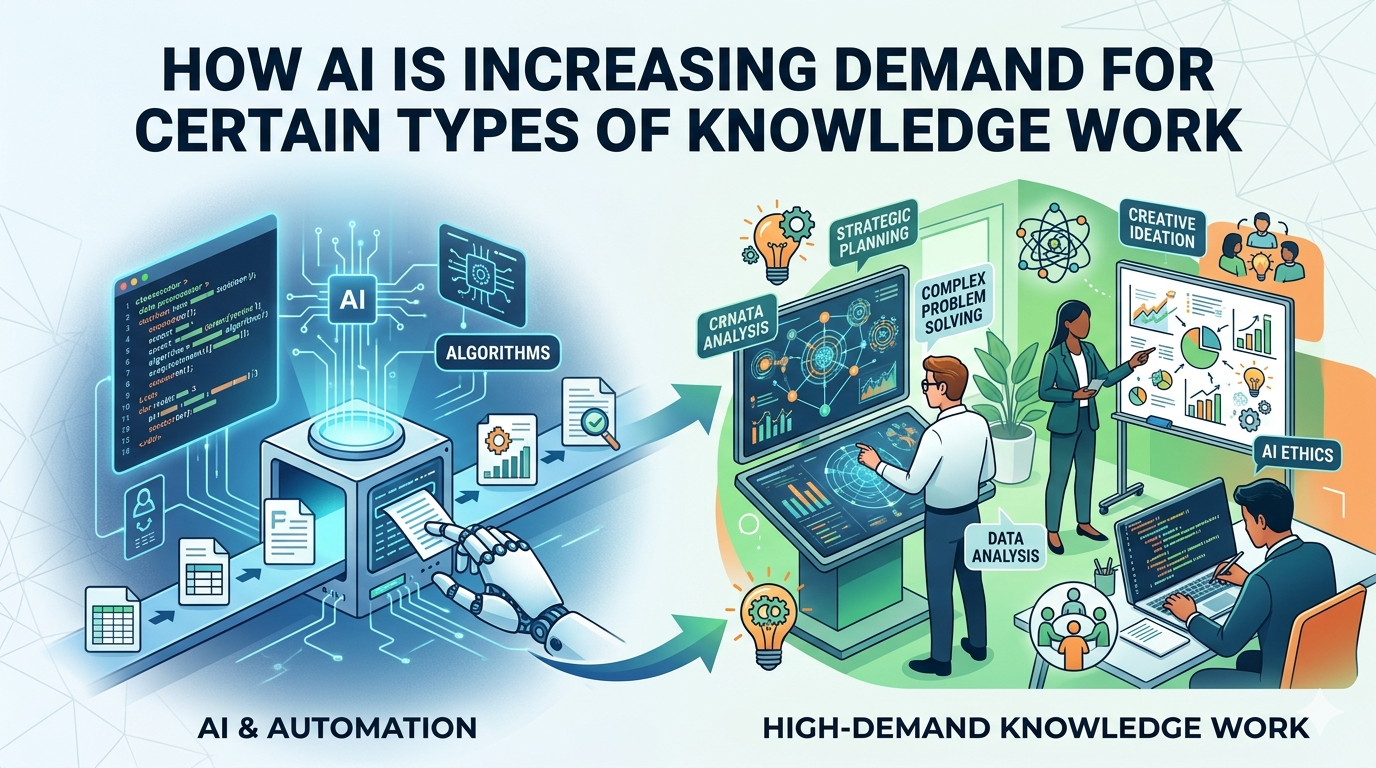
There is a common fear that artificial intelligence will simply replace human workers, rendering entire categories of knowledge work obsolete. While this concern is understandable, the reality unfolding in offices, studios, and research labs tells a more nuanced story. AI is not merely eliminating jobs; it is actively increasing demand for specific kinds of knowledge work, reshaping what organizations value and how professionals spend their time.
The most immediate effect of AI adoption is the amplification of output. Tasks that once took hours now take minutes. A marketing professional who previously wrote three campaign briefs per week can now draft fifteen. A legal researcher who once summarized a handful of case files daily can now process dozens. This acceleration does not reduce the need for human involvement. Instead, it raises the ceiling on what teams are expected to produce, which in turn increases the total volume of work that requires human judgment, refinement, and strategic oversight.
What AI generates is rarely finished product. It is raw material, a first draft, a starting point that requires human expertise to shape into something genuinely useful. This creates a surge in demand for the kind of knowledge work that involves discernment. Professionals who can evaluate AI output for accuracy, tone, legal compliance, ethical implications, and strategic alignment find themselves more essential than ever. The ability to spot a subtle error in a generated financial report, to recognize when a proposed marketing message would alienate a key demographic, or to identify a logical flaw in a drafted contract, these critical faculties cannot be outsourced to algorithms.
Organizations are also discovering that deploying AI effectively requires a new layer of knowledge work around implementation and governance. Someone must decide which AI tools to adopt, how to integrate them with existing systems, how to train staff in their use, and how to establish guardrails that prevent misuse or reputational harm. This has created robust demand for professionals who understand both the technical capabilities of AI and the operational realities of their industry. The hybrid worker, someone who speaks the language of technology and business simultaneously, has become one of the most sought-after profiles in the job market.
Creative and strategic thinking have seen renewed emphasis precisely because AI handles the mechanical aspects of production so well. When the execution of routine tasks becomes trivial, the competitive advantage shifts toward those who can ask better questions, frame problems more precisely, and imagine solutions that do not yet exist. A consultant who can help a client redefine their market position in light of AI disruption provides value that no tool can replicate. A product manager who can envision an entirely new category of AI-enhanced service creates opportunities that automated systems cannot foresee. The demand for this kind of conceptual, big-picture knowledge work has grown substantially.
Quality assurance and fact-checking have emerged as unexpectedly critical growth areas. As organizations produce more content, more code, and more analysis with AI assistance, the risk of subtle errors, hallucinated facts, and biased outputs increases. This has expanded the need for editors, reviewers, and subject matter experts who can verify claims and maintain standards. A newsroom that uses AI to draft initial articles now needs experienced journalists to ensure accuracy and fairness. A pharmaceutical company that uses AI to analyze research data needs scientists who can validate findings before they inform drug development decisions. The demand for this verification layer has grown in direct proportion to the speed of AI-generated output.
Client-facing knowledge work has also experienced a renaissance. As AI handles more of the behind-the-scenes processing, the human interactions that build trust, negotiate complex deals, and manage sensitive relationships become more distinctive. Sales professionals who can interpret a client’s unspoken concerns, account managers who can navigate organizational politics, and advisors who can deliver difficult news with empathy, these roles have not diminished. If anything, the efficiency gains elsewhere have freed up resources to invest more heavily in the human connections that drive long-term business success.
Specialized expertise has become more valuable, not less. AI can summarize general knowledge with impressive fluency, but it struggles with highly specific, rapidly evolving, or deeply contextual domains. A tax attorney who understands the nuances of a particular regulatory regime, a biologist who can interpret novel experimental results, a software architect who can evaluate trade-offs in a complex legacy system, these professionals command higher demand because their knowledge sits at the intersection of deep specialization and irreplaceable judgment. AI might help them work faster, but it cannot substitute for the years of focused learning that produced their expertise.
The nature of problem-solving itself has shifted in ways that favor certain knowledge workers. AI excels at pattern recognition within existing frameworks, but it is less capable when a situation is unprecedented, when multiple conflicting values must be balanced, or when the stakes involve human wellbeing in ways that resist quantification. Ethicists, policy analysts, and strategic planners who can navigate ambiguity and make decisions under uncertainty find their skills increasingly requested. Organizations need people who can think through the second and third order consequences of AI adoption, who can anticipate how automating one process might create new vulnerabilities elsewhere.
Education and training represent another domain where demand has surged. As AI tools proliferate, the need to upskill existing workers has become urgent. This has created substantial opportunities for instructional designers, corporate trainers, curriculum developers, and educational technologists who can translate complex AI concepts into practical learning experiences. The knowledge worker who can teach others to work alongside AI effectively has become indispensable to organizational adaptation.
Perhaps most significantly, AI has increased demand for the kind of knowledge work that involves synthesis across disciplines. The most interesting challenges organizations face today do not fit neatly into single categories. They require understanding how technology intersects with law, how data science informs marketing strategy, how user experience design influences healthcare outcomes. Professionals who can bridge these domains, who can synthesize insights from multiple fields into coherent action, have seen their value rise precisely because AI tends to operate within the boundaries of its training rather than across them.
The transformation is not without disruption. Some types of knowledge work have indeed declined as AI capabilities advance. But the broader trend points toward a redistribution of demand rather than a simple reduction. The work that remains and grows tends to be that which requires human judgment, ethical reasoning, creative leaps, emotional intelligence, deep specialization, and cross-disciplinary synthesis. These are not fringe activities. They represent the core of what makes knowledge work meaningful and what makes human professionals irreplaceable partners to increasingly capable machines.
For individuals navigating this shift, the implication is clear. The path forward lies not in competing with AI on speed or volume, but in cultivating the distinctly human capabilities that AI enhances but cannot replicate. The professionals who invest in these areas are finding that AI has not diminished their opportunities. It has expanded them.