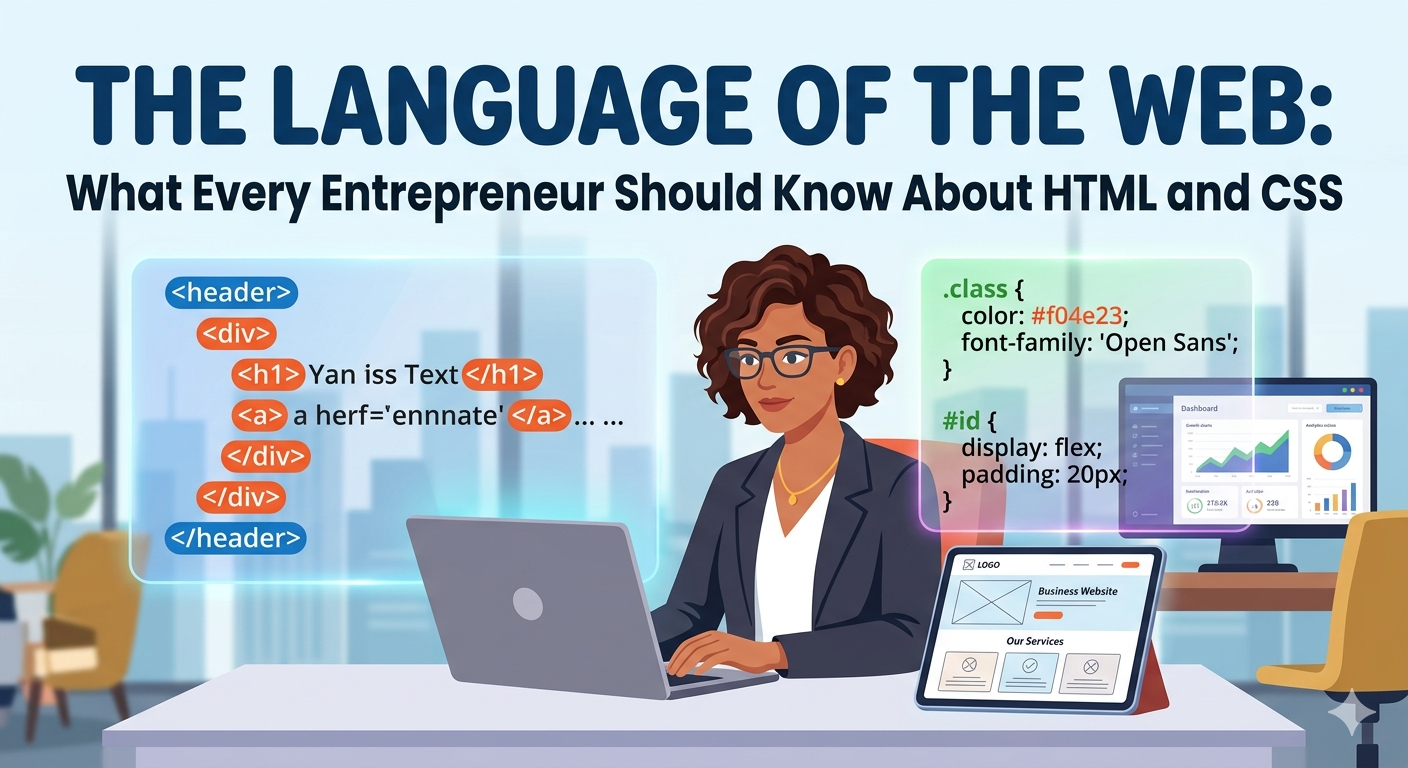
If you have ever looked at a website and thought about building one yourself, or if you have hired developers and wished you could speak their language, you need to understand two things: HTML and CSS. They are not programming languages in the traditional sense, and they are not as intimidating as they sound. Together they form the foundation of every webpage on the internet, and learning even a little about them will change how you think about building anything online.
HTML stands for HyperText Markup Language. Think of it as the skeleton of a webpage. It is a markup language, which means its job is to structure content and tell the browser what things are. When you write HTML, you are wrapping pieces of content in tags that describe them. A tag might say this is a heading, this is a paragraph, this is an image, or this is a link to another page. The browser reads those tags and assembles the content into a document. Without HTML, a browser would have no idea how to display the words and images you see on a screen. It would just be a raw stream of text. HTML gives everything its place and its meaning. It is the reason a headline looks like a headline and a button behaves like a button.CSS stands for Cascading Style Sheets. If HTML is the skeleton, CSS is the skin, the hair, the clothes, and the posture. CSS takes the structured content that HTML provides and decides how it should look. It controls colors, fonts, spacing, layout, and responsiveness. It is what makes a website look professional instead of looking like a plain document from 1994. The word cascading is important because it describes how styles flow down through a document. You can set a rule at the top level, and it will apply broadly, but you can also override it for specific elements when you need something to look different. This separation of structure and style is one of the most elegant ideas in web development. HTML handles what the content is. CSS handles how it appears. They are designed to work together, and they are both essential.
The relationship between them is simple in concept but powerful in practice. You write your content in HTML, marking up each piece so the browser knows what it is. Then you write CSS rules that target those marked-up pieces and define their visual properties. A single CSS file can control the appearance of an entire website with hundreds of pages. Change the font in one place, and it updates everywhere. This is why modern web development relies so heavily on CSS frameworks and design systems. They allow teams to maintain consistency across large projects without rewriting styles for every single page.For entrepreneurs, the value of understanding HTML and CSS goes far beyond the technical. It is about communication and independence. When you know how a webpage is built, you can have more productive conversations with developers and designers. You can make small edits yourself without waiting for someone else. You can evaluate whether a freelancer’s quote is reasonable because you understand the scope of the work. You can prototype an idea quickly without hiring a team. You become a better client, a better product thinker, and a better judge of what is technically possible.
Learning these skills has never been more accessible. Mozilla Developer Network offers comprehensive documentation and tutorials that are widely regarded as the gold standard for web fundamentals. It is free, thorough, and maintained by the same organization behind the Firefox browser. FreeCodeCamp provides a structured curriculum where you build real projects as you learn, and it is entirely free with a supportive community. Codecademy offers interactive lessons that guide you through HTML and CSS with immediate feedback, which is ideal if you prefer a more guided experience. For entrepreneurs who want to understand the business side of web development alongside the technical basics, Harvard’s CS50 course includes web programming modules that explain how the internet works from the ground up. YouTube also contains thousands of tutorials from individual creators who walk through building real websites step by step, which can be invaluable when you want to see someone else’s thought process in real time.
The internet is built on HTML and CSS. Every business with a website depends on them, either directly or through the platforms and tools that generate them behind the scenes. You do not need to become a professional developer to benefit from understanding how they work. You just need enough knowledge to see the structure beneath the surface, to ask better questions, and to build with confidence when the moment calls for it.