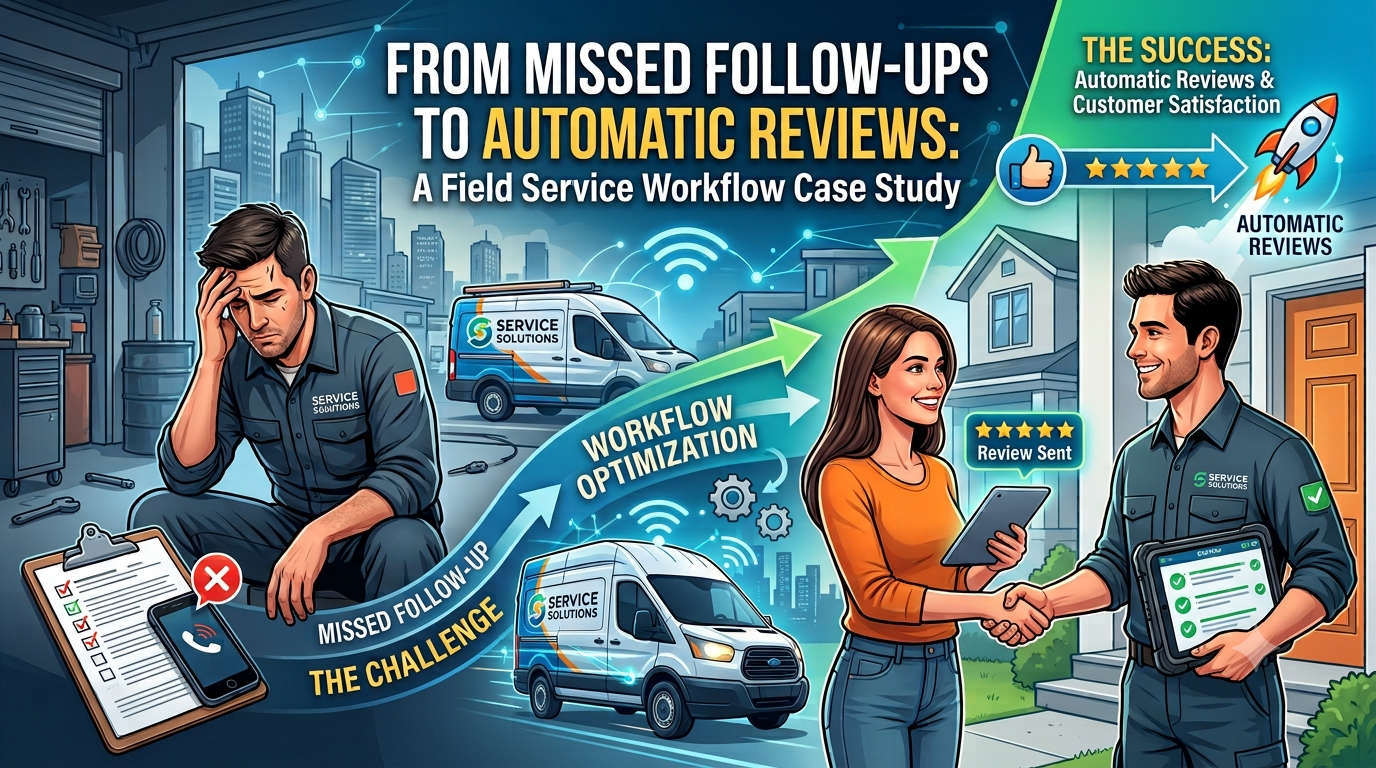
Every field service company runs on the same basic loop: a job comes in, a technician goes out, the work gets done, and somebody has to remember what happens next. That last part is where things quietly fall apart.
Picture a typical solar installation crew wrapping up a job on a Friday afternoon. The panels are up, the system is humming, and the customer is standing in their driveway genuinely thrilled about their new setup. This is the single best moment to ask for a review. The customer is happy, the experience is fresh, and they have every reason to say something nice.But the technician is already thinking about the next job. The office is closing out paperwork. Nobody sends the review request that day. By the time someone remembers, three days have passed, the emotional high has faded, and the ask feels like an afterthought instead of a natural next step. Multiply that by every job a company completes in a month, and you start to see the scale of the problem. It isn’t that crews don’t care about reviews. It’s that remembering to ask, at exactly the right moment, isn’t anyone’s actual job.
Why This Gap Is So Common
Most field service teams are optimized for getting the work done, not for what happens in the ten minutes after the work is done. Scheduling software tells a tech where to go. Dispatch tools tell the office who’s where. But very few systems close the loop on the moment that matters most for reputation: the handoff from “job complete” to “customer follow-up.”When that handoff depends on a person remembering to do it manually, it becomes inconsistent by default. A technician having a great day might send a text asking for a review. A technician racing to the next appointment might not. Over time, this turns review generation into a matter of luck rather than a repeatable part of the business.
What Changes With an Automated Workflow
The fix isn’t complicated, but it does require the software to actually understand the job lifecycle rather than just tracking it. Here’s how it plays out with a workflow built around automatic review requests.
A technician finishes the install and marks the job complete in the field service app, the same action they were already taking to close out the work order. That single action triggers everything else. The customer receives a personalized message within minutes, timed to land while the experience is still top of mind, asking them to share feedback on Google, EnergySage, or wherever the company wants to build its presence. No one on the team has to remember to send it, because the system already knows the job is done.The technician’s day doesn’t change at all. They’re not adding a task. They’re not carrying a mental checklist of who to follow up with later. The review request becomes a byproduct of doing their normal job, not an extra chore layered on top of it.
The Business Impact
The most immediate change companies notice is volume. When review requests go out consistently, on every job, instead of only when someone happens to remember, the number of reviews coming in rises noticeably within the first month. That’s not because customers suddenly became more willing to leave feedback. It’s because they were always willing, and now they’re actually being asked.
There’s a quieter benefit too. Consistent, timely reviews tend to read as more genuine, because they’re written while the details are still fresh rather than reconstructed from memory a week later. Customers mention specifics: the technician’s name, how clean the install looked, how a question got answered on the spot. That kind of detail builds more trust with future customers than a generic five-star rating ever could.
And because the workflow runs on a no-code platform, the review request itself isn’t locked into a rigid template. Companies can adjust the message, change the timing, or route requests to a different platform as their priorities shift, without needing a developer to make the change.
The gap between finishing a job well and turning that job into visible proof of quality work is almost never about capability. Crews already do great work. Customers are already satisfied. The gap is a matter of workflow, and specifically, a matter of what happens automatically versus what depends on someone remembering.Closing that gap doesn’t require hiring anyone new or adding steps to a technician’s day. It requires building the follow-up into the same system that already tracks the job. Once that connection exists, review generation stops being something a team hopes happens and becomes something that simply does, every time, for every completed job.