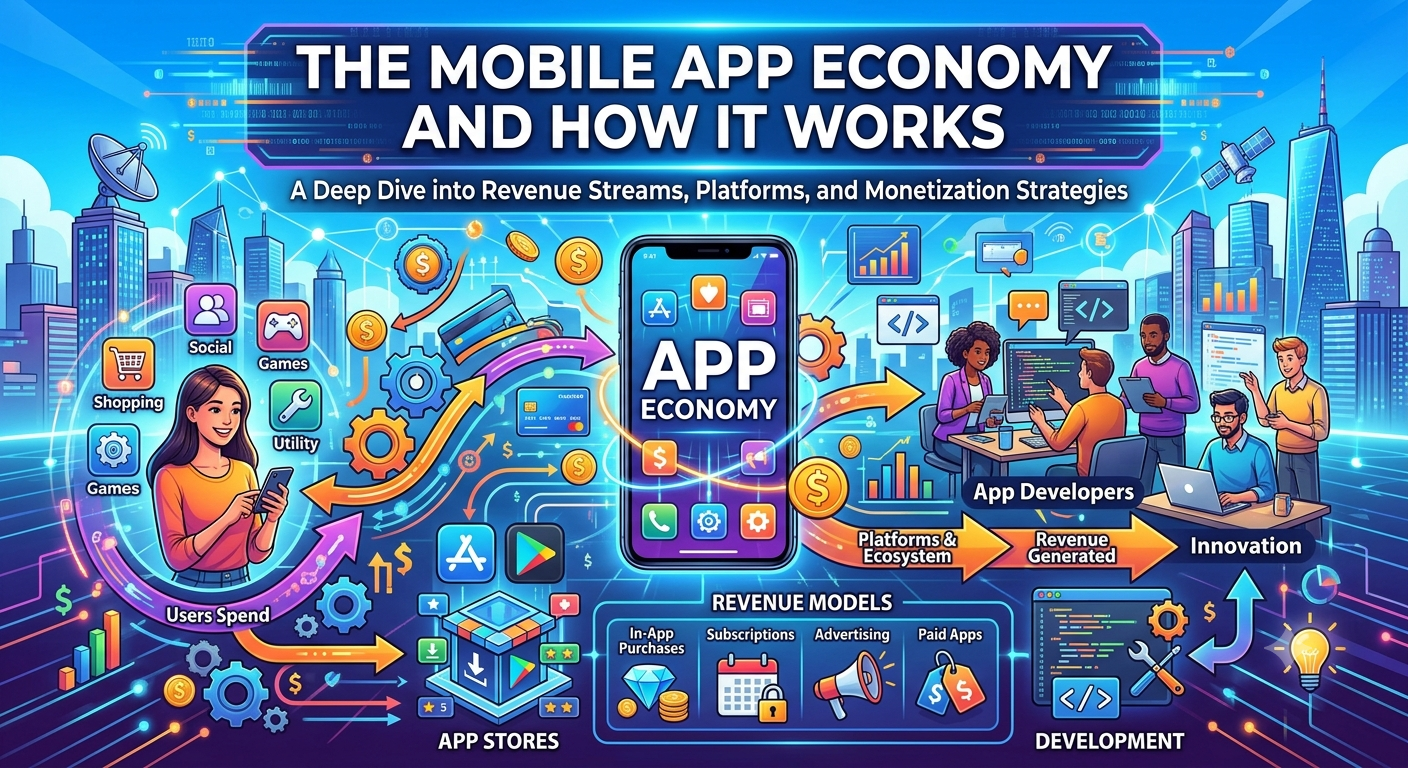
The mobile app economy is a strange beast. It is simultaneously a gold rush and a graveyard, a place where teenagers become millionaires overnight and where seasoned engineers burn through their savings building products nobody downloads. Understanding this business requires looking past the headlines and into the mechanics of how money actually moves in the app stores, because the economics of mobile are not intuitive and the path from code to cash is rarely a straight line.
At its core, the mobile app business is a distribution business more than it is a software business. The App Store and Google Play are not merely storefronts; they are algorithms, recommendation engines, and social proof systems rolled into one. When a user opens the store and searches for a solution to their problem, they are not evaluating your codebase or your architecture decisions. They are looking at your icon, your screenshots, your star rating, and your review count. This means that the skills required to succeed are disproportionately weighted toward product marketing, user psychology, and conversion optimization rather than pure engineering prowess. The indie developer who treats the app store as a technical platform rather than a marketplace is already at a disadvantage.
The revenue models that actually work for independent developers have narrowed over time. The freemium model dominates the landscape for a reason: it lowers the barrier to entry to zero, which is critical when users have millions of alternatives and attention spans measured in seconds. A free app with a compelling in-app purchase or subscription offer allows the product to speak for itself before asking for money. The challenge is designing the free experience to be genuinely valuable while creating enough friction or desire to convert a meaningful percentage of users to paid. This is where the art lives. Too generous, and you starve. Too restrictive, and you annoy users into uninstalling. The subscription model, in particular, has become the holy grail because it provides predictable recurring revenue, but it also raises user expectations. A one-time purchase app can be abandoned after launch; a subscription app requires ongoing development, customer support, and feature updates. The indie developer must be honest about whether they want to run a product or a project.
Advertising remains a viable path, though it demands scale. The economics are brutal: unless you are serving millions of impressions, the revenue from banner ads or interstitials will not pay rent. The successful ad-supported indie apps tend to be utilities or games with extremely high session frequency—calculators, weather apps, casual puzzle games—where even a few cents per user per day compounds across a large audience. The trade-off is user experience. Every ad is a small friction point, and in a market where alternatives are a tap away, excessive monetization can accelerate churn. Smart indie developers treat ads as a secondary revenue stream rather than a primary one, or they offer ad removal as an in-app purchase to capture both segments of users.
The paid app model is not dead, but it has become a niche strategy. There are still categories where users expect to pay upfront—professional tools, niche utilities, premium games—but the discoverability challenge is severe. The app store algorithms favor engagement metrics, and a paid app starts with zero downloads, which means zero engagement data, which means less visibility. The developers who make this work typically bring their own audience from elsewhere: a popular blog, a YouTube channel, a Twitter following. The app store becomes the transaction layer, not the discovery layer. For the indie developer without an existing platform, going paid upfront is often a fast path to obscurity.
The real cost of app development is not the initial build; it is the ongoing maintenance. Operating systems update annually, sometimes breaking existing functionality. Third-party services deprecate APIs. User expectations evolve. A solitaire game built in 2019 might still function, but if it has not been updated to support the latest screen sizes, privacy permissions, or OS features, it will look abandoned and reviews will reflect that. The indie developer must budget not just for the launch but for the long tail of updates, bug fixes, and customer support. This is why many successful indie developers eventually narrow their portfolio to a handful of apps rather than maintaining a sprawling catalog. Focus is a survival strategy.
Customer acquisition is the silent killer of indie app businesses. The app stores are saturated. There were over two million apps on the App Store the last time anyone counted, and that number grows daily. Organic discovery through search is possible but competitive, and the keywords that matter are often dominated by well-funded companies with dedicated app store optimization teams. Paid user acquisition through Apple Search Ads or Google App campaigns can work, but the cost per install frequently exceeds the lifetime value of a user, especially for apps with low price points or weak monetization funnels. The indie developers who thrive tend to acquire users outside the store—through content marketing, community building, or solving problems that people are already searching for on Google. An app that answers a specific, high-intent query has a natural acquisition channel that does not depend on the store’s capricious algorithms.
The most sustainable indie app businesses often look unglamorous from the outside. They are not the next social network or the revolutionary AI assistant. They are PDF converters that handle one edge case better than the competition. They are habit trackers with a particular aesthetic that resonates with a subculture. They are calculator apps for a specific profession. The common thread is that they solve a real problem for a definable group of people who are willing to pay for that solution. The indie developer who starts with a problem rather than a technology stack has already improved their odds. The code is the easy part. Understanding who will use it, why they will pay, and how they will find it is the business.
There is also a temporal reality to consider. The mobile app gold rush of the early 2010s, when a decent app could gain traction through novelty alone, is over. The market has matured. Users are more sophisticated, competition is fiercer, and the platforms themselves have consolidated power. But maturity also means stability. The app economy is no longer a speculative frenzy; it is a real industry with real customers spending real money. For the indie developer willing to treat it as a business—researching the market, validating demand, iterating based on feedback, and persisting through the long plateau between launch and traction—there is still money to be made. It is just harder to find and slower to accumulate than the success stories suggest.
The final truth is that most indie developers do not make meaningful money from their first app, or their second. They make it from their fifth or tenth, after they have learned what the market actually wants, how to read analytics without vanity metrics, and how to build a product that improves incrementally rather than collapsing under the weight of its own ambition. The business of mobile apps rewards patience, pragmatism, and a willingness to treat code as a means to an end rather than the end itself.