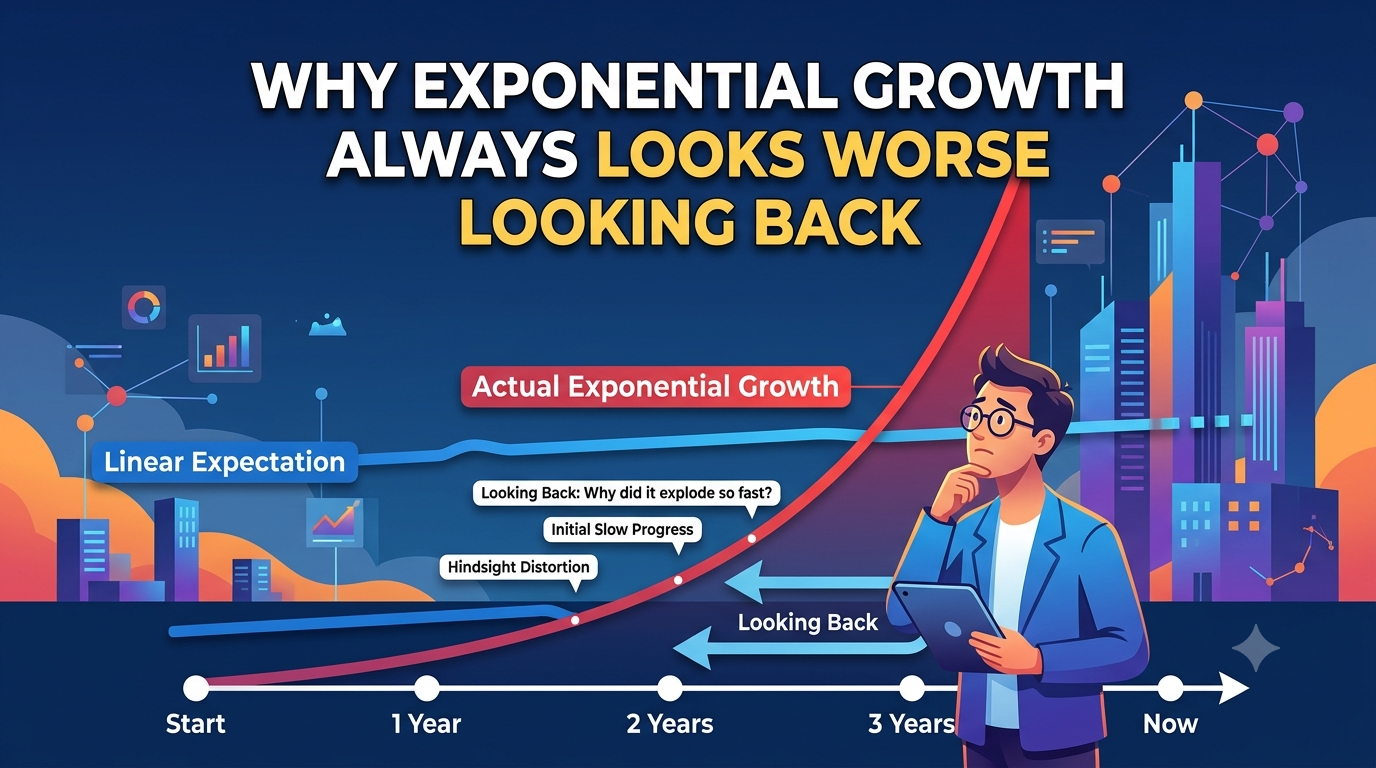
There is a peculiar trick that exponential growth plays on the human mind, and almost nobody talks about it. When you are living through a period of rapid compounding, whether in a business, a technology, a savings account, or an epidemic, the recent past always looks catastrophically worse than the distant past. Not because things got worse. Because of the mathematics of how exponential curves are shaped.
Here is the core of it. In exponential growth, the most recent period always accounts for a disproportionately large share of all the change that has ever occurred. If something doubles every year and you have been watching it for ten years, more than half of everything that ever happened happened in the last year alone. More than three quarters of it happened in the last two years. The entire first eight years of history look, from today’s vantage point, like almost nothing at all.This means that whenever you look backward from any point on an exponential curve, the view is inherently distorted. The recent past looks turbulent, overwhelming, almost out of control. The distant past looks placid and stable. But the distant past was not more stable. It was just smaller. The rate of change, the percentage growth, was identical throughout. What changed was the base it was growing from.Think about what this does to perception. Imagine you are running a company that has grown twenty percent per year for fifteen years. In year one, twenty percent growth meant a handful of new customers. Nobody panicked. Nobody called it unsustainable. In year fifteen, twenty percent growth means thousands of new customers, a hiring surge, an operations scramble, exploding infrastructure costs. Looking back, you might tell yourself that things used to be calmer, more manageable, more human-scale. They were not. The rate was the same. You were just further down the curve, where the absolute numbers are larger and therefore more viscerally felt.
The same illusion shows up in technology adoption. The first decade of the internet looks, in retrospect, like a gentle experiment. A few million people getting online, some quirky websites, a mild disruption here and there. The last decade looks like civilization-scale upheaval. But the percentage growth rates in the early period were often higher than they are now. The early internet was doubling and tripling every year. The reason it felt small was that it was small in absolute terms. The reason it feels large now is not that growth accelerated. It is that the base grew large enough for the absolute numbers to become staggering.
This matters enormously for how we make decisions and tell stories. When we look back at a period of exponential growth and ask “when did things start going crazy?”, our intuitive answer is almost always “recently.” But that answer is an artifact of the math, not a reflection of reality. Things did not start going crazy recently. The rate was the same the whole time. We are just standing at the point on the curve where the absolute scale has finally become impossible to ignore.There is a related trap that forecasters fall into constantly. When projecting forward from an exponential trend, people tend to underestimate what will happen in the long run and overestimate the drama of what just happened. The last period feels extraordinary because the absolute change was large. The future feels uncertain because the absolute scale of potential change is almost unimaginable. Both feelings are correct in a literal sense, but neither is evidence that the underlying rate of change is itself unusual. The curve is just doing what it has always done.
The rearview mirror problem also shapes how we assign blame and credit. Entrepreneurs who built something in the early, small phase of an exponential often get less credit than they deserve, because the absolute numbers from that era look modest now. Leaders who happened to be in charge during a later phase get more attention, because the absolute scale of activity on their watch was larger, even if the growth rate was identical or even slower. History written from the top of an exponential curve systematically underweights the work done near the bottom of it.
None of this means exponential growth is not real, or not sometimes worrying, or not sometimes worth slowing down. It means that our intuitions about when things changed, why they feel different, and whether something recently went wrong are systematically unreliable when the underlying process is exponential. The feeling that things are moving faster than ever is, at almost every point in an exponential process, mathematically guaranteed to be true in absolute terms and irrelevant in proportional terms.
The honest way to look at an exponential process is on a logarithmic scale, where equal distances represent equal percentage changes. On a log scale, a straight line means constant growth. Acceleration looks like an upward curve. Deceleration looks like a curve bending down. If you plot almost any major exponential trend on a log scale, you find that the line is surprisingly straight over very long periods of time. The chaos of recent years often turns out to be indistinguishable from the placidity of decades past, at least in proportional terms.
This is not a comforting thought so much as a clarifying one. It does not tell you whether the growth is good or bad, sustainable or not. It simply corrects for the optical illusion built into the shape of the curve. Looking back down an exponential is always going to feel vertiginous. The slope away from you is steep, the recent changes are large, the past seems almost impossibly distant and small. But you would have felt exactly the same way standing at any earlier point on the same curve. The rearview mirror on an exponential does not show you the road you actually traveled. It magnifies what is near and miniaturizes what is far, and if you forget that, you will keep mistaking perspective for history.