Posted on

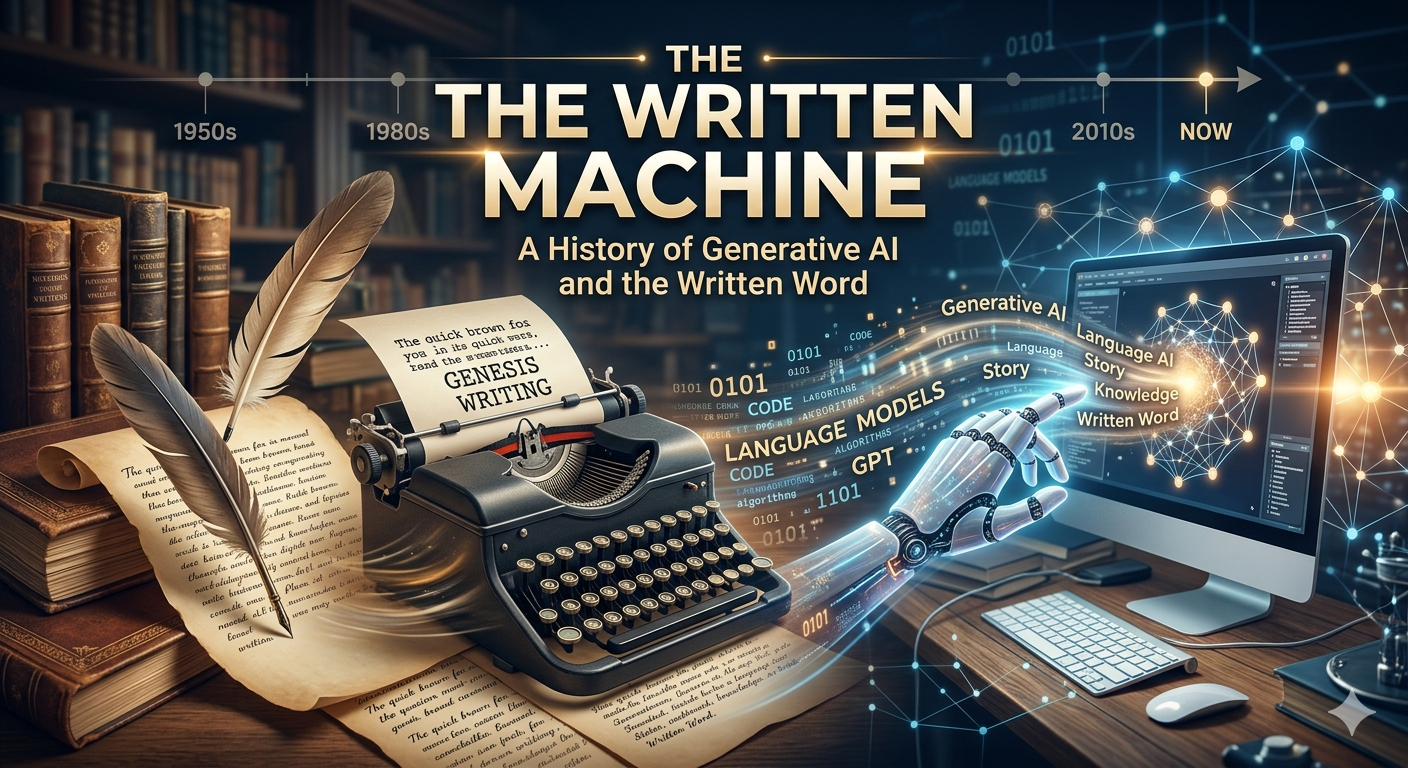
The Written Machine: A History of Generative AI and the Written Word

There is something particularly unsettling about a machine that writes. Images can be dismissed as imitation, video as manipulation, but language is the medium through which humans think, argue, grieve, and govern. When a machine begins to produce fluent, persuasive, emotionally resonant prose, it touches something closer to the center of what we believe makes us human. The history of how that happened is long, strange, and far from over.

Before the Revolution: Rules, Logic, and Early Attempts

The ambition to make machines produce language is almost as old as computing itself. Alan Turing, in his landmark 1950 paper “Computing Machinery and Intelligence,” proposed what became known as the Turing Test: a machine that could sustain a written conversation indistinguishable from a human’s could, he argued, be considered intelligent. That framing — language as the ultimate benchmark of machine cognition — shaped decades of research that followed.

The first generation of language-generating systems were rule-based. ELIZA, created at MIT by Joseph Weizenbaum between 1964 and 1966, was perhaps the earliest program to produce conversational text. It worked by pattern matching: recognizing phrases in the user’s input and responding according to scripted templates. ELIZA’s most famous persona, DOCTOR, simulated a Rogerian psychotherapist by reflecting questions back to the user. It was, in a technical sense, hollow — it understood nothing, believed nothing, meant nothing. And yet people formed emotional attachments to it. Weizenbaum was disturbed by how readily his colleagues confided in a program they knew to be a script. He spent the rest of his career warning about the dangers of anthropomorphizing machines.

ELIZA was followed by SHRDLU, developed by Terry Winograd at MIT in 1970, which could engage in natural language dialogue about a simulated world of colored blocks. It was genuinely impressive in its narrow domain and deeply brittle outside it. Throughout the 1970s and 1980s, researchers in the field then called Natural Language Processing, or NLP, worked on hand-crafted rules, parse trees, and semantic networks — elaborate attempts to encode human linguistic knowledge directly into software. Progress was real but slow, and the systems remained fragile, expensive to build, and impossible to scale.

The 1980s and early 1990s also saw the first experiments with statistical approaches to language. Instead of writing rules, researchers began asking whether a system could learn patterns from large bodies of text. N-gram models — which predicted the next word based on the probability distributions of preceding words — became workhorses of machine translation and speech recognition. They were modest tools, but they introduced a crucial idea: that language could be modeled statistically without anyone needing to understand it.

The Neural Turn and the Rise of Word Embeddings

The same deep learning revolution that transformed computer vision in 2012 eventually reshaped NLP as well, though the timelines overlapped and tangled in complex ways. A critical early development was the introduction of word embeddings — mathematical representations of words as vectors in high-dimensional space, positioned so that words with similar meanings clustered near each other. Google’s Word2Vec, released in 2013, made the technique widely accessible and produced results that surprised even its creators. The model learned, without any explicit instruction, that “king” minus “man” plus “woman” equaled something close to “queen.” Meaning, it seemed, had geometric structure.

Embeddings solved a fundamental problem. Earlier systems had treated words as arbitrary symbols with no relationship to each other. Embeddings gave neural networks a way to reason about semantic similarity, analogy, and context. They became the foundation on which more ambitious architectures would be built.

Recurrent neural networks, or RNNs, became the dominant architecture for language tasks through the mid-2010s. Unlike feedforward networks, RNNs had a form of memory — they processed sequences one element at a time, carrying forward a hidden state that encoded what had come before. Long Short-Term Memory networks, or LSTMs, introduced by Sepp Hochreiter and Jürgen Schmidhuber in 1997 but not widely used until the 2010s, addressed the problem of vanishing gradients that had made earlier recurrent networks hard to train. With LSTMs, systems could finally maintain context across reasonably long passages of text.

The results were striking. Google’s neural machine translation system, launched in 2016, dramatically outperformed the statistical phrase-based systems it replaced. Sentiment analysis, named entity recognition, text summarization — task after task saw step-change improvements as recurrent neural architectures were applied with sufficient data and compute. But RNNs had a fundamental limitation: they processed text sequentially, one word at a time, which made them slow to train and prone to forgetting information from early in a long sequence.

Attention Is All You Need: The Transformer Revolution

In June 2017, a team of researchers at Google Brain published a paper with a title that read almost like a manifesto: “Attention Is All You Need.” The architecture they proposed — the transformer — did not process text sequentially. Instead, it used a mechanism called self-attention to weigh the relationship between every word in a sequence simultaneously, allowing the model to consider context from anywhere in a passage at once, regardless of distance. The effect on training speed and model quality was dramatic.

The transformer was not immediately understood as the revolution it was. Its initial application was machine translation, where it set new benchmarks. But its full implications became clear in 2018, when Google introduced BERT — Bidirectional Encoder Representations from Transformers — and OpenAI introduced GPT-1. These were the first large pretrained language models: systems trained on enormous corpora of text to develop a general understanding of language, which could then be fine-tuned for specific tasks. The pretraining paradigm was a conceptual leap. Rather than building a system for each task from scratch, researchers could now train a single massive model on the general structure of language and adapt it cheaply and quickly.

BERT’s bidirectional architecture made it particularly effective at understanding tasks — reading comprehension, question answering, classification. GPT-1’s unidirectional, generative architecture made it effective at producing text. The two approaches represented a fork in the road that the field has been navigating ever since.GPT-2, GPT-3, and the Arrival of Emergent FluencyIn February 2019, OpenAI released GPT-2, a model with 1.5 billion parameters trained on eight million web pages. Its outputs were unlike anything a language model had produced before: coherent, stylistically varied, contextually aware across paragraphs. OpenAI made the unusual decision to release the model in stages, citing concerns about potential misuse — a decision that drew both praise and mockery but, more importantly, introduced the public to the idea that language models might be genuinely dangerous.

GPT-2 could write news articles, short stories, and technical explanations. It could sustain a fictional scenario across multiple paragraphs, adjust its register from formal to casual, and produce text that, in short samples, was indistinguishable from human writing. It also hallucinated freely — confabulating facts with the same fluency it brought to accurate statements. This combination of capability and unreliability would define the public perception of language models for years.

Then came GPT-3 in June 2020, and the scale of ambition became impossible to ignore. With 175 billion parameters — more than two orders of magnitude larger than GPT-2 — it demonstrated something researchers called in-context learning. Without any fine-tuning, a user could provide GPT-3 with a few examples of a task in the prompt itself, and the model would generalize from them. Few-shot learning, they called it, and it suggested that raw scale was unlocking capabilities that had not been explicitly trained for. The philosophical implications were queasy and contested: was the model reasoning? Generalizing? Or performing an extraordinarily sophisticated form of pattern completion?

GPT-3’s API, released to developers, spawned an ecosystem of applications almost overnight. Copywriting tools, code assistants, email drafters, summarizers, tutoring systems, game dialogue generators — the range of use cases reflected just how universal language is as a medium. For the first time, a general-purpose language model was a commercially viable product, not just a research artifact.The Instruction-Following Breakthrough and the ChatGPT MomentLarge language models trained purely on next-token prediction were powerful but often frustrating to use. They continued text rather than following instructions, producing completions rather than answers. The alignment research community had been working on this problem for years, and the solution that emerged — Reinforcement Learning from Human Feedback, or RLHF — proved transformative.The technique involved training a separate model to predict human preferences between pairs of model outputs, then using that preference model as a reward signal to fine-tune the language model via reinforcement learning. The result was a system that behaved more like an assistant and less like an autocomplete engine. InstructGPT, published by OpenAI in early 2022, demonstrated the approach, and the paper noted something counterintuitive: the instruction-following model was rated as more helpful than a much larger model trained only on next-token prediction.

ChatGPT launched in November 2022 and became the fastest-growing consumer application in history, reaching one hundred million users in two months. What had been understood by researchers and developers for years suddenly became viscerally real to the general public: a machine could hold a conversation, answer questions, write essays, debug code, draft legal memos, compose poetry, and tutor students in calculus, all within a single interface and at no cost. The experience was qualitatively different from anything that had come before — not because the underlying science was entirely new, but because the usability and accessibility had crossed a threshold.

The months that followed were a competitive frenzy. Google rushed to announce Bard, its own conversational AI, in February 2023 — a launch widely regarded as hasty and marred by a factual error in the demonstration. Meta released LLaMA, an open-weight model that immediately became the basis for dozens of community fine-tuned variants. Anthropic, founded by former OpenAI researchers, released Claude. Mistral, a French startup, released surprisingly capable smaller models that ran efficiently on consumer hardware. The field had gone, in the space of about eighteen months, from a specialist research domain to one of the most intensely competitive technology markets in the world.

The Multimodal and Agentic Turn

The history of written AI does not end with text. From 2023 onward, the most significant developments have involved breaking down the walls between modalities. GPT-4, released in March 2023, could accept both text and images as input. Google’s Gemini models were designed from the ground up to reason across text, images, audio, and video. The separation between “language models” and “vision models” began to dissolve.

Equally significant has been the move toward agentic applications — systems that do not simply respond to a single prompt but pursue goals across multiple steps, using tools, browsing the web, writing and executing code, and coordinating with other AI systems. The practical implications range from automated research assistants to software engineering agents to systems that can manage complex workflows with minimal human supervision. The risks — loss of human oversight, compounding errors, manipulation by adversarial inputs — have become a central concern of AI safety research.

The question of what these systems actually are, philosophically, has not gone away. Each new capability has renewed debates about understanding versus pattern-matching, about whether scale alone can produce something approaching cognition, about what it means for a system to know something versus to produce text that sounds like knowing. These are not merely academic questions. They have direct implications for how much we trust these systems, how we deploy them, and what accountability we expect when they fail.

What Bloggers and Writers Should Be Watching For

The history of written AI is inseparable from the history of labor, trust, and the economics of knowledge. For writers and commentators trying to stay ahead of the curve, several developments deserve sustained, rigorous attention.

The question of synthetic text and epistemic trust is arguably the defining challenge of the coming decade. Search engines, social media platforms, and news aggregators are already contending with the problem of AI-generated content at scale — content that may be accurate, inaccurate, or deliberately misleading, and that is increasingly difficult to distinguish from human-authored text. The downstream effects on public knowledge, scientific communication, and democratic deliberation are not hypothetical. They are unfolding now, and the frameworks for addressing them are nascent at best.

The economics of writing as a profession deserve close and unsentimental examination. Journalism, technical writing, marketing copywriting, academic writing support, translation — each of these fields is experiencing AI-driven disruption at a different pace and with different characteristics. Blanket narratives about job destruction miss the specificity that makes this story important. Who is losing work, and who is gaining leverage? Which tasks are being automated, and which skills are becoming more valuable? These questions require granular reporting, not generalization.

The regulation of AI-generated text is arriving, but unevenly. Several jurisdictions now require disclosure when AI generates content in certain contexts — political advertising, academic work, journalism. The enforcement mechanisms are largely absent, and the definitions are contested. Bloggers covering policy, law, or technology should treat the gap between disclosure requirements and disclosure reality as a permanent beat.The progress of smaller and more efficient models is a story that often gets lost beneath the headlines about frontier systems. Researchers at universities, national laboratories, and smaller companies have demonstrated that models a fraction of the size of GPT-4 can match or exceed its performance on specific tasks when carefully fine-tuned on high-quality data. This has profound implications for who can build and deploy AI systems, and for the concentration of power in the industry.

Finally, the question of what these models are actually doing — whether they reason, whether they understand, whether they are in any meaningful sense intelligent — remains genuinely open. The science of interpretability, which tries to understand the internal representations and computations of large language models, is one of the most intellectually rich and practically important fields in AI research. Its findings will shape not just our technical understanding but our moral and legal frameworks for these systems. Any writer serious about covering AI should have interpretability research on their reading list.

The Word, Rewritten

From ELIZA’s scripted reflections to a transformer generating a legal brief indistinguishable from a lawyer’s draft, the arc of written AI is a story about what language is and what it is for. It is a story about the relationship between pattern and meaning, between statistical regularity and genuine comprehension. It is also, inescapably, a story about power — about who controls the systems that shape how information is produced, distributed, and trusted.

The machines have learned to write. The harder question, the one that will occupy researchers, writers, policymakers, and philosophers for a long time to come, is what we do with that fact.


Posted on

From Pixels to Possibility: The History of Generative AI in Image and Video Creation

There is a moment, familiar to anyone who has typed a prompt into Midjourney or watched a Sora-generated clip, when the strangeness of what just happened quietly settles in. A machine looked at words and produced a picture. A system watched millions of hours of footage and learned to dream in moving images. What feels like a sudden miracle is, in fact, the result of decades of incremental, often tedious scientific labor. To understand where generative AI is going, it helps enormously to understand how it got here.

The Early Foundations: Teaching Machines to See

The story does not begin with chatbots or viral art generators. It begins in the 1950s and 60s, when researchers first asked whether a machine could learn to recognize patterns the way a human brain does. Early neural networks — crude, slow, and hungry for computing power that didn’t yet exist — laid a theoretical groundwork that would take another half-century to bear fruit.The critical turning point came in 2012, when a deep learning model called AlexNet stunned the computer vision community by dramatically outperforming every other system on the ImageNet challenge, a large-scale image recognition benchmark. AlexNet didn’t generate images; it classified them. But the architecture it used — deep convolutional neural networks running on graphics processing units — became the engine that would eventually power the generative revolution. The research community suddenly understood that given enough data and enough compute, neural networks could do something that looked, from the outside, a great deal like understanding.

GANs and the Birth of Synthetic Imagery

The first genuine breakthrough in AI image generation came in 2014, when Ian Goodfellow, then a PhD student at the University of Montreal, introduced the Generative Adversarial Network, or GAN. The concept was elegant and adversarial by design. Two neural networks were pitted against each other: a generator that tried to create convincing fake images, and a discriminator that tried to catch them. As they competed, both improved. The generator got better at fooling the discriminator; the discriminator got better at spotting fakes; and both, in their rivalry, pushed each other toward something remarkable.

Early GAN outputs were blurry and strange — ghostly faces that resembled no one, textures that almost looked like fabric or grass. But the trajectory was steep. By 2018, NVIDIA’s Progressive GAN was producing photorealistic faces of people who had never existed. In 2019, StyleGAN refined the approach further, allowing researchers to control specific features like age, hair color, and lighting. The website “This Person Does Not Exist” launched that year and became a cultural moment, confronting the public with the uncanny fact that synthetic human faces were now indistinguishable from real ones.

GANs were not limited to faces. Researchers applied them to artwork, fashion, architecture, and medical imaging. They were used to generate training data for autonomous vehicles, to restore damaged photographs, and to translate satellite imagery. The GAN era established a crucial precedent: generative AI was not a parlor trick. It was a serious tool with serious implications.Diffusion Models and the Creative ExplosionIf GANs were the first wave, diffusion models were the tsunami. The theoretical foundations for diffusion-based generation were laid in a 2015 paper by Jascha Sohl-Dickstein and colleagues, but the approach didn’t become practically powerful until around 2020 and 2021, when OpenAI’s DALL-E and then Google Brain’s research on diffusion processes demonstrated that a new paradigm was possible.

The core idea of diffusion is almost counterintuitive. Rather than learning to build an image from scratch, a diffusion model learns to reverse a process of destruction. During training, noise is gradually added to an image until it becomes pure static. The model learns to run that process backward — to start with noise and, step by step, remove it, revealing a coherent image. When combined with text descriptions, the model learns which direction to denoise toward in order to produce an image matching the words.

The results were transformative. In April 2022, OpenAI released DALL-E 2, and the world started paying attention in a new way. That summer, Stability AI released Stable Diffusion as an open-source model, democratizing image generation in a way that had not been possible before. Anyone with a consumer GPU could now generate detailed, stylized images from a text prompt. Midjourney launched around the same time and quickly built an enormous creative community.

The cultural shockwave was immediate. Artists debated questions of authorship and originality. Getty Images and a coalition of visual artists filed lawsuits over training data. The U.S. Copyright Office began issuing guidance on AI-generated works. Advertising agencies, book cover designers, game developers, and filmmakers all started reckoning with the new landscape. Within eighteen months of these releases, the question had shifted from “can AI make art?” to “what does art mean now?”

The Move to Video: A Far Harder Problem

Generating a single compelling image is difficult. Generating a video — a sequence of hundreds or thousands of frames that must be temporally consistent, physically plausible, and narratively coherent — is a problem of an entirely different order. A face can drift between frames. Objects can appear and disappear. Physics can break down in ways that are immediately obvious to human perception. The challenge of video generation pushed researchers to develop new architectures and new training strategies.

Early video generation systems in the 2018–2020 period produced short, low-resolution clips that quickly fell apart. They could sustain coherence for a second or two before descending into visual chaos. Models like VGAN and MoCoGAN made incremental progress, but nothing that looked genuinely usable.

The landscape shifted in 2023, as transformer-based architectures — the same class of models underlying large language models — were applied to video. Companies including Runway, Pika, and Meta released increasingly capable video generation tools. Runway’s Gen-2 model could take a text prompt or a source image and extend it into a few seconds of surprisingly coherent motion. The results were still imperfect: hands remained a persistent nightmare, objects morphed in unsettling ways, and anything involving fast motion tended to collapse. But the direction was unmistakable.

Then, in February 2024, OpenAI demonstrated Sora. The model could generate minute-long video clips from text prompts, with a command of lighting, camera movement, and physical continuity that the field had not seen before. A single clip showed a woman walking through a neon-lit Tokyo street, the reflections on wet pavement, the crowd moving around her, the whole scene holding together with something approaching cinematic coherence. Researchers and filmmakers alike recognized it as a genuine step change. Sora was not publicly released immediately, and questions about its training data and energy consumption multiplied even as the demonstrations dazzled. But the benchmark had been set.

The Infrastructure Beneath the Innovation

It would be a mistake to tell the history of generative AI purely as a story of clever algorithms. The hardware revolution is equally important. The GPU — originally designed to render video game graphics — turned out to be extraordinarily well-suited to the parallel matrix operations that neural networks require. NVIDIA’s CUDA platform, introduced in 2006, allowed researchers to write programs that ran on GPUs, and the company’s chips became the de facto infrastructure of modern AI.

The rise of cloud computing added another dimension. Amazon Web Services, Google Cloud, and Microsoft Azure made enormous computational resources available on demand, which meant that a researcher or a startup could train a large model without building a data center. The cost of training has fallen dramatically even as the scale of models has grown. This combination — better algorithms, better hardware, and accessible cloud infrastructure — explains why progress has felt so rapid.

Equally important is the role of data. Generative AI models are trained on staggering quantities of images, videos, and text scraped from the internet. LAION-5B, the dataset underlying many open-source image models, contains five billion image-text pairs. The ethical questions this raises — about consent, compensation, copyright, and representation — are among the most contested in the field and remain largely unresolved.What Bloggers Should Be Watching ForFor writers and commentators trying to make sense of what comes next, several threads deserve close attention.

The question of multimodal integration is perhaps the most significant near-term frontier. Models are already capable of understanding and generating text, images, audio, and video separately. The next development is tight, seamless integration — systems that can take a script, a reference photograph, a voice recording, and a musical style guide, and produce a finished short film. The pieces exist; the coherent integration is arriving fast.

Regulation is coming, and the details will matter enormously. The European Union’s AI Act, signed into law in 2024, is the most comprehensive legal framework so far, requiring transparency about AI-generated content and placing restrictions on high-risk applications. The United States has moved more cautiously, relying on executive orders and voluntary commitments from major labs. Bloggers should watch how enforcement actually unfolds — the distance between legislation and practice is often where the real story lives.

The question of synthetic media and trust is one that will only grow more urgent. Deepfakes — AI-generated videos that place real people in fabricated scenarios — have existed since the GAN era, but the quality and accessibility of the tools are improving rapidly. The 2024 election cycles in the United States, India, and several European countries all saw AI-generated media used in political contexts. Detection tools exist but consistently lag behind generation tools. The information ecosystem consequences of this gap are not yet fully understood, and any blogger covering media, politics, or technology should treat it as a continuing story.

The economics of creative labor deserve sustained scrutiny. Stock photography agencies have reported significant revenue declines since the generative image explosion of 2022. Illustrators, concept artists, and visual effects workers are navigating a market that has changed faster than any labor adaptation mechanism can keep pace with. The story is not simply “AI takes jobs” — it is a more complicated picture of shifting skill premiums, new workflows, and uneven distribution of both disruption and opportunity. Specific industries, from advertising to publishing to film, are experiencing these shifts differently, and the granular reporting has barely begun.

Finally, there is the question of energy and environmental cost. Training a large generative model consumes electricity at a scale comparable to the annual energy consumption of a small country. As these models proliferate and inference costs accumulate across billions of queries, the carbon arithmetic becomes increasingly difficult to ignore. Researchers are working on more efficient architectures, and some labs have made commitments to renewable energy. Whether those commitments are substantive or performative is a question worth asking with rigor and regularity.

A Moment Still in Motion

Generative AI in image and video creation is not a story with a conclusion. It is a story in the middle of its most consequential chapter. The tools being built today will reshape visual communication, entertainment, journalism, education, and advertising in ways that are not yet fully imaginable. The history reviewed here — from AlexNet to GANs to diffusion models to Sora — is the foundation of something larger still to come.

The most useful posture for anyone writing about this space is neither breathless enthusiasm nor reflexive alarm. It is attentive curiosity: watching what is actually being built, who is building it, who benefits, who is harmed, and what values are being encoded into systems that will soon help shape what billions of people see and believe. The pixels are just the beginning.

Posted on

The Long Game: Why the Ability to Wait May Be the Most Important Skill You’ll Ever Develop

There is a particular kind of person who, when handed a marshmallow, eats it immediately. And there is another kind of person who stares at that marshmallow for fifteen agonizing minutes and does not eat it, because they were told a second one is coming if they can hold out. In the late 1960s, psychologist Walter Mischel ran exactly this experiment at Stanford University’s Bing Nursery School, and what he found — or rather, what he discovered when he tracked those same children into adulthood — quietly upended how we think about human potential.

The children who waited for the second marshmallow turned out, decades later, to have higher SAT scores, lower rates of substance abuse, better health outcomes, and more stable careers than those who didn’t. It was not intelligence that separated them, not family wealth, not access to opportunity. It was the capacity to defer a reward in the present for a larger benefit in the future. In other words, it was patience with a purpose.

The Seduction of Now

We live inside a culture engineered to destroy delayed gratification. Every feed, every notification, every one-click purchase is designed to collapse the distance between wanting something and having it. The dopamine economy — the vast infrastructure of apps, platforms, and algorithms built to provide instant reward — has made immediate satisfaction not just available but expected. We are conditioned, at a neurological level, to feel that waiting is a kind of failure.

But here is the quiet truth that sits behind every meaningful achievement: almost nothing worth having arrives quickly. A strong body is built in the gym over years, not weeks. A genuinely valuable skill — whether it is playing an instrument, writing well, or understanding the mechanics of a business — compounds slowly and then suddenly. A deep relationship is constructed through thousands of ordinary moments that feel, in isolation, unremarkable. The payoff for all of it is real, but it refuses to come on demand.

Delayed gratification is not, at its core, about willpower in the way we typically imagine it — the white-knuckled suppression of desire. It is really about the ability to hold two time frames in mind simultaneously: the discomfort of the present moment and the vivid, credible reality of a future reward. The people who are best at waiting are not necessarily the ones with the most self-discipline. They are the ones who can most clearly see what they are waiting for.

Trust as the Hidden Variable

One of the more sobering findings to emerge from follow-up research on the marshmallow experiment was that a child’s ability to wait was heavily influenced by how reliable their environment was. Children who had been let down by adults before — who had been promised things that never arrived — were far less likely to wait for the second marshmallow. Why would they? Their experience had taught them that the future is uncertain, that promises are hollow, and that the bird in hand is always worth more than the two in the bush.

This reframes the entire conversation about delayed gratification. It is not purely a matter of character or willpower. It is also a matter of earned trust — trust in the world, trust in institutions, trust in one’s own ability to persist and follow through. People who have built a track record of keeping their own promises to themselves, who have watched their past patience pay off, find it progressively easier to wait. Each successful act of deferred reward strengthens the neural architecture of future patience.This is why so much advice about building better habits begins with starting small. It is not because small habits are inherently valuable. It is because completing them teaches the nervous system a crucial lesson: the future arrives, and when it does, the investment was worth it.

What Success Actually Requires

It is worth being careful about what we mean by success, because the word has been colonized by a narrow set of images — the corner office, the seven-figure income, the viral moment of recognition. But success in any domain that genuinely matters almost always involves a long period of invisibility, of doing the work before there is any external evidence that the work is paying off.

The novelist writes hundreds of pages that will never be published. The scientist pursues a line of inquiry for years before a result crystallizes. The entrepreneur builds and rebuilds a product in relative obscurity before finding product-market fit. The athlete trains through seasons that produce no trophies. In every case, the question that separates those who eventually break through from those who abandon the path is the same: can you sustain effort when the reward is not yet visible?

This is where delayed gratification reveals its deepest connection to success. It is not simply the ability to resist eating a marshmallow. It is the ability to believe in a future that has not yet announced itself. It is working on a Tuesday afternoon with the same focus you would bring if the cameras were rolling, because you understand that the camera-ready moments are built on the camera-off ones.

The Compounding Nature of Patience

One of the most underappreciated aspects of delayed gratification is how it interacts with compounding — that mathematical magic by which small, consistent inputs produce disproportionately large outputs over time. Warren Buffett, who built one of the greatest fortunes in modern history almost entirely through the patient holding of investments, has said that he could have had more fun along the way. What he means is that compounding demands time above all else. The returns are not linear. They accelerate. But only if you stay in the game long enough to let them.

This principle extends far beyond finance. A writer who produces one page a day will have written a novel in a year. A person who exercises moderately three times a week will have a fundamentally different body in two years. A professional who invests an hour each evening into a new skill will be genuinely expert in five years. None of these outcomes feel particularly dramatic in any single moment. They feel almost boring. But the accumulation of boring, consistent effort, made possible by the willingness to delay the gratification of doing something more immediately rewarding, is precisely what produces remarkable results.

The tragedy is that most people give up during what author Seth Godin calls “the dip” — the long, unglamorous middle section of any meaningful endeavor, where the initial excitement has faded and the ultimate payoff is not yet in sight. The people who emerge on the other side of the dip are not always the most talented. They are most often the ones who could tolerate the most sustained discomfort without abandoning their position.

Learning to Wait Better

If patience with a purpose is a skill, then it can be practiced and developed. The research on this is actually quite encouraging. Unlike IQ, which resists direct intervention, the capacity for delayed gratification appears to be genuinely trainable.

The most effective strategies share a common feature: they change the relationship between the person and the waiting, rather than simply demanding more willpower. Creating systems that remove the need to make repeated in-the-moment decisions — automating savings, setting fixed hours for deep work, removing temptations from the immediate environment — reduces the cognitive load of waiting. So does reframing the waiting itself, understanding that the discipline is not a cost but a form of identity, evidence of the kind of person you are becoming.

Perhaps most powerfully, there is the practice of getting very specific about what you are waiting for. Vague future rewards are easy to abandon. Vivid, concrete, emotionally resonant ones are not. The person who knows exactly what their patience is building — the specific version of the life they are working toward — is the one who can tolerate the most sustained discomfort in the present.

The Marshmallow, Revisited

Mischel himself, in his later years, was somewhat ambivalent about the way his experiment had been popularized. He worried that it had been used to suggest that patience was a fixed trait — something you either had or did not — when his own view was more nuanced and more hopeful. The capacity to delay gratification, he believed, was deeply contextual, responsive to environment, teachable, and changeable across a lifetime.

What does seem durable in his findings is the basic relationship: the ability to hold a future vision clearly enough, and to trust it fully enough, that you are willing to endure present discomfort on its behalf — this ability is among the most reliable predictors of a life well-built. Not because waiting is virtuous in itself, but because almost everything worth building takes longer than we initially expect, and the people who succeed are simply the ones who stay.

Eat the marshmallow if you must. But know what you are trading.

Posted on

10 Books on Copywriting Every Entrepreneur Should Read

Words sell. Before the product, before the pitch deck, before the launch — there is language. The entrepreneur who understands copywriting holds an asymmetric advantage: they can communicate value, earn trust, and move people to act without a full marketing team or an agency retainer. The ten books below represent some of the most useful thinking ever committed to paper on the subject of persuasive writing. Read them in any order. But read them.

1. The Adweek Copywriting Handbook by Joseph Sugarman

Joe Sugarman made millions selling sunglasses and gadgets through mail-order ads, and this book is the distillation of everything he learned. His central insight — that every element of an ad has one job, which is to get the reader to read the next sentence — reframes copywriting as a system of momentum rather than a collection of clever lines. Sugarman walks through psychological triggers, how to research a product until you find the “seeds of its own promotion,” and why the slippery slope of readability matters more than cleverness. For entrepreneurs writing their own sales pages, product descriptions, or email sequences, this is one of the most practical books available.

2. Ogilvy on Advertising by David Ogilvy

David Ogilvy built one of the most celebrated advertising agencies of the twentieth century, and this book reads like a long, candid conversation with a man who had strong opinions about almost everything. He championed research over intuition, headlines over body copy, and results over awards. His rules feel prescriptive at first — he insists, for example, that body copy should always be set in serif type — but underneath the prescriptions is something more valuable: a philosophy that advertising exists to sell, not to entertain. Entrepreneurs who read this book begin to see their own marketing differently, less as branding and more as a direct conversation with a specific person who needs a specific thing.

3. Breakthrough Advertising by Eugene Schwartz

This is the book that serious copywriters treat as a bible, partly because it went out of print for decades and commanded extraordinary prices secondhand. Schwartz’s core contribution is the concept of market sophistication and awareness — the idea that every prospect sits somewhere on a spectrum from completely unaware of their problem to fully aware of your solution, and that the copywriter’s job is to meet them exactly where they are. He argues, famously, that the copywriter does not create desire but channels it. For entrepreneurs trying to understand why some messaging resonates and some falls flat, this book provides a structural explanation rather than a stylistic one.

4. Ca$hvertising by Drew Eric Whitman

Where Schwartz is theoretical, Whitman is blunt. This book distills decades of consumer psychology research into a practical toolkit for writing ads that sell, and it wastes almost no time on philosophical detours. Whitman introduces the “Life Force 8,” a framework of primal human desires that drive nearly all purchasing decisions, and shows how to tap each one through specific copy techniques. The book is irreverent, direct, and occasionally overwrought in the way that books about direct-response advertising tend to be — but the underlying research is solid, and the examples are instructive. Entrepreneurs who walk away with just two or three of Whitman’s frameworks will find them useful in almost every piece of marketing they ever write.

5. The Copywriter’s Handbook by Robert W. Bly

Bob Bly has been writing copy professionally since the 1970s, and this handbook reflects a career’s worth of organized, methodical thinking about the craft. It covers everything from writing headlines and leads to structuring long-form sales letters, writing for digital formats, and working within the constraints of B2B marketing. Unlike books that focus on a single technique or philosophy, Bly’s handbook functions as a reliable reference — the kind of book you return to when you’re writing a specific type of piece and want to make sure you haven’t missed anything. For the entrepreneur who writes across multiple channels, its breadth is its strength.

6. Tested Advertising Methods by John Caples

Caples wrote what may be the most famous headline in advertising history — “They Laughed When I Sat Down at the Piano, But When I Started to Play!” — and this book explains the thinking behind it. First published in 1932 and updated several times since, it remains relevant because Caples based everything on testing. He didn’t theorize about what headlines worked; he ran the ads and measured the results. The lessons that survived those tests have a durability that more intuitive advice lacks. This is a foundational text for anyone who wants to understand why self-interest consistently outperforms cleverness as a headline strategy, and why emotional specificity outperforms general claims.

7. Made to Stick by Chip Heath and Dan Heath

Not a copywriting book in the traditional sense, but arguably one of the most important books an entrepreneur can read about communication. The Heath brothers investigated why some ideas spread and others vanish, and they arrived at six principles — summarized by the acronym SUCCES — that make messages memorable: simplicity, unexpectedness, concreteness, credibility, emotion, and stories. The book is full of case studies drawn from public health campaigns, business strategy, and urban legend, and it forces readers to interrogate their own messaging against a set of clear standards. Entrepreneurs who absorb these principles write pitches, taglines, and launch emails that people remember and repeat.

8. Everybody Writes by Ann Handley

Ann Handley occupies a different corner of the copywriting world than Ogilvy or Caples — she writes from the context of content marketing and digital communication — but her advice is grounded in the same fundamentals. This book is, at its heart, a guide to developing a writing habit and a writing standard, which matters enormously for entrepreneurs who need to produce consistent, quality content across websites, newsletters, social media, and sales materials. Handley is particularly good on the relationship between clarity and credibility: readers trust writers who write clearly, and they distrust writers who hide behind jargon. Her framework for structuring web copy and blog posts is especially practical.

9. Building a Story

Brand by Donald Miller

Donald Miller’s central argument is that most businesses make the same mistake in their marketing: they position themselves as the hero of the story instead of the guide. Customers don’t want to hear about how great your company is — they want to see themselves as the protagonist who overcomes a problem, with your product as the tool that makes it possible. The StoryBrand framework gives entrepreneurs a structured way to rebuild their messaging around that dynamic, from website headlines to elevator pitches. Whether or not you adopt the full framework, the underlying insight about narrative positioning is one of the most clarifying ideas in modern marketing writing.

10. Hey Whipple, Squeeze This by Luke Sullivan

This book lives in the advertising creative tradition rather than direct-response, and it brings something the other nine books mostly lack: a sense of voice and wit. Sullivan spent decades at major agencies working on everything from small regional accounts to global campaigns, and his perspective on what makes great advertising great is filtered through genuine creative experience. He is skeptical of formulas without being dismissive of craft, and he makes a sustained argument that the best advertising respects the intelligence of its audience. For entrepreneurs who want their copy to be not just effective but genuinely good — writing they’d be proud of regardless of the conversion rate — this book is a welcome addition to the shelf.

Reading about copywriting is not the same as practicing it. These books will accelerate your thinking considerably, but the real skill develops at the keyboard, writing the same headline fifteen different ways, cutting the second paragraph because it’s really just the first paragraph said again, and learning to read your own work with the cold eye of someone who has no idea who you are and no reason yet to care. The best copywriters read constantly and write constantly. Start with one book. Then write something. Then read the next one.

Posted on

If It Ain’t Broke, Maybe Don’t Fix It

The quiet cost of optimizing what’s already workingThere’s a particular kind of ambition that gets rewarded in business: the drive to improve things. Streamline this. Automate that. Rebuild it from scratch with modern tooling. It’s energetic, it sounds forward-thinking, and it gets people promoted.But there’s a question that doesn’t get asked often enough before the consultants are hired and the project kickoff meeting is scheduled: Is this process actually causing a problem?

The Allure of “Optimization”

When a new leader joins a team, or a company adopts a new methodology, or a vendor pitches a platform upgrade, the instinct is to look for things to change. Change signals competence. Change is visible. Standing pat is harder to defend in a strategy deck.But this bias toward action creates real costs — costs that are easy to overlook because they don’t show up immediately, and because the damage is hard to attribute to the decision that caused it.

What You Risk When You Fix What Isn’t Broken

You disrupt institutional knowledge. Processes that have been running for years carry embedded wisdom. The quirky workaround your team uses isn’t arbitrary — someone built it in response to a real constraint, even if no one remembers the original reason. Replacing it without understanding it can mean quietly removing something that was quietly doing a lot of work.

You drain capacity. Any change initiative — even a well-managed one — costs time and focus. People need to be trained, workflows need to be tested, and edge cases need to be ironed out. When the old process was functional, that’s capacity spent not on growth, but on returning to a baseline you already had.You introduce new failure modes. Every new system has bugs, gaps, and unexpected interactions with other systems. An old process that’s been battle-tested has already had most of those found and fixed. A replacement, however theoretically superior, starts from zero.You erode trust and morale. Teams that are repeatedly asked to change how they work — without a compelling reason why — start to feel like they’re being managed by whim. The implicit message is that their judgment about what works can’t be trusted.

The Right Questions to Ask First

Before touching a process that’s running without obvious problems, it’s worth sitting with a few honest questions:What specific outcome are we trying to improve? If you can’t name a concrete metric or pain point, that’s a signal.

Who is experiencing friction, and how often? Anecdote is not the same as pattern.What’s the opportunity cost? What else could this team do with the time and energy a change initiative will consume?What could break? Mapping the risks of change is just as important as mapping the risks of staying put.Are we solving a real problem, or pursuing novelty? This one is uncomfortable to ask, but worth asking.

When Change Is the Right Call

None of this is an argument for ossification. Processes absolutely should be changed when they’re creating genuine friction, when they can’t scale, when they’re exposing the business to risk, or when a substantially better alternative exists and the transition costs are manageable.The point isn’t that change is bad. It’s that change has a cost, and that cost needs to be weighed against a real benefit — not a theoretical one.

A More Honest Standard

The phrase “best practice” is often used to justify change without doing the harder work of justifying it for your specific situation. What works brilliantly at a different company, in a different context, with different people, may not translate. And a process that already works in your context is evidence — actual evidence, not a pitch deck — that it belongs there.”If it ain’t broke, don’t fix it” isn’t a philosophy of complacency. It’s a philosophy of proportionality. It asks you to reserve your energy, your team’s capacity, and your organization’s risk tolerance for problems that are actually worth solving.

Sometimes the most sophisticated thing a leader can do is look at something that’s running well, and leave it alone.Have a business process question or a story about a “fix” that made things worse? The comments are open.

Posted on

The K-Shaped Economy: What It Means For Bloggers

There’s a term that economists started throwing around during the pandemic recovery that never quite made it into mainstream conversation the way it should have. The K-shaped economy doesn’t get the same airtime as inflation or interest rates, but for anyone trying to build an audience and earn a living online, it might be the single most important economic concept to understand right now.

So What Exactly Is a K-Shaped Economy?

A K-shaped recovery describes what happens when different segments of a population recover from an economic downturn at dramatically different rates. Instead of everyone rising together (a V-shaped recovery) or everyone staying flat (an L-shaped one), the economy splits into two distinct paths that diverge like the two arms of the letter K. The upper arm climbs upward. The lower arm slopes down.

The dividing line is rarely a single factor, but it tends to follow patterns of education, industry, and wealth. People working in knowledge-based sectors — technology, finance, professional services — often see their incomes and asset values rise even during turbulent periods. Meanwhile, workers in service industries, retail, hospitality, and manual labor find themselves on the descending arm, facing stagnant wages, job insecurity, or outright unemployment. The two groups share the same economic moment but experience it as if they’re living in parallel realities.

What makes the K-shape particularly insidious is that aggregate data can mask it entirely. When economists average out the gains at the top and the losses at the bottom, the resulting number can look like modest, stable growth. The headline figures seem fine. The reality underneath them is a society pulling apart at the seams.

The Two Audiences in the Room

For bloggers, the K-shaped economy isn’t just background noise. Every piece of content you create lands in front of readers who are living in one of those two economic realities. Understanding which arm of the K your audience occupies, and how that shapes their psychology, spending, and their relationship to your content, is fundamental to building anything sustainable.

Readers on the upper arm of the K are likely still spending. They’re booking travel, upgrading their home offices, investing in hobbies, and paying for premium subscriptions. They have disposable income and they have anxiety about maintaining their position. This creates an audience hungry for content about optimization, luxury, self-improvement, and status signaling, even if that last motivation is never stated directly.

Readers on the lower arm are in a completely different headspace. They’re cutting back, comparison shopping, hunting for value, and often feeling a quiet shame about their financial situation that no one in the media seems to be naming honestly. They want practical help. They want someone who takes their constraints seriously without condescending to them. They want to feel seen in a media landscape that often writes as though everyone has the budget and bandwidth of an upper-middle-class professional.

The mistake many bloggers make is writing for an imagined average reader who doesn’t actually exist. In a K-shaped economy, there is no average. There’s a bifurcation, and your content either resonates with one side or the other.

Monetization in a Polarized Economy

The K-shape complicates monetization in ways that aren’t immediately obvious. If your readers are primarily on the lower arm, affiliate commissions on premium products become a strange mismatch. Recommending a $400 kitchen appliance to an audience that’s worried about groceries doesn’t just fail commercially — it erodes trust. Readers notice when their favorite blogger seems to have quietly forgotten what life actually costs.

On the other side, if your content genuinely serves a more affluent readership, there’s often an opportunity to charge more for direct products and services than many bloggers assume. Premium memberships, high-ticket digital products, and consulting arrangements can work extremely well for an audience with real spending power and an appetite for expertise. The mistake here is underpricing out of a kind of reflex modesty that ignores who’s actually in the room.

Ad revenue is particularly volatile in a K-shaped environment. Advertisers are intensely aware of which consumer segments are actually converting, and media buyers increasingly concentrate their spend on content that reaches the ascending arm. If your audience skews toward people under financial pressure, you may find CPMs declining even as your traffic holds steady. The audience is there, but advertisers are less willing to pay to reach them.

The Authenticity Problem

There’s also a cultural tension that bloggers in this economy have to navigate carefully. Aspirational content has always been a cornerstone of publishing — people read about lives slightly better than their own because it’s motivating, entertaining, or just pleasantly escapist. But the K-shape has pushed the gap between aspiration and reality to a point where aspirational content can start to feel alienating, even hostile.When a lifestyle blogger casually mentions renovating their second bathroom while their audience is debating whether to renew a streaming subscription, the disconnect doesn’t go unnoticed. Authenticity has become table stakes in content creation, and in a polarized economy, authenticity means reckoning honestly with your own material position and your audience’s. That doesn’t mean performative self-deprecation about your good fortune. It means not writing past the economic reality your readers are living in.

The bloggers who are finding durable audiences right now tend to be the ones who have picked a lane and committed to it honestly. Some create openly aspirational content with a kind of winking self-awareness that makes it fun rather than alienating. Others plant themselves firmly in the “making the most of what you have” territory and deliver genuine, practical value to readers who are tired of being ignored by mainstream media. Both approaches can work. The uncomfortable middle — pretending the K-shape isn’t happening while quietly hedging your bets — tends not to.

Where the Opportunity Actually Lives

It would be easy to read all of this as a warning, but there’s a genuine opportunity inside the K-shaped moment for bloggers who are paying attention. The lower half of the K represents an enormous, underserved audience. Legacy media doesn’t speak to them particularly well. Many brands are slow to reach them authentically. And they are deeply loyal to voices that take them seriously.

Frugality content, financial recovery writing, practical DIY advice, mental health content about economic stress, and career transition resources are all categories with real and growing demand. The audience is large, their need is genuine, and the space is less crowded than the premium lifestyle territory that attracts most of the influencer attention and brand partnership dollars.

Understanding the K-shaped economy won’t make the structural forces driving it disappear. But it reframes the challenge of blogging during recoveries from a mystery into something more navigable. Know which arm of the K your readers are on. Speak to their actual reality.

Posted on

The Best-Laid Plans: Why Smart Entrepreneurs Always Expect Things to Go Wrong

There’s a particular kind of optimism that kills businesses. It’s not pessimism, cynicism, or a lack of vision — it’s the quiet assumption that the plan will unfold as written. That the supplier will deliver on time. That the launch will go smoothly. That customers will behave the way the spreadsheet predicted they would.Shrewd entrepreneurs know better. Not because they’re negative people, but because they’ve internalized one of the most reliable truths in business: things will go wrong. The only question is whether you’ll be surprised when they do.

Murphy Was an Optimist

You’ve heard of Murphy’s Law — anything that can go wrong, will go wrong. What most people don’t appreciate is that Murphy was actually describing a design principle, not a curse. The phrase originated in aerospace engineering, where professionals were trained to anticipate failure modes and build systems that could survive them.Successful entrepreneurs think the same way. They don’t build businesses that work perfectly under ideal conditions. They build businesses that can absorb a punch.

The Difference Between a Plan and a Bet

Every business plan is, at its core, a set of assumptions. Assumptions about demand, timing, competitors, costs, technology, and human behavior. The plan feels solid because it’s written down, formatted neatly, and supported by research.But assumptions are not facts. The moment your business touches reality, some of them will be wrong.The entrepreneur who treats their plan as a prediction will be derailed by this. The one who treats it as a hypothesis will adapt. The difference isn’t intelligence — it’s expectation. One person is shocked. The other is already three steps into the contingency.

What “Expecting Failure” Actually Looks Like

Expecting things to go wrong doesn’t mean walking around braced for doom. It means building specific habits and structures into how you operate:Pre-mortems over post-mortems. Before launching anything significant, ask: if this fails six months from now, what killed it? Work backward from the imagined disaster. You’ll surface risks you hadn’t consciously acknowledged — and you can address them before they materialize.

Redundancy in critical systems. The supplier you rely on exclusively, the one key employee who holds all the institutional knowledge, the single revenue stream — these are vulnerabilities. Shrewd operators build in backups before they need them, not after.

Cash buffers, not just cash projections. Forecasts are always optimistic. Revenue comes in late. Expenses surprise you. The entrepreneur who runs lean right up to the projected break-even date is one bad month from crisis. The one who builds a buffer into their financial planning can breathe through disruption.

Decision frameworks for chaos. When things go sideways, clarity degrades. Decisions that would take five minutes under normal conditions take five days under stress. Having pre-agreed protocols — for crisis communication, for financial thresholds, for who has authority to do what — keeps a stumble from becoming a spiral.

The Psychological Edge

Beyond the operational benefits, there’s a quieter advantage to this mindset: it keeps you sane.Entrepreneurs who expect perfection experience every setback as a sign that something is fundamentally broken. Each problem becomes evidence that they were wrong to try, that the business is failing, that they are failing. This emotional turbulence clouds judgment exactly when clear thinking is most needed.

The entrepreneur who expects problems treats them differently. A server going down at launch, a key hire falling through, a product defect discovered at scale — these are events, not omens. They require solutions, not existential reckonings.

Equanimity in the face of adversity isn’t a personality trait you either have or don’t. It’s a byproduct of appropriate expectations.Resilience Is a Design Choice

The businesses that survive their first decade aren’t the ones that avoided adversity. They’re the ones that were designed — consciously or not — to absorb it.

That design starts in the mind of the founder. It starts with accepting, honestly and without drama, that the road between here and success is going to be bumpier than the plan suggests. That the map is not the territory. That optimism about the destination and realism about the journey are not contradictory — in fact, you need both.Expect things to go wrong. Prepare accordingly. Then get started anyway.That’s what shrewd entrepreneurs do.

Posted on

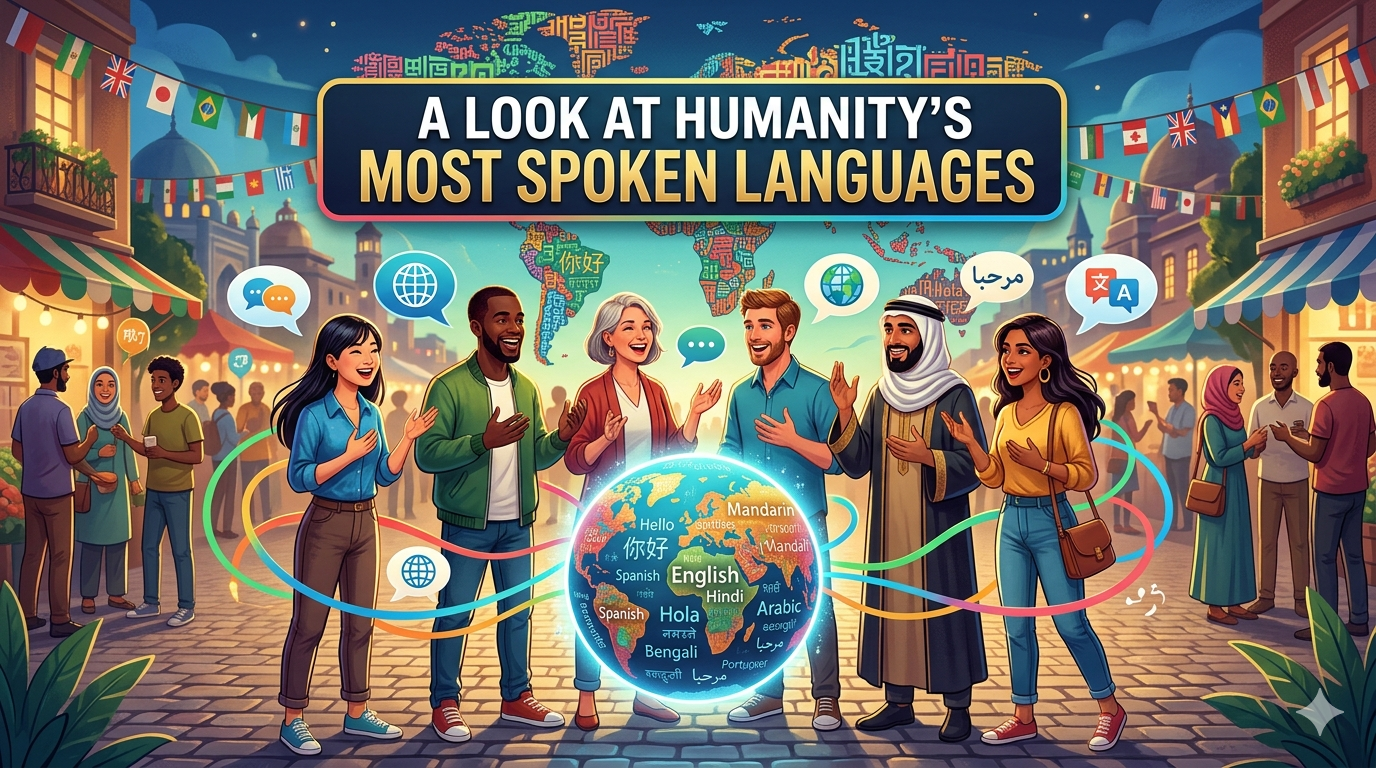
A Look at Humanity’s Most Spoken Languages

Language is the invisible architecture of human civilization. It shapes how we think, how we trade, how we fall in love, and how we wage peace. With over seven thousand languages currently spoken across the planet, the vast majority of human communication flows through a remarkably small number of tongues. Understanding which languages dominate the global conversation reveals not just demographic realities, but the deep historical currents of empire, migration, trade, and technological change that have carried certain voices across continents and oceans.When we measure linguistic dominance by total speakers—counting both those who learned the language from birth and those who adopted it later.

English stands alone at the summit. Approximately 1.45 billion people now speak English in some capacity, making it the undisputed lingua franca of the modern era. This figure represents a staggering transformation for a language that began as a Germanic dialect on a small island off the European coast. English’s rise owes much to the British Empire’s global reach, followed by American economic, cultural, and technological dominance in the twentieth and twenty-first centuries. Today it serves as the primary language of international business, scientific research, aviation, and digital communication, with roughly 380 million native speakers supported by more than a billion non-native speakers who have learned it for education, employment, or global participation. Yet if we shift our lens to examine native speakers alone—those who absorbed a language in childhood as their primary tongue—the picture changes dramatically. Mandarin Chinese claims this crown with approximately 930 million native speakers, making it the most spoken first language on earth. When second-language speakers are included, Mandarin’s total reaches roughly 1.1 billion people, placing it second only to English in overall reach. The language’s dominance reflects the sheer demographic weight of China, where it serves as the official state language, as well as its use in Taiwan and Singapore. What makes Mandarin particularly fascinating is its linguistic structure: a tonal language where meaning shifts with pitch, written through a character system containing tens of thousands of symbols, yet understood by nearly a billion people as their primary means of expression. Hindi occupies the third position in global rankings with approximately 600 million total speakers, including roughly 345 million native speakers primarily in India and Nepal. As one of India’s most widely spoken languages, Hindi serves as a crucial bridge in a nation of extraordinary linguistic diversity, where hundreds of languages coexist within a single political boundary. Its total speaker count reflects both its role as a mother tongue across northern India and its function as a second language for millions who speak regional languages but adopt Hindi for national communication. Spanish follows closely with approximately 559 million total speakers worldwide, supported by roughly 485 million native speakers. Its geographic reach is remarkable, spanning Spain and nearly all of Latin America, with the United States now representing a major center of growth where over 40 million people speak Spanish natively and approximately 55 million speak it in total. This makes the United States the second-largest Spanish-speaking country in the world by total speakers, surpassing Spain itself. Spanish’s expansion across the Americas traces back to the colonial era, yet its continued growth today reflects ongoing migration patterns, demographic trends, and its increasing importance in global commerce and culture. Arabic presents a unique case in global linguistics. With approximately 370 million native speakers and over 400 million total speakers, it dominates North Africa and the Middle East. However, Arabic exists in a state of diglossia—multiple spoken dialects vary dramatically across regions, from Moroccan Arabic to Gulf Arabic to Levantine Arabic, while Modern Standard Arabic serves as the unified written and formal spoken language used in media, education, and religious contexts. This linguistic duality means that an Arabic speaker from Morocco might struggle to understand the casual speech of someone from Iraq, yet both can read the same newspaper or watch the same news broadcast with perfect comprehension. French demonstrates how colonial history continues to shape linguistic geography long after political empires have dissolved. With approximately 80 to 85 million native speakers but over 300 million total speakers, French’s global footprint extends far beyond France itself. It serves as an official language in twenty-nine countries, with particularly rapid growth in West and Central Africa where demographic expansion is driving a surge in French-speaking populations. The Democratic Republic of Congo alone contains over 42 million French speakers, making it the world’s largest Francophone nation. This transformation from European language to African lingua franca illustrates how languages evolve and find new centers of gravity as global demographics shift. Portuguese, with roughly 230 million native speakers and 258 million total speakers, owes its global presence almost entirely to Brazil, which contains the vast majority of its speakers. Russian maintains significant influence across Eastern Europe and Central Asia with approximately 150 million native speakers and 260 million total speakers, reflecting both the historical reach of the Soviet Union and Russia’s continued cultural and political significance in its near abroad. German, while spoken natively by about 95 million people, reaches 135 million total speakers through its importance in European trade, engineering, and higher education. Bengali, with approximately 250 million total speakers concentrated in Bangladesh and eastern India, and Japanese, spoken by roughly 125 million people almost exclusively within Japan’s borders, round out the upper tier of global languages. Each tells a different story: Bengali’s density reflects the population concentration of the Bengal region, while Japanese’s relatively modest numbers despite Japan’s economic power demonstrate that linguistic influence does not always correlate with speaker count. What emerges from this landscape is a world where language operates on multiple scales simultaneously. English functions as the global connector, the language people learn when they need to communicate across national boundaries. Mandarin and Spanish serve as continental giants, anchoring vast populations across single regions. Hindi, Arabic, and French operate as regional bridges, linking diverse communities within multi-ethnic nations or across post-colonial networks. Meanwhile, thousands of smaller languages persist in specific valleys, islands, and neighborhoods, carrying unique cultural knowledge and ways of understanding the world that would be lost if these tongues fell silent.The future of global language distribution remains open to speculation. Demographic projections suggest that African languages—particularly French and Arabic as used in Africa, as well as indigenous languages like Swahili, Hausa, and Yoruba—will grow substantially as the continent’s population expands. Mandarin’s influence may continue to spread through China’s economic engagement, though its complexity as a written language presents barriers to adoption as a second language. English seems likely to maintain its position as the global default, though its share of internet content has already declined from nearly sixty percent a decade ago to roughly forty-nine percent today, suggesting a slow diversification of digital communication. In the end, the most spoken languages in the world are not merely tools of communication. They are living repositories of human history, carrying within their vocabularies and grammars the accumulated experiences of empires and migrations, of trade routes and religious movements, of technological revolutions and demographic shifts. To speak one of these languages is to participate in a conversation that spans centuries and continents, connecting individual voices to the vast chorus of human expression that has shaped, and continues to shape, our shared world.

Posted on

The Architecture of Digital Borders: How Countrywide Firewalls Reshape the Internet

When we think of borders, we imagine walls, checkpoints, and passport stamps. Yet some of the most consequential borders today are invisible, constructed from lines of code rather than concrete and steel. These digital barriers, commonly known as countrywide firewalls, represent one of the most ambitious attempts to reshape the fundamental architecture of the internet, transforming what was designed as an open global network into a collection of nationally controlled information spaces.

The internet was born from a vision of decentralized communication, a network that would route around damage and resist centralized control. Its foundational protocols treat censorship as a form of damage to be circumvented. Countrywide firewalls stand in direct opposition to this philosophy, seeking not to route around control but to establish it at massive scale. They represent a fundamental reimagining of what the internet can become when sovereign authority is applied to its infrastructure.

At the technical core of these systems lies a sophisticated apparatus of network management that operates across multiple layers simultaneously. Internet service providers within the country’s jurisdiction are compelled to implement filtering mechanisms at the backbone level, creating a chokepoint through which all international data must pass. This is not merely a matter of blocking specific websites but involves deep packet inspection, a technique that examines the actual content of data transmissions rather than merely their addressing information. When you send a message or request a webpage, your data travels in small bundles called packets, each carrying both destination information and payload content. Deep packet inspection technologies read through these payloads in real time, searching for forbidden keywords, identifying encrypted traffic patterns associated with circumvention tools, and analyzing behavioral signatures that might indicate prohibited activity.

Domain Name System manipulation represents another critical component of this architecture. When you type a website address into your browser, your computer consults DNS servers to translate that human-readable name into the numerical IP address that computers use to locate each other. By controlling the DNS resolution process at the national level, authorities can ensure that requests for certain domains simply return no valid address, making targeted websites effectively unreachable regardless of whether their actual servers remain online. This is complemented by IP address blocking, where traffic destined for specific numerical addresses is dropped at the network border, and by routing table manipulation that ensures data packets simply never reach their intended destinations.

The scale of these operations demands infrastructure that mirrors the complexity of the internet itself. Major firewall implementations require thousands of specialized hardware installations positioned strategically throughout a country’s network topology. These installations must process traffic volumes measured in terabits per second, making them among the most demanding real-time filtering systems ever constructed. The computational requirements alone are staggering, involving pattern matching against vast and constantly evolving databases of prohibited content while maintaining latency low enough that everyday internet usage remains functional.

What makes these systems particularly effective is their integration with legal and commercial frameworks that extend control beyond pure technology. Internet service providers operating within the jurisdiction face licensing requirements that mandate compliance with filtering directives. Content delivery networks and cloud service providers must locate servers within national boundaries, subjecting them to local jurisdiction and data sovereignty requirements. Major technology platforms often find themselves choosing between participating in these markets under restrictive conditions or abandoning them entirely, and many choose adaptation over exclusion.

The evolution of these systems reveals an ongoing arms race between filtering technologies and circumvention methods. Early implementations relied heavily on simple IP blocking and DNS manipulation, techniques that knowledgeable users could bypass with basic tools. In response, filtering systems grew more sophisticated, learning to identify and block virtual private network traffic by analyzing packet timing and size patterns rather than merely reading headers. This led to the development of obfuscation protocols designed to make encrypted traffic resemble ordinary unencrypted web browsing. The cycle continues, with each advancement in detection prompting innovations in evasion, creating a technological ecosystem that exists in parallel to the mainstream internet.

The social implications extend far beyond the technical mechanisms. When a countrywide firewall operates effectively, it shapes the information environment that citizens inhabit daily. Search results are curated, news sources are restricted, and social media platforms function within parameters defined by state authority. This does not merely prevent access to specific content but alters the fundamental texture of online experience, creating digital environments where certain topics, perspectives, and conversations exist only in shadows or not at all. The effect is cumulative and subtle, shaping not just what people can see but what they come to believe exists.

Economic consequences follow inevitably from this architecture. International businesses must navigate compliance requirements that may conflict with their values or operational standards. Innovation in certain technology sectors becomes constrained when access to global research, collaboration tools, and open-source communities is filtered. Yet these same systems can foster domestic technology ecosystems by reducing competition from established global platforms, creating protected markets where local alternatives flourish under regulatory shelter.

The philosophical tension at the heart of countrywide firewalls concerns the nature of sovereignty in the digital age. Traditional notions of territorial authority assume that a state controls what crosses its physical borders. The internet challenged this assumption by enabling information to flow across borders without physical passage. Firewalls represent an attempt to reassert territorial control over information flows, to make cyberspace respect the same boundaries that govern physical space. Whether this represents a legitimate exercise of sovereign authority or an unacceptable constraint on human communication remains one of the defining debates of our era.

Looking forward, these systems continue to evolve in response to technological change. The proliferation of encrypted DNS protocols challenges traditional domain blocking methods. The growth of satellite internet and mesh networking creates potential bypass routes that bypass terrestrial infrastructure entirely. Artificial intelligence offers both more sophisticated content detection and more sophisticated evasion techniques. The firewall of the future may operate not merely by blocking content but by shaping the synthetic information environments that emerging technologies make possible.

Understanding countrywide firewalls requires recognizing them not as temporary aberrations but as persistent features of the internet’s development. They represent one answer to the question of how national governance adapts to global networks, an answer that prioritizes boundary maintenance over boundary dissolution. As the internet continues to penetrate every aspect of modern life, the tension between open connectivity and controlled access will only intensify, making these digital borders an enduring feature of our connected world.

Posted on

Subheadings Are An Underrated Source of Blog Traffic

Subheadings are one of the most overlooked yet powerful tools for making your blog content discoverable online. They serve as signposts that guide both human readers and search engine crawlers through your content, transforming a dense wall of text into a structured, navigable experience. When used thoughtfully, subheadings can significantly improve how search engines understand and rank your pages, while simultaneously keeping visitors engaged long enough to absorb your message.

From a search engine perspective, subheadings carry substantial semantic weight. Search engines like Google use them to grasp the hierarchy and main topics of your article. When you wrap key phrases in heading tags, you are essentially telling the algorithm this is what this section is about. This helps search engines match your content with relevant queries more accurately. If someone searches for a specific question and your subheading directly addresses that topic, your page becomes a stronger candidate for ranking well. The crawler does not just see a block of paragraphs; it sees a clear outline of concepts, each marked with importance levels that help it categorize your content properly.

Beyond the technical signals sent to algorithms, subheadings dramatically improve the user experience, which indirectly feeds back into your SEO performance. When a visitor lands on your page, they often scan rather than read word for word. Subheadings allow them to quickly locate the information they need, decide if the article is relevant, and navigate to the sections that interest them most. This reduces bounce rates because readers are less likely to leave out of frustration when they can instantly see that the content contains what they are looking for. Lower bounce rates and longer time on page are behavioral signals that search engines interpret as indicators of quality, which can positively influence your rankings over time.

Accessibility is another crucial dimension where subheadings make a real difference. Screen readers rely heavily on heading structures to help visually impaired users navigate web content. A logical progression of subheadings allows these tools to jump between sections efficiently, making your blog usable for a broader audience. Search engines increasingly value accessibility as part of their ranking considerations, so a well-structured heading hierarchy does not just help people with disabilities; it reinforces your overall SEO strategy by aligning with modern web standards.

The strategic placement of keywords within subheadings also deserves attention. While you should never force keywords where they do not belong, naturally incorporating relevant terms into your subheadings reinforces the topical relevance of your content. It creates consistency between what you promise in your title and what you deliver in each section. This alignment builds trust with both readers and search engines. When your subheadings accurately reflect the content beneath them, you avoid the pitfall of clickbait behavior that damages credibility and rankings alike.

Subheadings also make your content more shareable and quotable. When readers want to reference a specific point from your blog on social media or in their own articles, a clear subheading gives them an easy anchor to cite. This can lead to more backlinks and social signals, both of which contribute to your site’s authority and visibility. A well-structured article is simply easier to engage with, and ease of engagement translates into broader distribution across the web.

In longer articles, subheadings prevent cognitive overload by breaking complex information into digestible chunks. This chunking effect helps readers maintain focus and retain information better. When readers find value in your content and stay to read through multiple sections, they are more likely to explore other pages on your site, increasing internal traffic and signaling to search engines that your domain offers comprehensive resources on the topics it covers.

Ultimately, subheadings bridge the gap between writing for people and writing for machines. They satisfy the human need for clarity and organization while providing search engines with the structural cues needed to index and rank your content effectively. Neglecting them means leaving discoverability to chance, while embracing them gives you direct control over how your blog is interpreted, navigated, and valued in the vast landscape of online content.