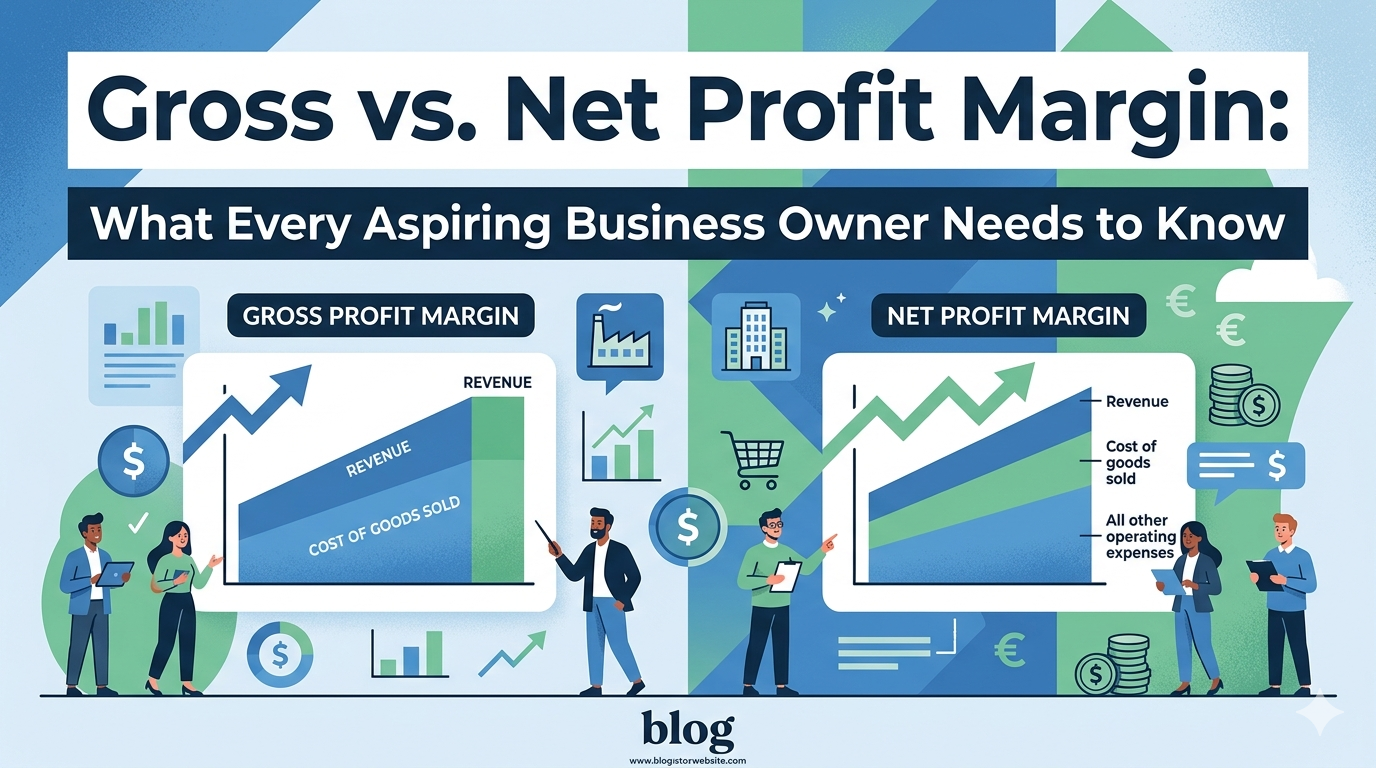
You’ve got a great idea, a product people want, and customers are actually buying. Money is coming in. So why does it feel like there’s never enough left over?The answer usually lives in the gap between two numbers: your gross profit margin and your net profit margin. Understanding the difference between them isn’t just accounting trivia — it’s one of the most important things you can do before you quit your day job.
What Is Gross Profit Margin?
Gross profit margin measures how much money you keep from each dollar of revenue after paying for the direct cost of producing or delivering what you sell. Those direct costs — called Cost of Goods Sold (COGS) — include things like:
Raw materials or inventory
Manufacturing costs
Direct labor (the people actually making or delivering your product)
Packaging and shipping
The formula:
Gross Profit Margin = (Revenue − COGS) ÷ Revenue × 100
Example: Say your bakery brings in $10,000 in a month. The flour, butter, eggs, packaging, and the part-time baker’s wages add up to $4,000. Your gross profit is $6,000, giving you a gross margin of 60%.
That 60% sounds healthy — and it might be! But it doesn’t tell the whole story.What Is Net Profit Margin?Net profit margin takes things much further. It measures what’s left after every single expense has been paid — not just the cost of making your product, but all the costs of running your business.
Those additional costs include:
Rent and utilities
Marketing and advertising
Software subscriptions
Loan interest and taxes
Your own salary (if you pay yourself)
Insurance, legal fees, and everything else
The formula:Net Profit Margin = Net Income ÷ Revenue × 100
Back to the bakery: Your gross profit was $6,000, but now subtract $2,500 for rent, $800 for marketing, $400 for utilities, and $600 for other overhead. You’re left with $1,700 in net profit — a net margin of 17%.
That’s still profitable! But notice how quickly the picture changed from 60% to 17%.
Why the Gap Between Them Matters
The spread between your gross and net margins tells you how efficiently your business converts sales into actual profit after supporting itself.
A wide gap (high gross margin, low net margin) often signals that overhead is eating you alive. Your product itself is profitable, but your operating costs are too high relative to your revenue. This is extremely common in early-stage businesses that have locked in leases, hired staff, and built infrastructure before the revenue has fully scaled to support it.
A narrow gap (where gross and net margins are close) means your fixed operating costs are lean and well-controlled relative to your revenue.
What “Good” Looks Like — and Why It Varies
There is no universal “good” margin. It depends heavily on your industry:
IndustryTypical Gross Margin
Grocery stores and restaurants have notoriously thin net margins, which is why volume and operational efficiency are everything in those industries. A software company, by contrast, can have enormous net margins because once the product is built, it costs relatively little to sell another copy.
Knowing your industry benchmarks gives you a target to aim for — and a warning sign when you’re falling short.
What This Means for Aspiring Business Owners
1. Run the numbers before you launch
Many new entrepreneurs project revenue enthusiastically but forget to stress-test their margins. Model out both your gross and net margins before you start. If your net margin at projected revenue is razor-thin, you have very little room for error — and surprises always happen.
2. Low gross margin is hard to fix later
If your product is priced too low or your COGS are too high, no amount of cost-cutting elsewhere will save you. Net margin problems can sometimes be solved by trimming overhead; gross margin problems usually require rethinking your pricing, your suppliers, or your product itself.
3. Revenue growth doesn’t automatically fix profitability
It’s tempting to think “if we just sold twice as much, we’d be fine.” But if your gross margin is poor, you’ll just lose money faster. Scaling a broken margin structure scales the problem.
4. Watch for margin compression over time
As you grow, costs have a sneaky habit of creeping upward — more staff, bigger space, more software tools. Revenue tends to grow in steps; overhead tends to grow gradually but relentlessly. Keep an eye on your margins every month, not just your top-line revenue.
5. Use both numbers to tell the real story
Gross margin tells you whether your product is viable. Net margin tells you whether your business is viable. You need both to be healthy — and you need to know which one is the problem when things aren’t going as planned.
A Simple Way to Remember It
Think of gross margin as “what you made on the thing you sold.” Think of net margin as “what you actually got to keep.”
The goal isn’t just to sell things — it’s to build a business where selling things leaves enough behind to sustain and grow what you’ve built. Understanding where your money goes between those two numbers is how you take control of that process.
Before you sign the lease, hire the team, or put everything on the line: know your margins.