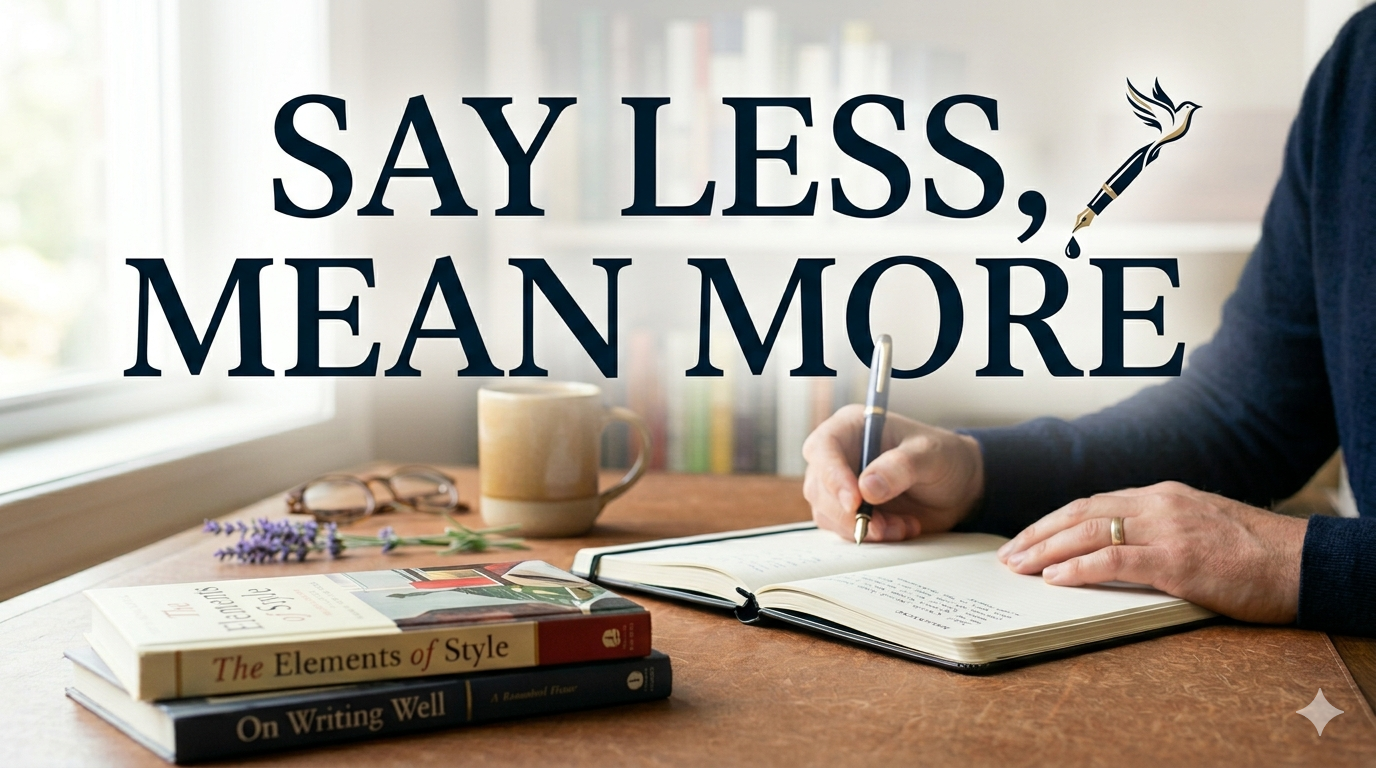
There is a particular kind of writer who believes that length signals effort. The longer the sentence, the more impressive the thought. The more clauses stacked inside a paragraph, the more the reader will trust that something serious is being said. This writer is wrong, and most of us have been this writer at some point.Good writing is not about how much you say. It is about how much you leave out.
The Bloat We Don’t Notice
Words accumulate the way clutter does — gradually, invisibly, until one day you look at a sentence and realize it is doing almost nothing. Consider the phrase “at this point in time.” It means now. Three words have been replaced by five, and nothing has been gained. Or “due to the fact that,” which is simply “because” wearing a trench coat. We reach for these constructions not because they communicate better, but because they feel more formal, more considered, more written. They don’t. They just feel that way.
The instinct to add is deeply human. We pad sentences because silence makes us nervous — on the page just as in conversation. We keep talking to signal that we’re still thinking, still engaged, still worth listening to. But the reader has no obligation to stay. Every unnecessary word is a small tax on their attention, and attention is the most finite resource a writer can ask for.
Brevity Is Not Simplicity
There is a common misunderstanding worth clearing up: concise writing is not simple writing. Hemingway is brief. So is Wallace Stevens. So, in their different ways, are Toni Morrison and Joan Didion. Concision is not about using small words or short thoughts. It is about closing the gap between what you intend and what you express — removing the distance between your meaning and its arrival.When a sentence is lean, each word carries more weight. The reader feels this, even if they don’t know why. The prose seems to move faster, to breathe differently. There is a kind of trust that forms between a writer and a reader when nothing is being wasted — a sense that the writer respects the reader’s time too much to fill it with noise.
The Edit Is Where Writing Happens
Most writers don’t find concision on the first draft. They find it on the third or the fourth, when they go back through a paragraph and ask, ruthlessly: what does each sentence actually do? Which words are earning their place? Where is the idea, and what is just the scaffolding left behind from assembling it?Good editing is not about making writing shorter for its own sake. It is about finding the true shape of a thought and cutting away everything that isn’t it. A sentence should be as long as it needs to be, and not a word longer. Sometimes that is three words. Sometimes it is forty. The length is not the point. The precision is.
What Readers Actually Experience
When a reader encounters a dense, over-written paragraph, they don’t feel impressed. They feel tired. Comprehension drops. The main idea gets lost somewhere in the subordinate clauses. They reach the end of a sentence and have to go back to the beginning just to find their footing. The writer, trying to say more, ends up saying less.Strip that paragraph down — cut the hedges, cut the filler, make every clause do something — and the reader leans in. The idea lands.
They keep going.
That is the paradox of concise writing: by taking away, you give more. You give the reader the clearest possible path to your meaning, and you give them credit for being able to walk it without your hand holding theirs the entire way.
A Practice, Not a Rule
Concision is not a law. It is a discipline — one that requires constant practice, constant return to the page, constant willingness to kill sentences you liked. It means resisting the urge to explain what you’ve already shown, to say again what you just said, to soften every claim with a qualifier that only signals your own uncertainty.
Write the draft. Then go back and ask, for every single sentence: is this earning its place? Be honest. Be patient. Be merciless.The writing that lasts is almost always the writing where the writer trusted the words to be enough — and had the good sense to stop there.