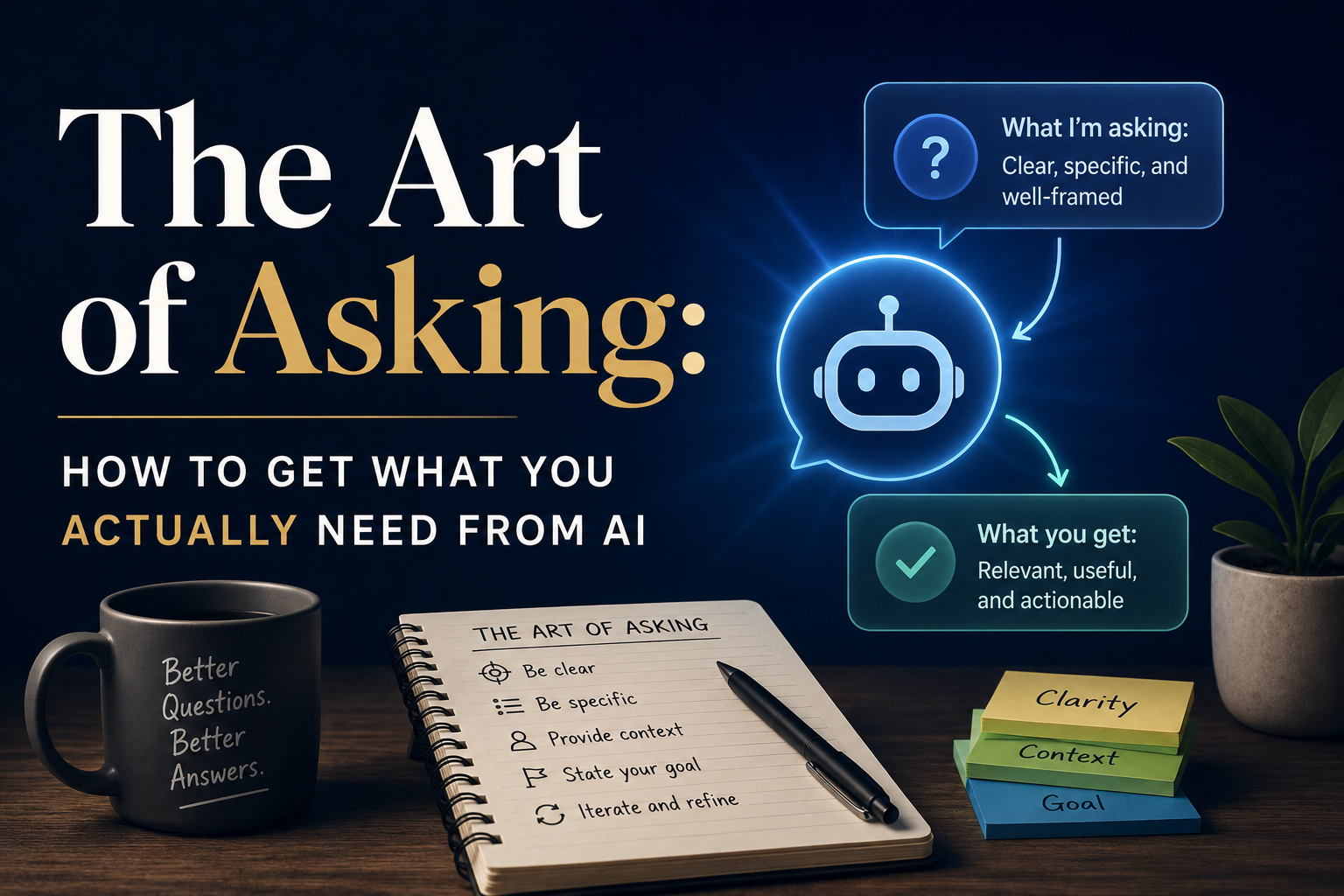
Most people treat artificial intelligence like a vending machine. They punch in a few words, expect the right answer to drop out, and get frustrated when it does not. The problem is not the machine. The problem is the way they are asking. AI is not a database that retrieves facts on command. It is a reasoning engine that responds to the structure of your request, the context you provide, and the constraints you set. A poorly formed prompt gets a generic, confused, or confidently wrong response. A well-formed prompt gets something precise, useful, and often surprisingly insightful. The difference is not luck. It is craft.
The first principle is to stop thinking in keywords and start thinking in instructions. If you type “marketing tips” into an AI, you will get a list of generic advice that could apply to any business in any industry at any stage. The AI has no anchor, no direction, no sense of what you are actually trying to accomplish. Instead, frame your request as a task with context. Tell the AI who you are, what you are building, who your audience is, what you have already tried, and what specific outcome you need. The more dimensions you add, the more the AI can narrow its response to something that fits your situation rather than something that fits every situation.
Context is the most underused tool in prompting. People assume the AI knows what they mean, but the AI knows nothing until you tell it. If you are asking for help with a business plan, the AI needs to know your industry, your revenue stage, your geographic market, your team size, and your constraints. If you are asking for help with writing, the AI needs to know the tone, the audience, the length, the format, and the purpose of the piece. If you are asking for code, the AI needs to know the language, the framework, the existing codebase, and the specific bug or feature you are addressing. Every piece of context you omit is a variable the AI will guess at, and its guesses are based on averages, not on your specific needs. The average answer is rarely the best answer.
Specificity extends beyond context into the structure of the request itself. Vague questions get vague answers. If you ask the AI to “improve this paragraph,” you might get a rewrite that changes your voice, your meaning, or your intent. If you ask the AI to “make this paragraph more concise while preserving the tone and keeping the second sentence intact,” you have given it boundaries that shape the output in a predictable way. The AI does not know what you value unless you tell it. It does not know what you want to protect unless you name it. Constraints are not limitations on the AI’s creativity. They are the guardrails that keep its output aligned with your purpose.
Role assignment is another powerful technique that most people ignore. The AI can adopt a persona, and that persona changes how it thinks, what it prioritizes, and how it communicates. If you ask it to respond as a skeptical investor, you will get a different analysis than if you ask it to respond as an enthusiastic customer. If you ask it to act as a senior engineer reviewing junior code, you will get different feedback than if you ask it to act as a teacher explaining a concept to a beginner. The role sets the frame, and the frame determines what the AI notices and what it dismisses. This is not a gimmick. It is a way to access different modes of reasoning within the same model, and the mode you choose should match the perspective you need.
Iteration is where most people give up too soon. They ask once, get a mediocre response, and conclude that the AI is not good enough. The best results come from a conversation, not a single transaction. You read the first output, identify what is missing or wrong, and feed that back into a follow-up prompt. You can ask the AI to expand on a specific point, to rewrite a section in a different style, to check its own work for errors, to provide sources or counterarguments, or to approach the problem from a completely different angle. Each round refines the output, and the refinement compounds. The AI does not get tired, does not get offended, and does not charge extra for the tenth revision. This is an advantage that human collaborators cannot match, and it is wasted when the user treats the interaction as a one-shot deal.
One of the most common mistakes is asking the AI to do too much at once. A prompt that requests a full business plan, a marketing strategy, a financial model, and a hiring timeline in a single response will get a shallow treatment of each. The AI has a limited attention window, and sprawling requests dilute its focus. The better approach is to break the work into stages. Start with the strategy. Once that is solid, move to the tactics. Once those are clear, address the execution details. This mirrors how a human expert would work, and it produces better results because the AI can build each layer on top of the previous one rather than trying to construct everything simultaneously from a blank slate.
Another frequent error is failing to define the output format. The AI can produce text, code, tables, outlines, step-by-step instructions, comparisons, summaries, and creative writing, but it defaults to prose unless told otherwise. If you need a structured format, say so. If you need bullet points, say so. If you need a specific template or framework, provide it. If you need the response in a tone that matches your brand guidelines, describe that tone or paste an example. The AI is highly capable of format matching, but only when the format is explicitly requested. Otherwise it will guess, and its guess will often be the least useful option for your particular workflow.
Examples are perhaps the most reliable way to improve output quality. If you show the AI a piece of writing you admire and ask it to produce something in that style, it will analyze the patterns and replicate them more accurately than if you tried to describe the style in abstract terms. If you show it a spreadsheet layout you prefer, it can generate new data in that same layout. If you show it a customer email that worked well, it can draft variations that preserve the elements that made the original effective. The AI learns from patterns, and examples are the purest form of pattern. Describing what you want is helpful. Showing what you want is definitive.
It is also worth understanding what the AI cannot do, because unrealistic expectations lead to bad prompting. It cannot access real-time information unless specifically connected to tools that do so. It cannot browse the live web in most standard interfaces. It cannot know your private data unless you paste it into the prompt. It cannot verify facts with perfect accuracy, and it will sometimes generate plausible-sounding but incorrect details. It cannot replace domain expertise in highly regulated or technically complex fields. Knowing these limits allows you to use the AI for what it is good at, which is reasoning, structuring, drafting, brainstorming, and transforming information, while handling the fact-checking and final judgment yourself.
The final principle is to review and verify. The AI is a tool, not an authority. Its output should be treated as a first draft, not a finished product. Read it critically. Check any claims that matter. Test any code before deploying it. Consider whether the tone is appropriate for your audience. Look for logical gaps, factual errors, or places where the AI has defaulted to generic advice because your prompt was not specific enough. The best users of AI are not the ones who trust it blindly. They are the ones who use it to accelerate their own thinking while maintaining full responsibility for the result.
Prompting well is a skill that develops with practice. The first few attempts will feel clumsy. The outputs will miss the mark. You will forget to include context, or you will ask for too much at once, or you will accept the first response without pushing for refinement. This is normal. The users who get the most value are the ones who treat each interaction as a learning opportunity, who save their best prompts and iterate on them, who study what worked and what did not, and who gradually build a personal library of approaches for different kinds of tasks. Over time, the gap between a mediocre prompt and a masterful one becomes enormous, and the time saved, the quality gained, and the insights unlocked make the investment in learning this skill one of the highest returns available in modern work.
The AI is not going to ask you the right questions. That is your job. The clarity of your thinking, the precision of your language, and the depth of your context determine everything that follows. Treat the prompt as the most important part of the work, because it is. Everything else is just the AI catching up to what you already should have known.