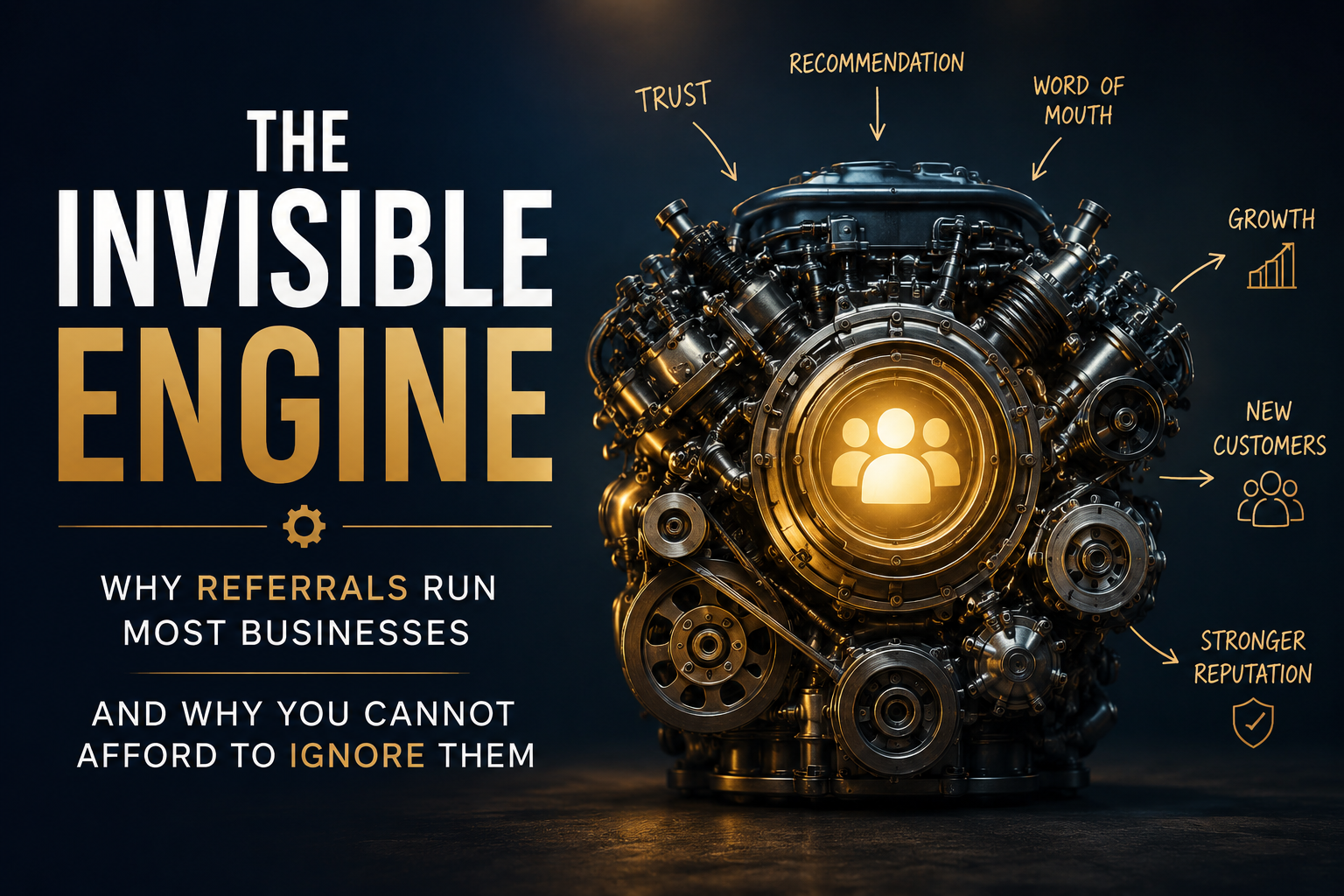
There is a number that sits quietly in the financial records of nearly every successful business, rarely discussed in marketing meetings, rarely celebrated in quarterly reports, rarely optimized with the same urgency as ad spend or content calendars. That number is the percentage of revenue that comes from referrals. It is often higher than the founder expects, sometimes higher than the founder even knows, and in many cases it is the single largest source of new business the company has. Yet it is treated as an afterthought, a happy accident, a byproduct of good work rather than a system to be engineered. This is a costly mistake, because referrals are not a bonus. They are the foundation, and the businesses that understand this build differently from the ones that do not.
The data on this is consistent across industries and decades. Studies by Wharton, the Harvard Business Review, and various market research firms have found that referrals account for somewhere between twenty and fifty percent of new customer acquisition for most established businesses, with some professional service firms seeing numbers as high as seventy or eighty percent. The exact figure varies by industry, by business age, by price point, and by the strength of the referral system itself, but the pattern is universal. Word of mouth is not a marginal channel. It is the dominant channel for businesses that have been around long enough to earn it, and it is often the most profitable channel by a wide margin.
A customer who arrives through a referral is different from a customer who arrives through an advertisement. They come pre-qualified, pre-trusted, and pre-disposed to buy. The cost of acquisition is effectively zero, or close to it, because the marketing work was done by someone the prospect already trusts. The sales cycle is shorter because the objection of whether you are legitimate has already been handled by the referrer. The lifetime value is higher because referred customers tend to be more loyal, less price-sensitive, and more likely to refer others in turn. The churn rate is lower because the relationship begins with social proof embedded in it, not with a transaction between strangers.
This is why the referral percentage matters so much. It is not just a measure of how nice your customers are. It is a measure of how efficiently your business converts trust into revenue, and how much of your growth is funded by goodwill rather than capital. A business that grows primarily through paid acquisition is a machine that requires constant fuel. Every new customer costs money, and the cost typically rises over time as the easy prospects are exhausted and the platforms increase their prices. A business that grows primarily through referrals is a self-sustaining system. The customers bring the customers, and the marginal cost of each new acquisition approaches zero while the trust compounds.
The problem is that most businesses do not know their referral percentage with any precision. They might track it loosely, through a question on an intake form or a casual conversation at checkout, but they rarely build rigorous systems to measure it, to attribute revenue accurately, or to distinguish between a true referral and a customer who happened to hear about them from multiple sources. The result is a blind spot. The founder knows that word of mouth is important, but they do not know how important, and they do not know whether it is growing or shrinking, and they do not know which customers or which experiences are driving it. They are flying a plane with a fogged windshield, guessing at altitude based on how the engine sounds.
This blindness leads to underinvestment. The business that does not know that forty percent of its revenue comes from referrals will not allocate resources to making that forty percent into sixty percent. It will not train its team to ask for referrals at the right moment. It will not build a formal referral program with incentives that reward the behavior it wants. It will not design the customer experience to create moments so remarkable that talking about them becomes natural. It will spend its marketing budget chasing new channels while its most powerful channel atrophies from neglect.
The businesses that treat referrals as a system rather than a surprise do the opposite. They measure obsessively. They know not just how many customers came from referrals, but which customers referred them, what triggered the referral, how long after the purchase it happened, and what the referred customer went on to buy. They map the customer journey looking for peak moments of delight, the moments when the customer is most likely to feel gratitude and most likely to mention the business to a friend. They engineer those moments intentionally, knowing that a referral is not a random event but the predictable outcome of a specific emotional state.
They also ask. This is the part that makes many founders uncomfortable. The idea of directly requesting a referral feels pushy, desperate, or transactional. But the data shows that customers who are satisfied are often willing to refer and simply do not think to do so unless prompted. The prompt does not need to be aggressive. It can be a simple question at the end of a successful project, a note in a follow-up email, a small incentive that feels like a thank-you rather than a bribe. The businesses that master this do not ambush their customers. They create a context where the request feels natural, and they make the act of referring as easy as possible. A referral link, a pre-written email, a social media post ready to share. Friction is the enemy of word of mouth, and the best referral systems remove it at every step.
The importance of this becomes acute when a business is being sold or valued. A buyer looking at a company with a high referral percentage sees a business that is not dependent on the founder’s personal network or on advertising platforms that could change their rules tomorrow. They see a business with a moat made of trust, with customer relationships that produce new customer relationships without additional cost. This is a premium asset. It commands a higher multiple because the risk is lower and the future revenue is more predictable. Conversely, a business with a low referral percentage is a business that must constantly buy its customers, and the buyer knows that the cost of that purchase may rise and the yield may fall. The valuation reflects this uncertainty.For the founder who is not planning to sell, the referral percentage is still the most honest scorecard of the business’s health. Revenue can be manipulated with discounts and promotions. Follower counts can be purchased. Ad metrics can be gamed. But a referral is a vote that costs the voter something. It costs their social capital, their reputation, their implicit endorsement. A customer who refers you is staking their relationship with their friend on your performance. That is a high bar, and clearing it repeatedly is the truest sign that your product or service is genuinely good, not just well-marketed.This is why the obsession with viral marketing, growth hacking, and influencer partnerships often misses the point. Those tactics can spike awareness, but they rarely build the sustained trust that produces referrals at scale. A viral tweet might bring ten thousand visitors, but if the experience does not match the hype, those visitors will not return and they will not recommend. An influencer might drive a burst of sales, but if the product disappoints, the influencer’s audience will blame the influencer for the recommendation, and the trust is damaged on both sides. Referrals are slower than virality, but they are deeper, more durable, and more valuable over time. They are the tortoise that wins the race while the hare is chasing the next trend.The businesses that understand this invest in the long game of trust. They overdeliver on the promise they made in their marketing. They follow up after the sale not to sell again but to ensure satisfaction. They fix problems with a speed and generosity that turns complainers into advocates. They stay in touch with past customers, not with constant sales pitches but with genuine value, reminders, education, or community. They know that a customer who bought once and forgot about them is a wasted asset, while a customer who bought once and remains engaged is a potential referral engine for years.They also understand that not all customers are equally likely to refer. Some are natural connectors, people with large networks and a habit of making introductions. Some are quiet and satisfied but unlikely to mention the business unless directly asked. Some are unhappy but silent, and their silence is a warning sign that the referral percentage could be higher if the underlying issues were addressed. The sophisticated business segments its customers by referral potential and treats the segments differently. The connectors get special attention, early access, and explicit invitations to spread the word. The quiet satisfied customers get the nudge and the tools to make referring easy. The unhappy customers get outreach and resolution before their dissatisfaction becomes invisible churn.The referral percentage is also a diagnostic tool for the broader business. If it is low, the problem might be the product, the pricing, the customer service, the onboarding, or the simple fact that the business has not been around long enough to earn trust. If it is high but declining, the problem might be growth at the expense of quality, a new team member who does not understand the culture, or a change in the competitive landscape that makes the experience less remarkable. If it is high and stable, the business has likely found its rhythm and should protect it fiercely while looking for ways to compound it. The number tells a story, and the founder who learns to read it gains a perspective that no marketing dashboard can replicate.In the end, the reason referrals matter is not because they are cheap or because they are easy. They are neither. They are expensive in the sense that they require a level of quality and consistency that most businesses cannot sustain, and they are difficult in the sense that they cannot be manufactured through sheer effort or spending. They must be earned, and earning them is the work of the entire business, from the first touchpoint to the last follow-up. But once earned, they become the most powerful force in commerce. They are the proof that the business is real, that the promise was kept, that the customer was seen and served rather than merely sold to. They are the invisible engine that turns a transaction into a relationship, a customer into an advocate, and a business into an institution.If you do not know what percentage of your revenue comes from referrals, that is the first thing you should fix. Not because the number itself is the goal, but because the act of finding it forces you to look at your business through the lens of trust rather than the lens of traffic. And once you see it that way, you cannot unsee it. You begin to measure everything by whether it earns a referral or merely makes a sale. You begin to design for the long term rather than the quarterly report. You begin to build something that grows not because you spent more, but because you became worth talking about. That is the difference between a business that survives and a business that lasts.