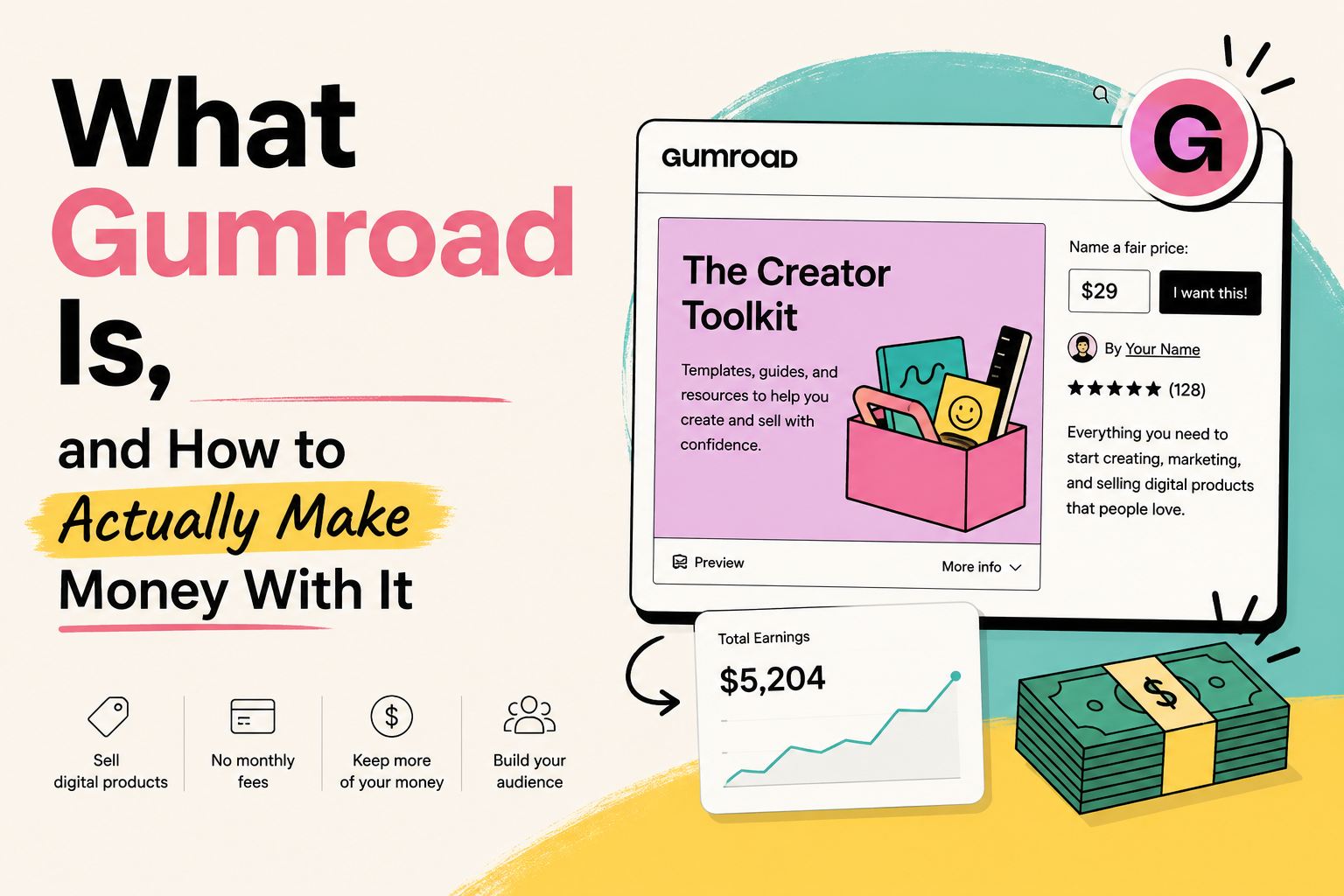
Gumroad is a platform that lets creators sell things directly to an audience without building a website, setting up payment processing, or hiring anyone to handle the technical side of e-commerce. Launched in 2011, it has grown into one of the most recognizable names in the creator economy, and at this point it has processed over a billion dollars in sales for the people who use it. The pitch is almost aggressively simple: you upload something, you set a price, and Gumroad gives you a link you can drop anywhere your audience already spends time. There is no storefront to design, no domain to register, and no checkout system to wire up. You paste a link in a tweet, a newsletter, or an Instagram bio, and when someone clicks it and pays, the money is yours, minus Gumroad’s cut.
What makes Gumroad distinct from a general e-commerce platform is its focus on digital goods. People sell ebooks, online courses, music, software, Notion templates, design assets, photography presets, and increasingly things like coaching calls and paid newsletters or memberships. It also supports pay-what-you-want pricing, which has made it a favorite among musicians and independent artists who want flexibility rather than a fixed price tag. Because everything is digital, Gumroad can automate the part that used to require real labor: the moment a payment clears, the platform delivers the file, grants access, or activates the subscription, with no manual intervention needed from the seller.
The economics work differently than a typical online store. Gumroad doesn’t charge a monthly subscription fee, so there’s no cost to simply having a page live. Instead, it takes a percentage of each sale, currently around ten percent plus a small flat fee per transaction, with payment processing built into that cut rather than charged separately. That means a creator selling a twenty dollar template keeps roughly eighty-five to ninety percent of the sale after fees, and there is no bill to pay if nothing sells that month. The tradeoff shows up at scale: because the fee is a flat percentage rather than a shrinking one, sellers moving serious volume each month often end up paying more in total fees than they would on a platform with a flat subscription price. For someone just starting out or testing whether a product idea has any traction at all, though, the lack of upfront cost is exactly the point. There’s also a feature called Discover, Gumroad’s internal marketplace where buyers browse and search for products without coming from a creator’s own audience. Sales that come through Discover carry a steeper fee, since Gumroad is effectively acting as the source of that customer rather than just the checkout page.
Actually making money on Gumroad comes down to two things working together: having something worth buying, and having a way to put it in front of people. The platform will host your product and process the payment, but it will not build you an audience. The sellers who do well tend to start with a specific group of people they already have some reach with, whether that’s a newsletter list, a social media following, a YouTube channel, or even just a community they’re active in, and they create something that solves a real problem for that specific group. A vague, broadly appealing product tends to underperform a narrow one that speaks directly to a defined audience’s pain point. Pricing matters too. Many successful Gumroad sellers find that pricing a digital product too low can actually hurt sales, since it signals low value, while a price that matches the perceived expertise or specificity of the product tends to convert better even though it’s higher.
The other part of making real money on Gumroad is treating it as the checkout page rather than the whole business. The creators who generate meaningful income are usually doing the work elsewhere, building an email list, posting consistently, engaging with a community, or running a content strategy, and then pointing all of that traffic at a Gumroad link when it’s time to buy. Gumroad itself provides some basic tools to help with this, including simple email collection, workflows that can automatically follow up with buyers, and affiliate features that let other people promote your product for a cut of the sale. None of these replace genuine audience-building, but they help convert the audience you do have more efficiently once it exists.
Used this way, Gumroad functions less like a marketplace and more like infrastructure: a fast, low-cost way to turn an audience’s trust into a transaction without spending months on the technical groundwork that used to be required to sell something online. For a first product or a side income stream, that simplicity is often worth more than a lower fee on a platform that takes weeks to set up.