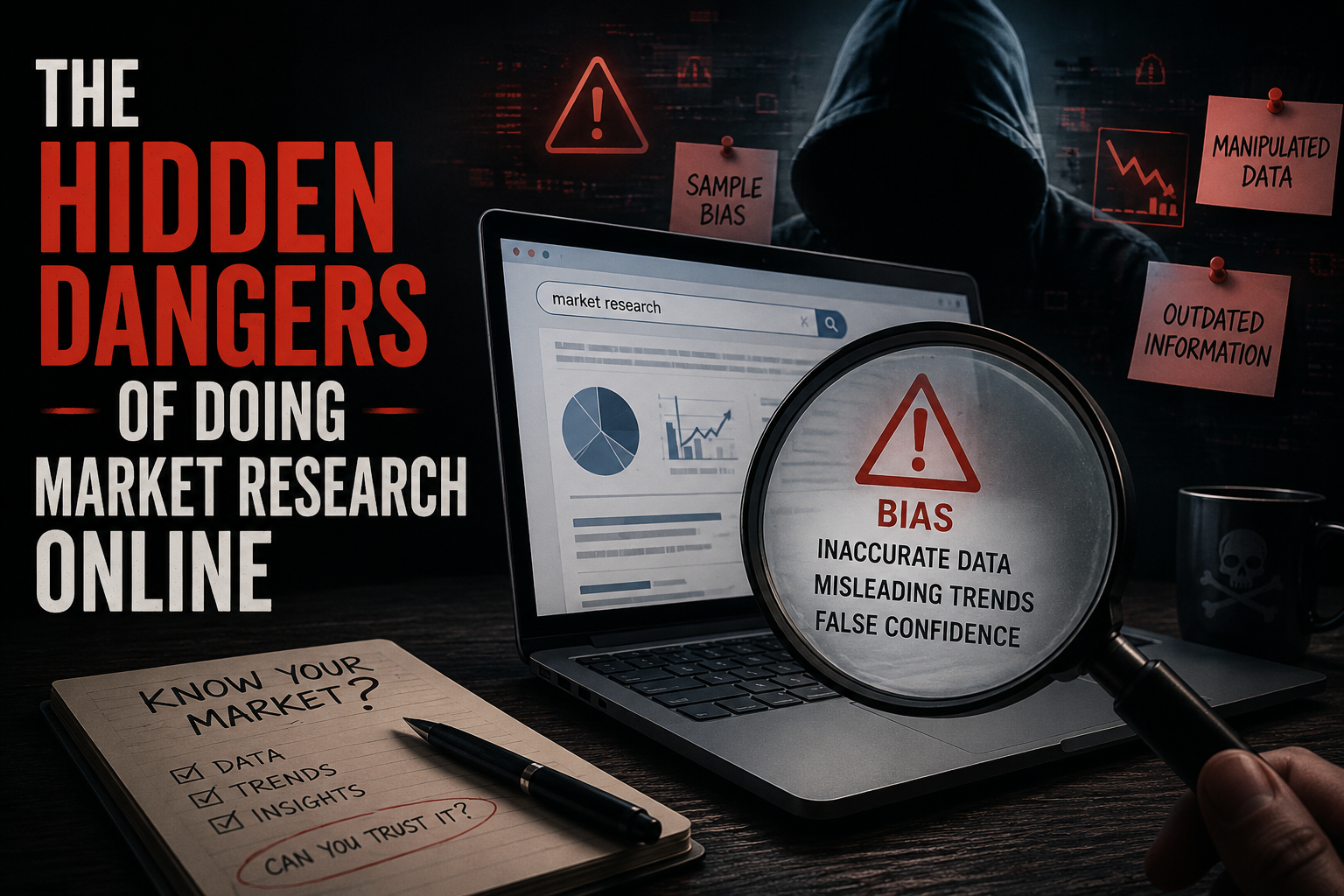
Market research used to mean fieldwork: interviews, focus groups, and analysts who spent years building relationships with industry insiders. Today, a founder can open a browser, run a few searches, and feel like they understand an entire market in an afternoon. That feeling is often an illusion, and it can be an expensive one.
The first danger is the sheer unevenness of what gets published online. Search engines reward content that is optimized to rank, not content that is accurate. A blog post written to capture search traffic can sit above a peer-reviewed study or a primary government dataset simply because it uses better headlines and more backlinks. Anyone relying on the first page of results is really trusting an algorithm’s judgment about popularity, not a researcher’s judgment about truth.
A second problem is the recycling of bad numbers. A single market-size estimate, sometimes invented or wildly extrapolated, gets cited by one site, then picked up and rephrased by another, and within a year it looks like a consensus figure simply because it appears everywhere. This is sometimes called citation laundering, and it is remarkably common in industries like software, wellness, and consumer goods, where actual primary data is scarce and expensive to produce.
There is also a serious issue of staleness. Free online reports are frequently years old, repackaged with a new date stamp, while the underlying data reflects a market that has since shifted dramatically. Competitive landscapes, regulatory environments, and consumer preferences can change within a single quarter, so a number from 2021 dressed up as current insight can quietly steer a business plan in the wrong direction.Bias is another quiet danger. A great deal of “free” market research online is published by vendors, trade associations, or companies with something to sell. Their numbers are not necessarily false, but they are usually framed to support a narrative, whether that is the size of an opportunity, the inevitability of a trend, or the superiority of a particular technology. Reading only these sources means absorbing someone else’s incentives along with their data.
Finally, there is the newer risk of AI-generated summaries and answers. Tools that synthesize information from the web can confidently present incorrect figures, blend incompatible data sources, or invent statistics that sound plausible but trace back to nothing real. Because the output reads fluently, it is easy to mistake confidence for accuracy.None of this means online research is worthless. It means it should be treated as a starting point for forming questions, not an ending point for making decisions. For research that actually needs to hold up under scrutiny, it helps to go to organizations that build their reputations on rigor and methodology rather than search rankings.McKinsey, Bain, and BCG remain the standard reference points for strategic and competitive analysis, particularly when a question touches corporate strategy, growth planning, or industry transformation. Their public insights are useful, though their deepest work is typically available only through paid engagements.
Gartner and Forrester are the go-to names for technology and enterprise software markets. Their analyst reports, market quadrants, and wave evaluations are widely used by buyers and investors because the methodology behind vendor comparisons is disclosed and consistently applied.
For consumer goods, retail, and behavioral data, Nielsen and Kantar carry decades of household panel data and purchasing behavior research that is difficult to replicate from public sources. IDC and Euromonitor International serve a similar role for technology shipment data and global consumer trend tracking, respectively, with subscription access to detailed country and category breakdowns.Ipsos and Mintel round out the picture for custom survey work and packaged consumer insight reports, often used by companies that need primary data collected specifically for their question rather than a general industry overview.
Paying for access to these firms, or at minimum reading their publicly released summaries and methodology notes, is usually far cheaper than building a strategy on a number that turns out to be three years old or quietly invented by a content marketer chasing search traffic.