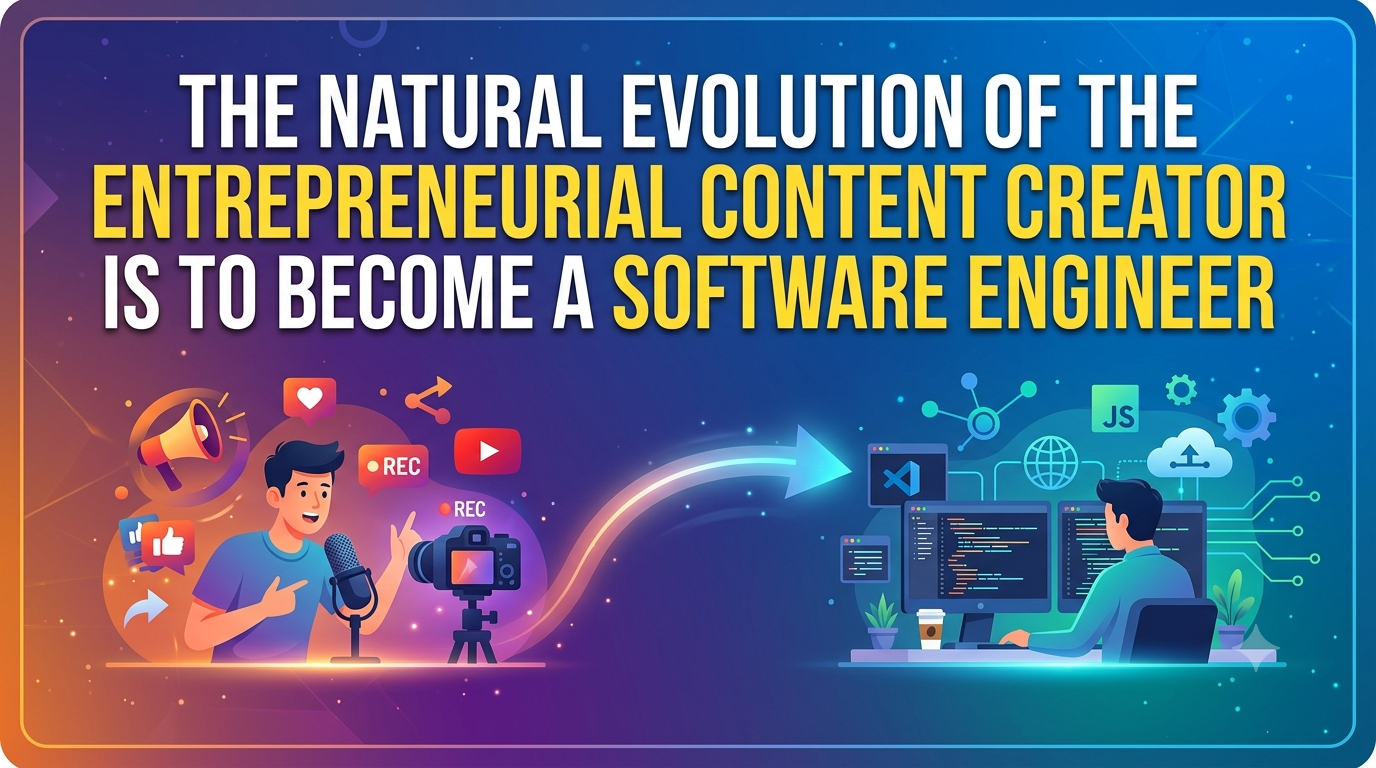
Many people begin their entrepreneurial journey by creating content. They start a blog, a YouTube channel, a newsletter, or a social media account focused on a topic they know well. They learn how to write compelling headlines, communicate ideas clearly, attract an audience, and build trust over time. These are valuable skills, but they are often just the beginning of a much larger journey.
As content creators gain experience, they begin to notice patterns. Their audience repeatedly asks the same questions. Readers struggle with the same problems. Customers spend hours performing repetitive tasks. The more deeply a creator understands a niche, the easier it becomes to recognize opportunities that others overlook.
This is where software enters the picture.
Software is a way to solve problems at scale. A blog post can explain how to complete a task. A video can demonstrate the process. A course can teach someone the necessary skills. Software, however, can often perform the task automatically or make it dramatically faster. Instead of explaining the solution, software becomes the solution.
This makes software a natural next step for entrepreneurs who already understand their audience. They have spent months or years listening to customer feedback, answering questions, and identifying recurring pain points. They know what frustrates people because they hear about those frustrations every day.
Content creation becomes market research.
Every email from a reader, every blog comment, every support question, and every conversation provides clues about what people truly need. While many entrepreneurs spend significant time and money trying to identify profitable product ideas, content creators often receive those ideas directly from their audience.
Eventually, many creators realize that another article is not always the best answer. Sometimes readers need a calculator instead of an explanation. Sometimes they need a dashboard instead of a tutorial. Sometimes they need automation instead of another checklist.
That realization often marks the transition from educator to software builder.There is also a strong business reason for making this transition. Content businesses frequently depend on advertising, sponsorships, affiliate marketing, or recurring publishing schedules. These models can produce meaningful income, but they often require continuous effort. New articles must be written. Videos must be recorded. Social media accounts must remain active.Software operates differently.
Once a useful application has been built, each additional customer can often be served at very little additional cost. Although software requires maintenance and customer support, it allows entrepreneurs to separate revenue from hours worked more effectively than many service-based businesses.
This does not mean software is easy to build. Learning to program requires patience and consistent practice. There are bugs to fix, systems to design, and users to support. Yet many entrepreneurial content creators already possess one of the hardest things to acquire: a deep understanding of customer problems.
Technical skills can be learned.
Customer empathy is much harder to develop.
Modern programming tools have also lowered the barrier to entry. Artificial intelligence can assist with coding, debugging, documentation, and testing. Small teams and even solo founders can now build products that would have required far larger engineering teams only a decade ago. Someone who is willing to learn can move from publishing ideas to building practical tools much faster than was previously possible.
The relationship between content and software is also mutually beneficial. Content attracts visitors through search engines and social media. Those visitors become users of the software. Software users provide feedback that inspires new articles. Each side strengthens the other, creating a cycle that becomes more valuable over time.
This combination also builds credibility. A creator who publishes thoughtful educational content while offering software that solves real problems demonstrates expertise in multiple ways. Readers gain confidence because they can see both the knowledge behind the product and the product itself.
Another advantage is that software creates stronger competitive advantages than content alone. A well-written article can often be copied or rewritten. Software requires engineering effort, ongoing improvements, and continuous refinement. The more useful a product becomes, the more difficult it is for competitors to replicate everything that makes it valuable.
Entrepreneurs who understand both communication and programming occupy an especially powerful position. They know how to explain complex ideas in simple language, attract an audience, understand customer needs, and translate those needs into practical software. These skills reinforce one another rather than competing with one another.Importantly, becoming a software engineer does not mean abandoning content creation. The two disciplines complement each other. Content continues to educate, inspire, and attract new customers. Software delivers ongoing value after those customers arrive. Together, they create a business that is both educational and practical.
Not every content creator needs to become a professional engineer working on massive enterprise systems. Many successful entrepreneurs build relatively simple applications that solve very specific problems for a clearly defined audience. A niche tool that saves users time can become a highly valuable business even if it serves a relatively small market.
The most successful entrepreneurial creators often stop thinking of themselves as people who publish articles or videos. Instead, they begin thinking of themselves as problem solvers. Sometimes the best solution is an article. Sometimes it is a video. Sometimes it is a course. Increasingly, however, the best solution is software.
As artificial intelligence continues to accelerate software development, this transition may become even more common. The gap between identifying a problem and building a working solution is shrinking. Entrepreneurs who already understand their markets are in an excellent position to take advantage of this change because they know what should be built long before they know exactly how to build it.
In many ways, content creation teaches entrepreneurs to observe, communicate, and earn trust. Software engineering teaches them to automate, scale, and deliver solutions. When these abilities are combined, they create businesses that can educate people, attract customers, and solve meaningful problems all at the same time.
For entrepreneurial content creators, learning software engineering is not about acquiring another technical skill. It is a natural extension of the same mission they have pursued from the beginning. The medium changes from articles and videos to applications and automation, but the underlying purpose remains the same. The entrepreneurs who embrace both communication and software development place themselves in a position to create products that are not only useful, but capable of reaching people around the world with a level of scale that content alone rarely achieves.