
Posted on

The Valuation Paradox: Why a Smaller Business Must Sell for Less Than You Think

There is a particular kind of arithmetic that founders of small businesses resist, and it goes like this. The business makes two hundred thousand dollars a year in profit. The founder has heard that businesses sell for multiples of earnings. Three times earnings seems reasonable. Four times seems optimistic but possible. The founder does the math and arrives at a number somewhere between six hundred thousand and eight hundred thousand dollars. They feel good about this number. It represents years of work, sleepless nights, personal sacrifice, and the gradual building of something from nothing. Then they take the business to market, and the offers come in at two hundred fifty thousand, or three hundred, or perhaps no offers at all. The founder is angry, or confused, or both. They feel insulted. They withdraw from the market and tell themselves they will wait for a better buyer, or they will grow the business first, or the market simply does not understand what they have built. The truth is simpler and harder to accept. The market understands perfectly. The founder is the one who has misunderstood the relationship between size and value.

The valuation of a small business is not a linear function of its earnings. It is a function of risk, and small businesses are saturated with risk in ways that larger businesses are not. A buyer looking at a business doing two hundred thousand dollars in profit is not buying a cash flow. They are buying a job with a question mark attached. The founder is likely still involved in daily operations. The client relationships may be personal. The systems may exist only in the founder’s head. The marketing may depend on the founder’s voice or network. The supplier relationships may be informal. The financial records may be clean or may be a mess that takes months to untangle. The buyer cannot know these things with certainty, and uncertainty is the enemy of valuation. Every unknown is a potential cost, and every potential cost is subtracted from the price.

This is why the multiple compression for small businesses is so severe. A business doing ten million dollars in profit with a management team, audited financials, diversified revenue, and institutional processes might sell for six to eight times earnings. The same business doing two hundred thousand dollars in profit might sell for one to two times earnings, and sometimes less. The difference is not the quality of the earnings. The difference is the probability that those earnings will survive the transition from founder to buyer. In a large business, that probability is high. In a small business, it is low, and the market prices that risk ruthlessly.

The founder of a small business often conflates their personal income with the business’s profit. They look at the two hundred thousand dollars they take home each year and think of it as the business’s return. But much of that income is actually payment for the founder’s labor. If the founder were to hire someone to do their job, the cost of that replacement would need to be subtracted from the earnings before a true profit figure emerges. In many small businesses, that replacement cost is so high that the actual transferable profit is a fraction of what the founder believes. A business that pays its owner two hundred thousand dollars but would require a one hundred fifty thousand dollar salary to replace them is not a two hundred thousand dollar profit business. It is a fifty thousand dollar profit business with a highly compensated employee who happens to own the equity. The buyer sees this immediately. The founder often does not.This is the concept of owner earnings, and it is the starting point for any honest valuation. Owner earnings are what is left after the business pays a fair market salary for the work the founder currently does. If the founder is the salesperson, the project manager, the bookkeeper, and the customer service representative, then the cost of hiring those roles must be accounted for. Only then does a true profit figure emerge, and that figure is almost always smaller than the founder imagined. The smaller the business, the more likely the founder is doing multiple roles, and the larger the gap between stated profit and transferable profit. This gap is the single biggest reason small businesses fail to sell at the prices their owners expect.There is also the problem of concentration. Small businesses tend to have concentrated revenue, concentrated clients, concentrated traffic sources, or concentrated supplier relationships. A business with one client representing forty percent of revenue is not a stable business. It is a gamble. A business with all its traffic coming from one Facebook ad campaign is not a marketing engine. It is a temporary advantage that could vanish with an algorithm change. A business with one supplier who has never been formalized into a contract is vulnerable to disruption. Large businesses have the resources to diversify, to negotiate, to absorb shocks. Small businesses do not, and each point of concentration is a discount on the valuation. The buyer looks at the risk and asks what the business would be worth if that client left, if that traffic source dried up, if that supplier raised prices. The answer is often much less, and the price reflects that answer.

The market for small businesses is also thinner. There are fewer buyers for a business doing two hundred thousand dollars in profit than for a business doing two million. The buyers who are interested are often individuals looking to buy a job, not institutional investors looking to deploy capital. These individuals have limited funds, limited borrowing capacity, and limited appetite for risk. They are not going to pay a premium. They are going to negotiate hard, demand seller financing, and require the founder to stay on for a transition period that may last months or years. Each of these requirements reduces the effective price and increases the founder’s ongoing obligation. The founder who imagined a clean exit at a high multiple often discovers that the real transaction is a gradual handover at a modest price, with significant strings attached.

This is why the honest founder of a small business must approach valuation with humility. The number in their head is not the market’s number. The market’s number is derived from comparable sales, from risk-adjusted cash flows, from the cost of replacing the founder, and from the probability that the business can survive without them. These factors do not care about the founder’s emotional investment. They do not care about the years of sacrifice. They do not care about the potential the founder sees if only the right buyer would come along. The market is a weighing machine, not a wishing machine, and it weighs what is, not what could be.

The practical implication is that a small business must be priced to sell, or it will not sell at all. An overpriced small business sits on the market, grows stale, and eventually becomes toxic. Buyers see that it has been listed for months, assume something is wrong, and either avoid it or offer even less. The founder’s insistence on a high price becomes a self-fulfilling prophecy of low value. The alternative is to price aggressively, attract multiple buyers, create competition, and let the market reveal what the business is actually worth. This is painful for the ego but effective for the outcome. A business sold at one point five times earnings to a motivated buyer is better than a business listed at four times earnings that never sells.

There is another path, which is to grow the business before selling. But this path is harder than it sounds, because the founder who has built a small business that depends on them is the same founder who must now build systems, hire people, and remove themselves from operations in order to make the business sellable. This is the work of two to four years, not two to four months. It requires investment in team, in processes, in financial reporting, and in the gradual transfer of client relationships. It requires the founder to work on the business rather than in it, which is a transition many founders never successfully make. Those who do are rewarded with higher multiples. Those who do not must accept the lower multiple that the market assigns to a founder-dependent operation.

The founder who understands this early is the founder who can plan for it. They can build with the exit in mind from the beginning, creating systems that do not require their presence, diversifying revenue from the start, keeping clean financial records that a buyer can audit, and gradually building a team that makes the business transferable. They can accept that the first few years of a small business are worth very little on the open market, and that the real value is created in the middle years when the business has grown past the founder’s personal capacity. They can set their expectations accordingly, and they can avoid the disappointment that comes from discovering, too late, that the market does not share their valuation.

The smaller your business, the lower your valuation must be. This is not a judgment on your worth as a founder. It is not a dismissal of your effort. It is a reflection of the risk that any buyer assumes when they purchase a business that is still essentially an extension of its owner. The buyer is not buying your history. They are buying your future cash flows, and those cash flows are uncertain when the business is small, concentrated, and dependent. The price must reflect that uncertainty, and the only way to raise the price is to reduce the uncertainty. That takes time, structure, and the willingness to build something that can outlast you.

If you are running a small business and you have a number in your head for what it is worth, cut that number in half. Then ask yourself what would need to be true for the business to be worth the original number. The gap between those two figures is your real business plan. It is not the marketing strategy. It is not the product roadmap. It is the list of structural changes that transform a personal income stream into a transferable asset. That work is harder than growing revenue. It is less glamorous than launching new features. But it is the only work that creates the kind of value the market will pay for. Everything else is just a job with a story attached.

Posted on

The Art of Asking: How to Get What You Actually Need from AI

Most people treat artificial intelligence like a vending machine. They punch in a few words, expect the right answer to drop out, and get frustrated when it does not. The problem is not the machine. The problem is the way they are asking. AI is not a database that retrieves facts on command. It is a reasoning engine that responds to the structure of your request, the context you provide, and the constraints you set. A poorly formed prompt gets a generic, confused, or confidently wrong response. A well-formed prompt gets something precise, useful, and often surprisingly insightful. The difference is not luck. It is craft.

The first principle is to stop thinking in keywords and start thinking in instructions. If you type “marketing tips” into an AI, you will get a list of generic advice that could apply to any business in any industry at any stage. The AI has no anchor, no direction, no sense of what you are actually trying to accomplish. Instead, frame your request as a task with context. Tell the AI who you are, what you are building, who your audience is, what you have already tried, and what specific outcome you need. The more dimensions you add, the more the AI can narrow its response to something that fits your situation rather than something that fits every situation.

Context is the most underused tool in prompting. People assume the AI knows what they mean, but the AI knows nothing until you tell it. If you are asking for help with a business plan, the AI needs to know your industry, your revenue stage, your geographic market, your team size, and your constraints. If you are asking for help with writing, the AI needs to know the tone, the audience, the length, the format, and the purpose of the piece. If you are asking for code, the AI needs to know the language, the framework, the existing codebase, and the specific bug or feature you are addressing. Every piece of context you omit is a variable the AI will guess at, and its guesses are based on averages, not on your specific needs. The average answer is rarely the best answer.

Specificity extends beyond context into the structure of the request itself. Vague questions get vague answers. If you ask the AI to “improve this paragraph,” you might get a rewrite that changes your voice, your meaning, or your intent. If you ask the AI to “make this paragraph more concise while preserving the tone and keeping the second sentence intact,” you have given it boundaries that shape the output in a predictable way. The AI does not know what you value unless you tell it. It does not know what you want to protect unless you name it. Constraints are not limitations on the AI’s creativity. They are the guardrails that keep its output aligned with your purpose.

Role assignment is another powerful technique that most people ignore. The AI can adopt a persona, and that persona changes how it thinks, what it prioritizes, and how it communicates. If you ask it to respond as a skeptical investor, you will get a different analysis than if you ask it to respond as an enthusiastic customer. If you ask it to act as a senior engineer reviewing junior code, you will get different feedback than if you ask it to act as a teacher explaining a concept to a beginner. The role sets the frame, and the frame determines what the AI notices and what it dismisses. This is not a gimmick. It is a way to access different modes of reasoning within the same model, and the mode you choose should match the perspective you need.

Iteration is where most people give up too soon. They ask once, get a mediocre response, and conclude that the AI is not good enough. The best results come from a conversation, not a single transaction. You read the first output, identify what is missing or wrong, and feed that back into a follow-up prompt. You can ask the AI to expand on a specific point, to rewrite a section in a different style, to check its own work for errors, to provide sources or counterarguments, or to approach the problem from a completely different angle. Each round refines the output, and the refinement compounds. The AI does not get tired, does not get offended, and does not charge extra for the tenth revision. This is an advantage that human collaborators cannot match, and it is wasted when the user treats the interaction as a one-shot deal.

One of the most common mistakes is asking the AI to do too much at once. A prompt that requests a full business plan, a marketing strategy, a financial model, and a hiring timeline in a single response will get a shallow treatment of each. The AI has a limited attention window, and sprawling requests dilute its focus. The better approach is to break the work into stages. Start with the strategy. Once that is solid, move to the tactics. Once those are clear, address the execution details. This mirrors how a human expert would work, and it produces better results because the AI can build each layer on top of the previous one rather than trying to construct everything simultaneously from a blank slate.

Another frequent error is failing to define the output format. The AI can produce text, code, tables, outlines, step-by-step instructions, comparisons, summaries, and creative writing, but it defaults to prose unless told otherwise. If you need a structured format, say so. If you need bullet points, say so. If you need a specific template or framework, provide it. If you need the response in a tone that matches your brand guidelines, describe that tone or paste an example. The AI is highly capable of format matching, but only when the format is explicitly requested. Otherwise it will guess, and its guess will often be the least useful option for your particular workflow.

Examples are perhaps the most reliable way to improve output quality. If you show the AI a piece of writing you admire and ask it to produce something in that style, it will analyze the patterns and replicate them more accurately than if you tried to describe the style in abstract terms. If you show it a spreadsheet layout you prefer, it can generate new data in that same layout. If you show it a customer email that worked well, it can draft variations that preserve the elements that made the original effective. The AI learns from patterns, and examples are the purest form of pattern. Describing what you want is helpful. Showing what you want is definitive.

It is also worth understanding what the AI cannot do, because unrealistic expectations lead to bad prompting. It cannot access real-time information unless specifically connected to tools that do so. It cannot browse the live web in most standard interfaces. It cannot know your private data unless you paste it into the prompt. It cannot verify facts with perfect accuracy, and it will sometimes generate plausible-sounding but incorrect details. It cannot replace domain expertise in highly regulated or technically complex fields. Knowing these limits allows you to use the AI for what it is good at, which is reasoning, structuring, drafting, brainstorming, and transforming information, while handling the fact-checking and final judgment yourself.

The final principle is to review and verify. The AI is a tool, not an authority. Its output should be treated as a first draft, not a finished product. Read it critically. Check any claims that matter. Test any code before deploying it. Consider whether the tone is appropriate for your audience. Look for logical gaps, factual errors, or places where the AI has defaulted to generic advice because your prompt was not specific enough. The best users of AI are not the ones who trust it blindly. They are the ones who use it to accelerate their own thinking while maintaining full responsibility for the result.

Prompting well is a skill that develops with practice. The first few attempts will feel clumsy. The outputs will miss the mark. You will forget to include context, or you will ask for too much at once, or you will accept the first response without pushing for refinement. This is normal. The users who get the most value are the ones who treat each interaction as a learning opportunity, who save their best prompts and iterate on them, who study what worked and what did not, and who gradually build a personal library of approaches for different kinds of tasks. Over time, the gap between a mediocre prompt and a masterful one becomes enormous, and the time saved, the quality gained, and the insights unlocked make the investment in learning this skill one of the highest returns available in modern work.

The AI is not going to ask you the right questions. That is your job. The clarity of your thinking, the precision of your language, and the depth of your context determine everything that follows. Treat the prompt as the most important part of the work, because it is. Everything else is just the AI catching up to what you already should have known.

Posted on

Create Valuable Content, Not Just What You Enjoy

There is a particular kind of loneliness that comes with working alone, and it has a way of distorting every decision a solopreneur makes. When you are the only person in the room, the line between what the business needs and what you need becomes easy to blur. You start a blog post not because your customer asked for it but because you have been thinking about a topic and you want to get your thoughts out. You record a video not because it addresses a specific pain point in your market but because you feel strongly about an issue and you want to be heard. You redesign your website not because the data shows it is underperforming but because you are tired of looking at the old version and you want something that feels more like you. Each of these decisions feels productive in the moment. Each of them is a trap.

The solopreneur does not have the luxury of a team to absorb bad decisions. There is no marketing department to compensate for a self-indulgent content strategy. There is no sales team to convert the few leads that wander in despite the messaging. There is only you, your time, and the direct connection between how you spend that time and whether the business survives. This is why the emotional content creator is the most dangerous version of the solopreneur. They are burning their most limited resource on work that serves their own psychology rather than their customer’s problem, and because they are working alone, there is no one to stop them.

The mistake is understandable. Most solopreneurs started their business because they cared about something. They were experts in a field, or enthusiasts about a craft, or frustrated by a problem they wanted to solve. The business was born from passion, and passion is an emotional force. It is natural to assume that communicating that passion is the path to connection, that customers will be drawn to the authenticity of someone who genuinely cares. This is true in a narrow sense and catastrophically false in a broad one. Customers do not buy your passion. They buy the resolution of their own problem. Your passion is only relevant to the extent that it produces a better solution, a clearer explanation, or a more reliable outcome. If your content expresses your passion without addressing their need, you are performing for an audience of one.

The difference between emotional content and valuable content is not about tone. It is not that emotional content is warm and personal while valuable content is cold and clinical. Some of the most valuable content ever created is deeply personal, told through stories that reveal vulnerability and struggle. The difference is the direction of the arrow. Emotional content points inward. It asks the audience to understand the creator, to validate their perspective, to appreciate their journey. Valuable content points outward. It asks what the audience is struggling with, what they need to know, what decision they are trying to make, and what information would make that decision easier or that struggle lighter. The creator’s personal story is only present to the extent that it illuminates the audience’s situation. It is a tool, not a subject.This is harder than it sounds because the solopreneur’s identity is often wrapped tightly around the business. When someone criticizes the content, it feels like a criticism of the self. When a post performs poorly, it feels like a rejection of the person who wrote it. This fusion of ego and enterprise makes it nearly impossible to evaluate content objectively. The solopreneur looks at engagement metrics and does not see data. They see a referendum on their worth. A post that gets three likes and no comments is not just a failed experiment in messaging. It is a wound. And the natural response to a wound is to create something that feels better, something that expresses what the creator wants to express, something that restores their sense of competence and voice. The result is a spiral of increasingly self-referential content that speaks to the creator’s emotional needs while the audience drifts away, unaddressed and unmoved.

The antidote is not to suppress emotion or to write like a robot. It is to install a filter between the impulse to create and the act of creation, and that filter is a single question that must be answered with brutal honesty before any piece of content is published. Who is this for, and what specific problem or question does it solve for them? Not what do I want to say. Not what have I been thinking about. Not what would feel good to express. What does the person on the other side of this screen need from me right now, and would they be willing to pay for this information if it were not free? If the answer is unclear, or if the answer is that this content primarily serves the creator’s need to be seen, the content should not be made. The time should be spent on research, on customer conversations, on studying what the market is actually asking for, until a clear answer emerges.

This discipline is especially important because the solopreneur has no buffer. A large company can afford to publish content that misses the mark. They have a content calendar, a team of writers, a budget for promotion, and the statistical certainty that some percentage of their output will land even if much of it does not. The solopreneur has none of this. Each piece of content represents a significant fraction of their total output for the week or the month. A single self-indulgent post is not a minor misstep. It is a substantial diversion of resources away from the work that actually builds the business. The solopreneur who publishes once a week and wastes one of those weeks on content that serves their own emotional needs has just sacrificed four percent of their annual content output to vanity. Compound that over a year and the cost is not just lost time. It is lost momentum, lost trust, and lost opportunity to establish authority in the minds of the people who might have become customers.

The value-first approach requires a shift in how the solopreneur thinks about their own expertise. Many solopreneurs are genuinely knowledgeable. They have spent years in their field, solving problems, making mistakes, developing intuitions that are hard to articulate. The temptation is to share that expertise in the form it exists in their own mind, as a stream of insights and observations that feel profound to them because they carry the weight of lived experience. But the customer does not live in that experience. They live in their own confusion, their own urgency, their own limited frame of reference. The expert who speaks from the center of their knowledge is speaking a language the beginner cannot understand. The value-first creator must translate. They must find the entry point where the customer’s current understanding meets the expert’s deeper knowledge, and they must build a bridge between those two points one step at a time. This is harder than simply expressing what you know. It requires empathy, patience, and the willingness to slow down your own thinking to match the pace of someone who is still learning.

It also requires the willingness to be boring. The solopreneur who creates for emotional gratification often gravitates toward topics that feel exciting, controversial, or personally meaningful. The value-first creator must sometimes address topics that are mundane but urgent. How to file a specific form. How to troubleshoot a common error. How to compare two similar products. How to prepare for a meeting. These are not the posts that win awards or generate passionate comment threads. They are the posts that someone searches for at eleven at night when they are stuck and anxious and need an answer. They are the posts that build trust through usefulness rather than admiration. They are the posts that turn a stranger into a customer because the customer remembers who helped them when they needed help, not who impressed them when they were scrolling.

The emotional creator often resists this work because it does not feel like self-expression. It feels like manual labor, like translation, like service. This is exactly what it is, and this is exactly why it is valuable. The solopreneur is not an artist working for a patron. They are a service provider working for a market. Their content is not a portfolio of their inner life. It is a product, and like any product, it must be designed for the user, not the maker. The sooner the solopreneur internalizes this, the sooner they stop wasting their limited resources on content that feeds their ego and start building a body of work that feeds their business.

There is a deeper cost to emotional content creation that goes beyond wasted time. It is the erosion of the solopreneur’s ability to hear the market. When you create primarily to express yourself, you train yourself to look inward for validation. You judge the success of a piece by how it made you feel, by whether it captured what you wanted to say, by the elegance of your own phrasing. This habit makes you deaf to the signals that actually matter. Did the right people read it? Did they act on it? Did they return for more? Did it move them closer to a purchase? These are the questions that build a business, and they require the creator to step outside their own experience and inhabit the perspective of the customer. The emotional creator never develops this muscle because they are always looking back at themselves.

The value-first creator, by contrast, develops a feedback loop that is grounded in reality. They publish something useful, they watch how the audience responds, they adjust the next piece based on what they learned, and they gradually build a model of their customer that is more accurate than any persona document could be. This loop is the engine of growth for a solopreneur, and it only works when the content is designed to elicit a measurable response. Emotional content elicits feelings, which are hard to measure and easy to misinterpret. Useful content elicits actions, which are clear and which compound over time into a reliable understanding of what the market actually wants.

This does not mean the solopreneur should be cynical or manipulative. Providing genuine value is not a trick. It is an act of respect. It is the recognition that the customer’s time and attention are scarce, that they have chosen to spend some of that time with you, and that your obligation is to leave them better off than they were before they arrived. The emotional creator often mistakes their own need for connection with the customer’s need for value, and in doing so they disrespect the very people they are trying to reach. They make the interaction about themselves, and the customer senses it, even if they cannot articulate why they feel uneasy. The value-first creator makes the interaction about the customer, and the customer feels it as relief, as clarity, as the sense that someone finally understands what they are going through.

The practical implementation of this philosophy is straightforward but uncomfortable. Before creating any piece of content, the solopreneur should write down the intended audience member as a specific person with a specific problem. Not a demographic. Not a persona. A human being in a moment of need. What are they trying to accomplish? What have they already tried? What is confusing them? What would they search for on Google if they knew the right term? The content should answer that search, that confusion, that need, as directly and completely as possible. The creator’s opinions, experiences, and feelings should only appear if they serve that answer. If they do not, they should be cut, no matter how eloquent or heartfelt they are.

After publishing, the solopreneur should measure what matters. Not likes. Not compliments from peers. Not the warm feeling of having expressed themselves. They should measure whether the right people found it, whether they stayed to read it, whether they took the next step, whether they returned, whether they eventually bought. These metrics are harder to face because they are less flattering than vanity metrics, but they are the only metrics that pay the bills. Over time, the solopreneur who focuses on these numbers will build a content library that functions as a sales force, working while they sleep, answering questions before they are asked, and building trust at scale. The emotional creator will build a diary that is occasionally admired but rarely purchased from.

The hardest part of this shift is the grief it requires. The solopreneur must mourn the idea that their business is a vehicle for their self-expression. It is not. It is a vehicle for solving problems in exchange for money, and the content is a tool in that exchange. This is not a tragedy. It is a liberation. The moment you stop trying to be understood through your business and start trying to be useful, the business becomes lighter. The content becomes easier to produce because you are not mining your own emotions for material. You are simply observing your customer and reporting what you see. The connection you build with your audience becomes deeper because it is grounded in respect rather than need. They do not follow you because they find you interesting. They follow you because you make their life better, and that is a far more durable bond than admiration.

The solopreneur who masters this discipline gains an unfair advantage. While competitors are creating content that impresses their friends, they are creating content that converts strangers. While others are building an audience of spectators, they are building a pipeline of customers. While others are seeking validation, they are seeking revenue. The emotional creator might feel more fulfilled in the short term, but the value-first creator builds a business that lasts, and in the end, a business that lasts is the only kind of fulfillment that sustains a solopreneur through the inevitable hard years.

Create for the customer. The rest will follow.

Posted on

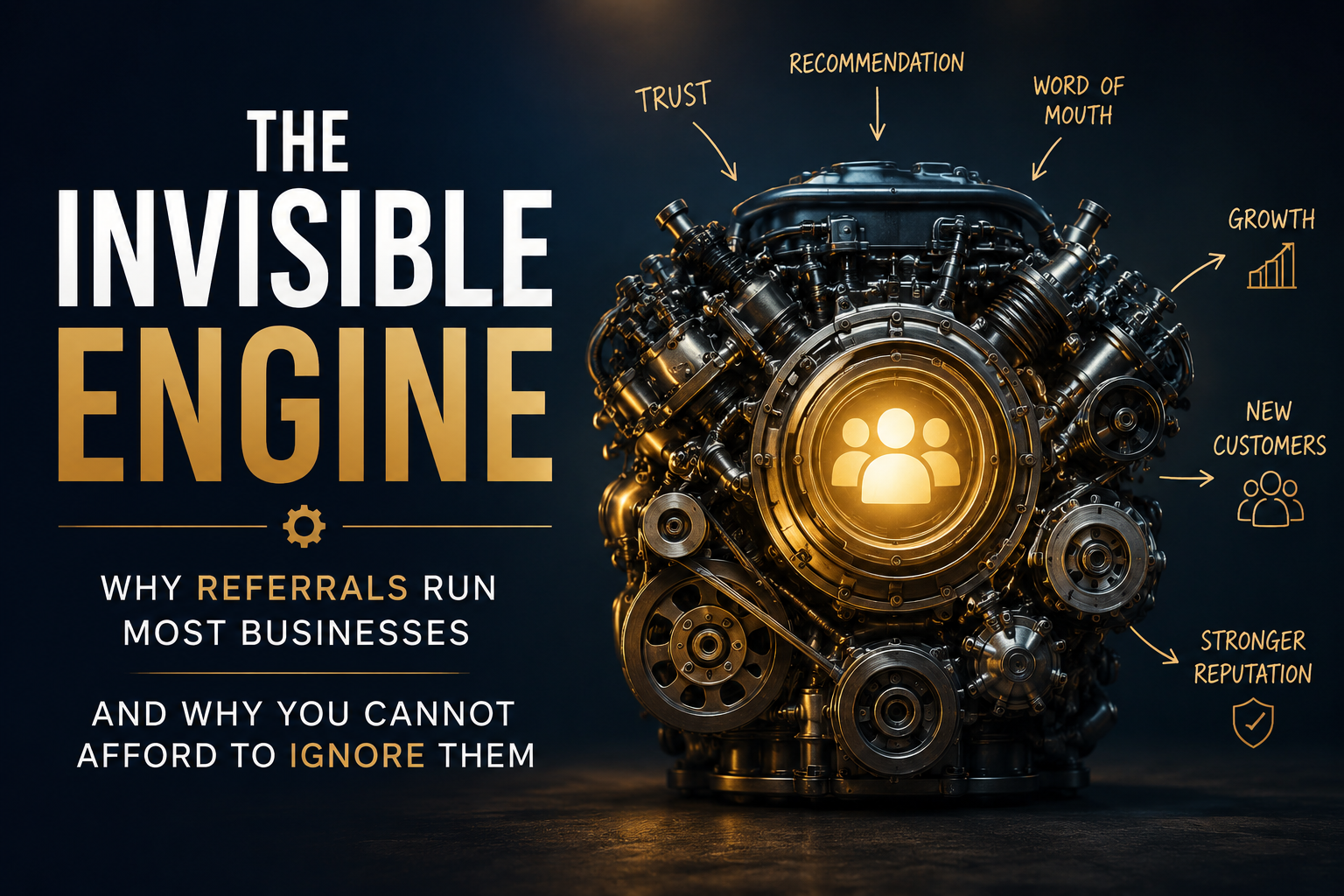
The Invisible Engine: Why Referrals Run Most Businesses and Why You Cannot Afford to Ignore Them

There is a number that sits quietly in the financial records of nearly every successful business, rarely discussed in marketing meetings, rarely celebrated in quarterly reports, rarely optimized with the same urgency as ad spend or content calendars. That number is the percentage of revenue that comes from referrals. It is often higher than the founder expects, sometimes higher than the founder even knows, and in many cases it is the single largest source of new business the company has. Yet it is treated as an afterthought, a happy accident, a byproduct of good work rather than a system to be engineered. This is a costly mistake, because referrals are not a bonus. They are the foundation, and the businesses that understand this build differently from the ones that do not.

The data on this is consistent across industries and decades. Studies by Wharton, the Harvard Business Review, and various market research firms have found that referrals account for somewhere between twenty and fifty percent of new customer acquisition for most established businesses, with some professional service firms seeing numbers as high as seventy or eighty percent. The exact figure varies by industry, by business age, by price point, and by the strength of the referral system itself, but the pattern is universal. Word of mouth is not a marginal channel. It is the dominant channel for businesses that have been around long enough to earn it, and it is often the most profitable channel by a wide margin.

A customer who arrives through a referral is different from a customer who arrives through an advertisement. They come pre-qualified, pre-trusted, and pre-disposed to buy. The cost of acquisition is effectively zero, or close to it, because the marketing work was done by someone the prospect already trusts. The sales cycle is shorter because the objection of whether you are legitimate has already been handled by the referrer. The lifetime value is higher because referred customers tend to be more loyal, less price-sensitive, and more likely to refer others in turn. The churn rate is lower because the relationship begins with social proof embedded in it, not with a transaction between strangers.

This is why the referral percentage matters so much. It is not just a measure of how nice your customers are. It is a measure of how efficiently your business converts trust into revenue, and how much of your growth is funded by goodwill rather than capital. A business that grows primarily through paid acquisition is a machine that requires constant fuel. Every new customer costs money, and the cost typically rises over time as the easy prospects are exhausted and the platforms increase their prices. A business that grows primarily through referrals is a self-sustaining system. The customers bring the customers, and the marginal cost of each new acquisition approaches zero while the trust compounds.

The problem is that most businesses do not know their referral percentage with any precision. They might track it loosely, through a question on an intake form or a casual conversation at checkout, but they rarely build rigorous systems to measure it, to attribute revenue accurately, or to distinguish between a true referral and a customer who happened to hear about them from multiple sources. The result is a blind spot. The founder knows that word of mouth is important, but they do not know how important, and they do not know whether it is growing or shrinking, and they do not know which customers or which experiences are driving it. They are flying a plane with a fogged windshield, guessing at altitude based on how the engine sounds.

This blindness leads to underinvestment. The business that does not know that forty percent of its revenue comes from referrals will not allocate resources to making that forty percent into sixty percent. It will not train its team to ask for referrals at the right moment. It will not build a formal referral program with incentives that reward the behavior it wants. It will not design the customer experience to create moments so remarkable that talking about them becomes natural. It will spend its marketing budget chasing new channels while its most powerful channel atrophies from neglect.

The businesses that treat referrals as a system rather than a surprise do the opposite. They measure obsessively. They know not just how many customers came from referrals, but which customers referred them, what triggered the referral, how long after the purchase it happened, and what the referred customer went on to buy. They map the customer journey looking for peak moments of delight, the moments when the customer is most likely to feel gratitude and most likely to mention the business to a friend. They engineer those moments intentionally, knowing that a referral is not a random event but the predictable outcome of a specific emotional state.

They also ask. This is the part that makes many founders uncomfortable. The idea of directly requesting a referral feels pushy, desperate, or transactional. But the data shows that customers who are satisfied are often willing to refer and simply do not think to do so unless prompted. The prompt does not need to be aggressive. It can be a simple question at the end of a successful project, a note in a follow-up email, a small incentive that feels like a thank-you rather than a bribe. The businesses that master this do not ambush their customers. They create a context where the request feels natural, and they make the act of referring as easy as possible. A referral link, a pre-written email, a social media post ready to share. Friction is the enemy of word of mouth, and the best referral systems remove it at every step.

The importance of this becomes acute when a business is being sold or valued. A buyer looking at a company with a high referral percentage sees a business that is not dependent on the founder’s personal network or on advertising platforms that could change their rules tomorrow. They see a business with a moat made of trust, with customer relationships that produce new customer relationships without additional cost. This is a premium asset. It commands a higher multiple because the risk is lower and the future revenue is more predictable. Conversely, a business with a low referral percentage is a business that must constantly buy its customers, and the buyer knows that the cost of that purchase may rise and the yield may fall. The valuation reflects this uncertainty.For the founder who is not planning to sell, the referral percentage is still the most honest scorecard of the business’s health. Revenue can be manipulated with discounts and promotions. Follower counts can be purchased. Ad metrics can be gamed. But a referral is a vote that costs the voter something. It costs their social capital, their reputation, their implicit endorsement. A customer who refers you is staking their relationship with their friend on your performance. That is a high bar, and clearing it repeatedly is the truest sign that your product or service is genuinely good, not just well-marketed.This is why the obsession with viral marketing, growth hacking, and influencer partnerships often misses the point. Those tactics can spike awareness, but they rarely build the sustained trust that produces referrals at scale. A viral tweet might bring ten thousand visitors, but if the experience does not match the hype, those visitors will not return and they will not recommend. An influencer might drive a burst of sales, but if the product disappoints, the influencer’s audience will blame the influencer for the recommendation, and the trust is damaged on both sides. Referrals are slower than virality, but they are deeper, more durable, and more valuable over time. They are the tortoise that wins the race while the hare is chasing the next trend.The businesses that understand this invest in the long game of trust. They overdeliver on the promise they made in their marketing. They follow up after the sale not to sell again but to ensure satisfaction. They fix problems with a speed and generosity that turns complainers into advocates. They stay in touch with past customers, not with constant sales pitches but with genuine value, reminders, education, or community. They know that a customer who bought once and forgot about them is a wasted asset, while a customer who bought once and remains engaged is a potential referral engine for years.They also understand that not all customers are equally likely to refer. Some are natural connectors, people with large networks and a habit of making introductions. Some are quiet and satisfied but unlikely to mention the business unless directly asked. Some are unhappy but silent, and their silence is a warning sign that the referral percentage could be higher if the underlying issues were addressed. The sophisticated business segments its customers by referral potential and treats the segments differently. The connectors get special attention, early access, and explicit invitations to spread the word. The quiet satisfied customers get the nudge and the tools to make referring easy. The unhappy customers get outreach and resolution before their dissatisfaction becomes invisible churn.The referral percentage is also a diagnostic tool for the broader business. If it is low, the problem might be the product, the pricing, the customer service, the onboarding, or the simple fact that the business has not been around long enough to earn trust. If it is high but declining, the problem might be growth at the expense of quality, a new team member who does not understand the culture, or a change in the competitive landscape that makes the experience less remarkable. If it is high and stable, the business has likely found its rhythm and should protect it fiercely while looking for ways to compound it. The number tells a story, and the founder who learns to read it gains a perspective that no marketing dashboard can replicate.In the end, the reason referrals matter is not because they are cheap or because they are easy. They are neither. They are expensive in the sense that they require a level of quality and consistency that most businesses cannot sustain, and they are difficult in the sense that they cannot be manufactured through sheer effort or spending. They must be earned, and earning them is the work of the entire business, from the first touchpoint to the last follow-up. But once earned, they become the most powerful force in commerce. They are the proof that the business is real, that the promise was kept, that the customer was seen and served rather than merely sold to. They are the invisible engine that turns a transaction into a relationship, a customer into an advocate, and a business into an institution.If you do not know what percentage of your revenue comes from referrals, that is the first thing you should fix. Not because the number itself is the goal, but because the act of finding it forces you to look at your business through the lens of trust rather than the lens of traffic. And once you see it that way, you cannot unsee it. You begin to measure everything by whether it earns a referral or merely makes a sale. You begin to design for the long term rather than the quarterly report. You begin to build something that grows not because you spent more, but because you became worth talking about. That is the difference between a business that survives and a business that lasts.

Posted on

The Work You Did Not Budget For: Why Every Business Takes More Than You Think

There is a moment that comes for every founder, usually around month six or month eighteen, when the spreadsheet stops matching reality. The revenue is lower than projected, the hours are higher than planned, and the list of tasks that were supposed to be finished by now has only grown longer. This is not a failure of planning. This is not a sign that you chose the wrong business or that you are not cut out for entrepreneurship. This is the moment when the business reveals its true shape, and that shape is always larger, messier, and more demanding than the neat outline you drew before you started.

The human mind is not built to estimate complexity accurately. When we imagine a business, we imagine the visible parts. The product being sold, the customer being served, the payment being collected. We do not imagine the email that bounces back because the client’s inbox is full and the follow-up that requires three attempts before they see it. We do not imagine the supplier who ships the wrong color and the negotiation to return it without destroying the relationship. We do not imagine the tax form that arrives in a language you do not speak, the software integration that breaks on a holiday weekend, the employee who quits the day before a major deadline, or the competitor who launches a similar product at half your price the week after you go live. These are not exceptions. They are the texture of the work. They are what running a business actually feels like, and they are invisible until you are inside them.

The planning fallacy is the psychological term for this, but the term makes it sound academic. It is not academic when you are awake at two in the morning rewriting a contract because a clause you did not notice could cost you ten thousand dollars. It is not academic when you realize the marketing strategy that was supposed to take ten hours a week is actually consuming thirty because the platform changed its algorithm and your ads stopped converting and now you are learning a new system from scratch while also fulfilling orders and answering customer complaints. The planning fallacy assumes that you can estimate better if you try harder. The truth is that you cannot estimate what you have never done, and starting a business is always something you have never done, because your business is not anyone else’s business. The variables are infinite and most of them are hidden.

This is why the advice to start before you are ready is both true and dangerous. It is true because waiting for perfect information means waiting forever. It is dangerous because starting without a cushion of time, money, or emotional resilience means that the first unexpected problem becomes a crisis instead of an obstacle. The founders who survive are not the ones who predicted every problem. They are the ones who built enough slack into their lives that the problems did not break them. They saved more money than the business plan suggested. They cleared more time than the launch schedule required. They told their partners and families that the next year would be harder than the spreadsheet implied, and they asked for patience before it was needed, not after they had already disappeared into the work.

The work itself expands to fill the space you give it. This is Parkinson’s Law applied to entrepreneurship, and it is relentless. If you think a task will take two hours, it will take four because you will discover a dependency you did not see, a question you cannot answer without research, a tool that does not work the way the tutorial claimed. If you think a project will take two weeks, it will take six because the client will change their mind, the contractor will miss a deadline, and the version you thought was final will need revisions that reopen work you considered done. This is not pessimism. This is the observed behavior of complex systems with human beings inside them. The only way to combat it is to assume it will happen, to build buffers that feel excessive, and to treat your initial timeline as a fiction that keeps you moving rather than a promise you have made to yourself.

The emotional labor is the part that no business plan captures. The decision to fire someone who is trying hard but not performing. The conversation with a customer who is angry about a delay that was not your fault but is your responsibility. The doubt that creeps in at three in the morning when you check the bank account and the numbers are lower than yesterday and you wonder if you made a terrible mistake. The envy you feel when you see a peer post about their effortless success while you are struggling to keep the lights on. The guilt when you miss a family event because a server went down or a shipment was lost or a contract needed to be signed. The loneliness of being the only person who understands the full picture, because you are the only person who has to. This work does not show up on a task list. It does not bill to a client. It accumulates invisibly until it demands attention, and by then it is often heavy enough to make you question why you started.

The founders who last are not the ones who avoid this emotional labor. They are the ones who build structures to carry it. They hire early, even when it feels expensive, because they know that isolation is a greater cost. They find mentors or peer groups who have been through similar moments, not for advice but for the simple confirmation that the struggle is normal. They separate their identity from the daily performance of the business, so that a bad month does not feel like a bad self. They exercise, sleep, and eat with a discipline that seems impossible given their schedule, because they know that a founder running on empty makes worse decisions than a founder running on rest. These are not luxuries. They are maintenance, and maintenance is always more work than the glamorous parts of the job.There is a particular delusion that infects online businesses, because the internet makes everything look easier than it is. You see a store with a beautiful website and assume the owner spends their days taking product photos and counting profits. You do not see the months of testing payment processors, the abandoned carts that required three email sequences to recover, the chargebacks that consumed hours of documentation, the ad accounts that were banned without explanation and required weeks of appeals, the content calendar that demanded daily creativity while the founder was also handling shipping and customer service and bookkeeping. The internet compresses time. A success story that took three years looks like an overnight result because the post only mentions the launch date and the current revenue. The work in between is edited out, and the editing makes the rest of us feel like we are moving too slowly, working too hard, failing where others succeeded effortlessly.

The truth is that every overnight success was a daily grind for years. The founder who sold their company for millions spent the first two years making less than they would have at a job, working more hours, and carrying more stress. The influencer with a million followers posted daily for eighteen months before the algorithm noticed, and spent another year learning monetization while their audience grew. The course creator with passive income streams built those streams by recording fifty hours of content, testing pricing for months, and handling every customer support ticket personally until they could afford to hire help. The work is always there. It is just hidden behind the highlight reel.

This is not an argument against starting. It is an argument for starting with clear eyes. The work will be more than you think. The timeline will be longer than you hope. The problems will be weirder than you imagine. The emotional cost will be higher than you budgeted. And none of this means you should stop. It means you should prepare. It means you should save more money than the plan says you need. It means you should protect your relationships before the business consumes them. It means you should build systems for rest and recovery before you are exhausted, not after. It means you should accept that the feeling of being overwhelmed is not a sign that you are doing it wrong. It is a sign that you are doing it at all.

The businesses that survive are not the ones with the best ideas. They are the ones with the founders who kept showing up when the work exceeded their expectations. The idea is the starting line. The work is the race, and the race is always longer than the map suggested. The founders who win are not the fastest. They are the ones who packed enough water, who trained for hills they could not see, and who kept moving when the finish line turned out to be farther away than the brochure promised.

If you are thinking about starting a business, or you are in the middle of one and wondering why it feels harder than it was supposed to, the answer is simple. It feels harder because it is harder. Not because you are inadequate. Not because the model is broken. But because the model was never going to be easy, and the people who told you it would be were either selling something or had already forgotten the struggle. The work is the work. It is more than you think, and it is worth doing anyway, but only if you go in knowing that the budget for effort was always too low, and the only adjustment is to raise it.

Posted on

Drop Servicing: The Business Model Hiding in Plain Sight

There is a model that sits between freelancing and running a full agency, and most people do not have a name for it. They call it an agency, or a consultancy, or a marketing firm, but the mechanics are different. The founder does not deliver the service. The founder does not even employ the people who deliver the service. The founder finds the client, quotes the work, collects the payment, and hires someone else to do the job at a lower rate. The difference is the profit. The client never knows, and in many cases, does not care, as long as the work is good and the deadline is met. This is drop servicing, and it is one of the most straightforward ways to build a business online without learning a trade first.

The name is a play on dropshipping, the e-commerce model where you sell products you never stock or ship. In drop servicing, you sell services you never perform. You are the middle layer, the interface, the brand that the client trusts. The actual labor happens elsewhere, often in another country, sometimes through freelance platforms, sometimes through white-label partnerships with other agencies. Your job is not to do the work. Your job is to sell it, manage the client relationship, and ensure quality control.

How It Actually Works

The mechanics are simple on the surface. A client needs a website built, or a logo designed, or a video edited, or a marketing campaign managed. They find your website, your portfolio, your cold email, your LinkedIn post, your ad. They reach out. You quote them a price. That price is typically two to five times what you will pay the freelancer or contractor who actually does the work. You collect a deposit or full payment upfront. You then hire the talent, manage the project, deliver the result to the client, and keep the margin.The client sees a professional brand, a structured process, a single point of contact, and a finished product. They do not see the freelancer in the Philippines or the designer in Eastern Europe or the video editor you found on Fiverr. If the system works, they never need to. The illusion is complete, and the illusion is the product.But the simplicity is deceptive. The model only works if three things are true. First, you must be able to sell. Not post on social media and hope. Not build a website and wait. You must actively generate leads, close deals, and command prices that leave room for markup. Second, you must be able to manage projects. This means setting expectations, creating timelines, reviewing work, handling revisions, and delivering on deadlines even when your freelancer misses theirs. Third, you must be able to maintain quality. If the work is bad, the client blames you, not the anonymous contractor. Your reputation is on the line for every project you outsource.

The Economics of the Middle Layer

The appeal of drop servicing is leverage. A freelancer trades time for money. An agency trades management for money. A drop servicing business trades coordination for money. The founder is not limited by their own hours or their own skills. They are limited by their ability to find clients and their ability to find reliable talent. In theory, this scales faster than freelancing and requires less capital than building an agency with full-time employees.Here is how the math looks in practice. A client pays you five thousand dollars for a website. You hire a developer for fifteen hundred dollars. You hire a copywriter for five hundred dollars. You spend two hundred dollars on a premium theme or plugin. Your direct costs are twenty-two hundred dollars. Your gross profit is twenty-eight hundred dollars. If you spent ten hours selling, managing, and reviewing the project, your effective hourly rate is two hundred eighty dollars. That is more than most freelancers charge, and you did not write a single line of code.

The model becomes dangerous when the margins shrink. If you are competing on price, if the client shops around and finds the freelancer directly, if the project scope creeps and you absorb the cost, the profit evaporates. Drop servicing is not a magic trick. It is arbitrage, and arbitrage only works when there is an information gap or a trust gap that you can fill. The client either does not know where to find the talent, or does not trust the talent they find, or does not want to manage the project themselves. Your value is in bridging that gap. If the gap closes, your business closes with it.

Where the Talent Comes From

Most drop servicing businesses source talent from freelance platforms. Upwork, Fiverr, Freelancer, PeoplePerHour, and Toptal are the common pools. The founder builds a roster of reliable contractors across different skill sets. Web development, graphic design, video production, search engine optimization, social media management, virtual assistance, content writing, and voiceover work are the most commonly outsourced services. Over time, the founder learns which freelancers deliver on time, which ones need hand-holding, which ones disappear under pressure, and which ones can handle direct client communication if necessary.

Some founders move beyond platforms and build direct relationships with contractors in lower-cost countries. The Philippines, India, Pakistan, Ukraine, Romania, and Argentina are common hubs for outsourced talent. A direct relationship can mean better rates, more loyalty, and faster turnaround. It also means more risk. Platforms offer dispute resolution, escrow, and ratings. Direct hires offer none of that. If the contractor takes the deposit and vanishes, you are the one who owes the client a refund or a replacement.The best drop servicing operators treat talent acquisition as a core function, not an afterthought. They interview contractors before they are needed. They test them with small projects. They build a bench of backups for every skill set. They know that one unreliable freelancer can destroy a client relationship and a reputation that took months to build.

The Client Side of the Equation

Finding clients is the harder half of the equation for most founders. The talent is abundant. The clients are not. The most common approaches are cold outreach, paid advertising, content marketing, and partnerships. Cold email and LinkedIn outreach work for B2B services like web design, lead generation, and marketing. Paid ads on Facebook, Instagram, and Google work for consumer-facing services like video editing, logo design, and social media management. Content marketing through YouTube, TikTok, and blogging builds long-term authority but requires patience most drop servicing founders do not have.The sales process is where many drop servicing businesses fail. The founder is often a former freelancer or a marketer who learned the model from a course. They understand how to hire on Fiverr. They do not understand how to sell a five thousand dollar package to a small business owner who has never bought a website before. They quote prices over email. They skip discovery calls. They fail to ask about the client’s real goals, their timeline, their budget, their past experiences. They present a price, the client ghosts, and the founder wonders why nobody buys.

Selling services is a skill. It requires listening, diagnosing, prescribing, and closing. It requires handling objections about price, timing, and scope. It requires building trust in a conversation that might last twenty minutes. The freelancer who spent years honing a craft often lacks this skill. The drop servicing founder who never learned a craft often lacks it too. The ones who succeed are the ones who treat sales as a craft in itself and invest the time to learn it.

The Ethics and the Reputation Risk

Drop servicing sits in a gray zone that makes some people uncomfortable. Is it deception if the client never asks who does the work? Is it fair if the freelancer does the labor and the founder takes the majority of the revenue? Is it sustainable if the client could eventually find the freelancer directly and cut out the middleman?

These questions have no universal answer. The client is paying for a result, not for a specific person to perform the work. Most businesses outsource something. Law firms use contract attorneys. Marketing agencies use freelance writers. Software companies use offshore developers. The difference is transparency and scale. A traditional agency might tell the client that a team is involved. A drop servicing business often implies, through branding and process, that the work is done in-house. The closer the implication is to a lie, the higher the reputational risk.

The bigger risk is quality. If the founder does not understand the service they are selling, they cannot judge quality effectively. They cannot catch errors in code they do not read. They cannot spot plagiarism in copy they do not write. They cannot assess whether a logo is original or a template with minor tweaks. They rely entirely on the freelancer’s competence and honesty. When that fails, the client receives bad work, blames the brand, and leaves a negative review that no amount of marketing can fix.

The founders who last in this model are the ones who develop enough expertise to audit the work, even if they do not perform it. They learn the basics of web development, or design principles, or copywriting standards. They know enough to ask the right questions, spot red flags, and demand revisions before the client ever sees the draft. They are not passive middlemen. They are active quality controllers.

Scaling and the Transition to Real Agency

Drop servicing is often a phase, not a destination. The founder starts alone, selling and outsourcing everything. As revenue grows, they hire a project manager, then a sales person, then an in-house designer or developer for the most critical work. The freelancers become a supplement, not the core. The business starts to look like a real agency, with employees, culture, and processes that the founder built from the ground up.This transition is where the model proves its value. It allowed the founder to start without capital, without skills, without a team. It generated cash flow that funded the hiring of that team. It validated that there was market demand before the founder invested years learning a trade. It was a stepping stone, not a scam, and the stepping stone worked because the founder treated it seriously.

Some founders never make the transition. They stay in the arbitrage phase indefinitely, churning through clients and freelancers, making money but building nothing durable. These are the operators who give drop servicing a bad name. They overpromise, underdeliver, and move on to the next client before the last one realizes they were sold a template at a custom price. They are the reason the model carries a stigma in some circles.

Who Should Consider This Model

Drop servicing is not for everyone. It is for people who can sell, who can manage, and who can tolerate ambiguity. It is for people who are comfortable with the idea that their value is not in what they make with their hands but in what they assemble with their judgment. It is for people who can handle the stress of a client deadline when their freelancer has gone silent and the deposit is already spent. It is for people who see business as a system to be built, not a craft to be practiced.

It is not for people who want to build a personal brand around their expertise. It is not for people who take pride in doing the work themselves. It is not for people who are risk-averse about reputation, because the reputation is always one bad project away from damage. And it is not for people who think it is easy money, because the easy money phase of this model ended years ago when the freelance platforms became saturated and the clients became savvier.

The Honest Bottom Line

Drop servicing is a real business model with real risks and real rewards. It is not a get-rich-quick scheme, though it is often marketed as one. It is not passive income, though the leverage is real. It is a coordination business, and coordination is harder than it looks. The founders who succeed are the ones who treat it like a business from day one. They build systems for hiring, for quality control, for client communication, and for sales. They invest in learning the services they sell well enough to judge them. They charge prices that leave room for error, for revisions, and for the occasional project that goes sideways. They build relationships with clients that transcend any single transaction.

The ones who fail treat it like a hack. They copy a website template, run a few ads, hire the cheapest freelancer they can find, and wonder why the client complains and the profit margin is zero. They move on to the next model, the next course, the next promise of easy money, never realizing that the problem was not the model. The problem was the operator.

If you are considering drop servicing, start with honesty. Be honest about whether you can sell. Be honest about whether you can manage. Be honest about whether you are willing to learn enough about the services you offer to protect your clients from bad work. Be honest about whether you are building a business or just looking for a shortcut. The model will work for some and fail for others, and the difference is rarely the model. It is almost always the person running it.

Posted on

The Valuation You Can’t Fake: Why Knowing Your Business’s Worth Is Key

Most entrepreneurs start with the wrong question. They ask how to get customers, how to build a product, how to run ads, how to grow a team. These are tactical questions, and tactics are seductive because they feel like progress. But the real question is this: what is this thing worth to someone who might want to buy it?

If you cannot answer that question with a number that would hold up under scrutiny, you are not building a business. You are building an income stream attached to your personality, your time, and your stress. And that is fine if that is what you want. But most people do not want that. Most people want an asset. Something they can sell, step away from, or scale without their daily presence becoming the bottleneck. The path to that outcome does not begin with a logo or a landing page. It begins with an honest valuation.

The Honesty Nobody Wants

Valuation is not a number you pull from ambition or hope. It is a number derived from what the market has actually paid for businesses like yours, adjusted for your specific risks, growth trajectory, and dependency on you as the founder. If you are doing ten thousand dollars a month in revenue but you are the only person who can deliver the service, talk to the clients, and close the deals, your business is not worth a multiple of that revenue. It might be worth close to nothing. A buyer is not purchasing your past effort. A buyer is purchasing future cash flows they can extract without you in the building. If the cash flows disappear when you do, there is nothing to buy.

This is the honesty that stings. Most founders discover, when they run the numbers properly, that their business is worth far less than they imagined. Not because they have failed, but because they have optimized for the wrong thing. They optimized for revenue, for social media followers, for vanity metrics that feel impressive at dinner parties but do not translate to transferable value. A business with two hundred thousand dollars in revenue and a full-time operator who is not the founder is worth more than a business with five hundred thousand dollars in revenue and a founder who works eighty hours a week and holds every client relationship personally.

The market does not care about your hustle. The market cares about risk-adjusted future earnings. And the biggest risk in most small online businesses is the founder.

How Valuation Actually Works

The standard approach for valuing a small online business is to apply a multiple to seller discretionary earnings, or SDE. SDE is essentially your profit plus your salary plus any personal expenses you have run through the business. The multiple typically ranges from two to five times SDE for most online businesses, though it can go higher for SaaS companies with recurring revenue, strong margins, and low churn, or lower for agencies with high client concentration and no recurring contracts.But the multiple is not the whole story. It is adjusted by a series of risk factors. Is the revenue concentrated in one or two clients? That lowers the multiple. Is the traffic dependent on a single Google algorithm or one influencer partnership? That lowers the multiple. Is the technology proprietary or easily replicated? That lowers the multiple. Are the financials clean, with three years of tax returns that match the profit and loss statements? That raises the multiple. Is there a management team in place that can run the business without the founder? That raises the multiple significantly. Is the growth rate accelerating, flat, or declining? That changes everything.

A business doing three hundred thousand dollars in SDE with clean books, diversified traffic, a small team, and a founder who works ten hours a week might sell for four to five times SDE, or one point two to one point five million dollars. The same business with all revenue coming from one client, no team, and a founder working sixty hours a week might struggle to sell at all, or might go for one to two times SDE if the buyer is betting they can diversify quickly. The difference is not the revenue. The difference is the structure.

Why Starting with Valuation Changes Everything

When you know what buyers are actually paying for, your priorities invert. Instead of asking how do I get more revenue, you start asking how do I make this business less dependent on me. Instead of chasing every client, you start asking which clients can be served by a system, not a person. Instead of building a personal brand, you start building a brand that can be operated by someone else. The goal shifts from making money today to building an asset that produces money tomorrow, with or without you.This is not about selling. Most founders who build sellable businesses never actually sell. They hold them, they collect the cash flow, they step back into an advisory role, and they start something else. The option to sell is what creates the freedom. A business that cannot be sold is a prison with good cash flow. A business that can be sold is a choice.

Knowing your valuation also changes how you think about investment. If you are considering spending fifty thousand dollars on a new marketing campaign, the question is not will this generate revenue. The question is will this increase the sellable value of the business by more than fifty thousand dollars. Sometimes the answer is yes. Sometimes the answer is no, because the campaign creates revenue that is tied to your personal involvement in closing deals, which does not transfer. A marketing campaign that builds a brand and a lead generation system is an asset. A marketing campaign that requires you to personally demo and close every sale is a treadmill.

The Trap of Founder Dependency

The most common reason online businesses fail to sell, or sell for disappointing multiples, is founder dependency. This manifests in ways that are easy to rationalize and hard to fix. You are the only one who understands the product. You are the only one the clients trust. You are the only one who knows how to run the ads. You are the only one who can write the content. You are the only one who understands the software stack. Each of these is a comfort in the early days and a liability in the later days.

The fix is not to hire a team and hope for the best. The fix is to document everything, systematize everything, and gradually transfer ownership of each function to someone else while you are still there to supervise. This takes longer than most founders want it to take. It requires you to slow down revenue growth in the short term to build infrastructure that enables faster growth later. It requires you to let people make mistakes that you would have avoided. It requires you to accept that in the short term, things will get worse before they get better. Most founders skip this step because it is uncomfortable and because the revenue numbers look better when they do everything themselves.

But the revenue numbers are a lie if they cannot exist without you. And buyers see through that lie immediately. They will dig into your client relationships, your traffic sources, your team structure, and your personal calendar. If they find that removing you from the equation removes half the revenue, they will either walk away or cut their offer in half. Sometimes both.

The Emotional Cost of Honesty

There is a psychological barrier here that most business advice ignores. Telling a founder that their business is worth less than they thought is not just a financial conversation. It is an identity conversation. The business is their creation, their proof of competence, their answer to the question of whether they could make it on their own. To learn that the market values that creation at a fraction of their emotional investment is a blow to the ego that many people avoid by simply never looking.

They do not get a valuation. They do not talk to brokers. They do not look at comparable sales. They keep their head down, keep grinding, and tell themselves they will figure it out later. But later is when the burnout hits, or the market shifts, or a competitor eats their lunch, and they are forced to sell from a position of weakness. The founders who get the best outcomes are the ones who looked at the number early, absorbed the disappointment, and spent the next two to four years fixing the gaps.

Honesty is not just about knowing the number. It is about accepting what the number implies about your current strategy, your current structure, and your current self. It is about looking at a valuation of two hundred thousand dollars for a business you have spent five years building and deciding whether that is enough, or whether you are willing to do the hard work of making it worth a million. The decision is yours. But you cannot make it if you do not know the number.

How to Start

If you are at the beginning of your online business journey, the best time to think about valuation is now. Not because you are going to sell next year, but because every decision you make from day one either builds transferable value or erodes it. Choose a business model that can scale without your daily presence. SaaS, marketplaces, subscription content, and productized services are all structurally more sellable than custom consulting or personal coaching. If you are in a service business, productize it. Create packages, create systems, create delivery teams, and remove yourself from the one-to-one client work as quickly as possible.

If you are already running a business and have never done a proper valuation, do it this month. Find a business broker who specializes in online businesses. Look at marketplaces like Empire Flippers, FE International, or Quiet Light to see what businesses like yours are actually selling for. Calculate your SDE. Apply the multiples you see in comparable sales. Be conservative. Then look at the gap between that number and what you think your business is worth, and ask yourself what would have to change to close that gap.The list of changes is your real business plan. Not the marketing strategy. Not the product roadmap. The list of structural changes that make your business worth more to a stranger than it is to you right now. That is the work that matters.

The Long Game

Building a sellable business is slower than building a personal income machine. It requires patience, systems thinking, and the willingness to sacrifice short-term revenue for long-term structure. It requires you to hire before you are comfortable, to delegate before you are ready, and to document before you feel like you have time. It requires you to look at your business as an object separate from yourself, with its own value, its own risks, and its own potential future without you.

That separation is the goal. Not because you want to leave, but because you want the option. The most successful entrepreneurs I know are not the ones who sold for the highest price. They are the ones who built something so structurally sound that they could have sold at any time, chose not to, and collected the cash flow while living the life they wanted. The valuation was not the endgame. The valuation was the proof that they had built something real.

Know your number. Be honest about it. Fix what it tells you to fix. That is the only path to a business that is truly yours, in the sense that you can choose to keep it, sell it, or step back from it without the whole thing collapsing. Everything else is just a job with extra steps.

Posted on

The Inner Circle: 10 Elite Professional Communities That Cost a Fortune to Join (And How to Build Your Own)

There’s a reason the most valuable professional communities aren’t listed on Meetup.com. The real power networks operate behind closed doors, behind paywalls, and behind vetting processes so rigorous they’d make a CIA background check look casual.These aren’t “communities” in the Facebook Group sense. They’re curated ecosystems where a single introduction can be worth more than a year’s salary. Where members don’t just share advice—they share deals, partnerships, and opportunities that never touch the public market.Let’s pull back the curtain.

1. Genius Network — 25,000/yearFounded by Joe Polish, Genius Network is the gold standard of high-ticket masterminds. It’s not just a networking group; it’s a curated board of advisors for entrepreneurs doing 1M+ annually. The price tag isn’t arbitrary—it’s a filter. At 25K, you don’t get tire-kickers. You get people who’ve already proven they can execute.What makes it elite: The “Genius Recovery” ethos. Members are open about their struggles, not just their wins. Vulnerability at this price point is rare—and valuable.

2. YPO (Young Presidents’ Organization) Forums — 10,000+/yearYPO isn’t just a networking group; it’s a requirement for admission to the business elite. To join, you need to be under 45 and lead a company generating 15 million+ in annual revenue. The Forums—small, confidential peer groups—are where members discuss everything from succession planning to marital problems.

What makes it elite: The revenue threshold self-selects for people who’ve already solved the “how do I make money?” problem and are now wrestling with “how do I build a legacy?”—3. EO (Entrepreneurs’ Organization) Forum — 2,500–5,000/year

The slightly more accessible cousin to YPO, EO requires 1M+ in annual revenue. Forums are monthly meetings where members present their biggest challenges and get unfiltered feedback from peers who’ve been there. The magic isn’t in the advice—it’s in the shared experience of people who don’t need to Google “how to scale.”What makes it elite: The “Gestalt” methodology—structured, confidential, no advice-giving, only experience-sharing. It forces a level of honesty that doesn’t happen in casual coffee meetings.

4. Strategic Coach — 10,000–20,000+/yearDan Sullivan’s program isn’t cheap, but it’s not trying to be. Strategic Coach works with entrepreneurs who want to 10x their results while working less. The community aspect happens in quarterly workshops where members map out their next 90 days with peer accountability.What makes it elite: The focus on “Unique Ability”—doubling down on what you do best and eliminating everything else. This attracts people who are serious about leverage, not just hustle.

5. MastermindTalks — 25,000–50,000/yearJayson Gaignard’s creation is application-only, and the acceptance rate is lower than Harvard’s. It’s not about the content; it’s about the curation. Gaignard famously once refunded every member and started over because the energy wasn’t right.What makes it elite: The events are intimate (50–100 people max), and the networking happens at private dinners, not in conference halls. The ROI isn’t measured in leads; it’s measured in relationships.

6. The World Luxury Chamber of Commerce (WLCC) — Invitation OnlyThis isn’t a “pay to play” network—it’s invitation-only, and the vetting process is opaque. The private LinkedIn group connects CEOs, founders, and visionaries in the luxury sector. It’s less about transactions and more about “who do you know that I should know?”What makes it elite: The luxury sector operates on relationships, not cold outreach. WLCC is the digital equivalent of a private club where everyone already knows your reputation before you shake hands.

7. The Summit Series — 5,000–15,000/eventTechnically an event series, Summit has built a community that transcends individual gatherings. Their flagship events bring together entrepreneurs, artists, and activists for experiences designed to create “collisions”—unexpected connections that lead to breakthroughs.What makes it elite: The experience design. You’re not sitting in a hotel ballroom; you’re on a cruise ship or in a remote mountain location. The environment forces a different caliber of conversation.

8. The Forum (UK Customer Service Network) — £2,995–£20,000/yearA more niche example, but illustrative: The Forum charges nearly £3,000 for base membership and up to £20,000 for corporate unlimited access. For a customer service network. Why? Because the members are senior leaders at major brands, and the value isn’t in the content—it’s in benchmarking against competitors who’d never take your call otherwise.

What makes it elite: Vertical specificity. Everyone in the room speaks the same language and faces the same regulatory and operational challenges.

9. Talent Collective (Executive Tier) — 2,899/year

While more accessible than YPO, the Executive tier of Talent Collective includes private leadership masterminds and executive coaching. It’s a tiered model that lets members self-select based on how much access they need.What makes it elite: The tiered structure creates a natural progression. Members can start at the Professional tier (69/month) and upgrade as their needs—and means—grow.—10. ADHD Big Brother (Small Group Coaching) — 150/month; 1:1 at 400/month

A surprising entry, but important: ADHD Big Brother proves that “elite” doesn’t always mean corporate. Their small group coaching at 150/month and 1:1 at 400/month creates a high-commitment environment for a specific niche. The price filters for people who are serious about managing their ADHD, not just looking for tips.What makes it elite: Niche specificity. In a world of generic productivity advice, a focused community for high-performers with ADHD creates deeper bonds than a general business group ever could.

The Pattern: What All Elite Communities Have in Common

Before we talk about how to build one, let’s identify the DNA.First, price functions as a filter, not a revenue model. The fee isn’t about profit; it’s about commitment. Free groups have 5% participation rates. Paid groups have 80%+.Second, curation always wins over scale. Every community on this list turns people away. The exclusivity is the product.

Third, the value flows peer-to-peer, not guru-to-student. The leader facilitates; the members deliver the value. This is crucial.Fourth, confidentiality serves as currency. What’s shared in the group stays in the group. This creates a safety zone that doesn’t exist on LinkedIn.

Fifth, vertical or psychographic specificity is non-negotiable. They’re not “for entrepreneurs.” They’re for “luxury brand CEOs” or “ADHD high-performers” or “15M+ revenue founders under 45.”

How to Build Your Own Elite Community: A Practical Blueprint

You don’t need a 25K price tag to start. You need the right structure. Here’s how to build a community that can command premium pricing within 12–18 months.

Phase 1: Define Your Niche (Months 1–2)The mistake most people make is starting broad. “Entrepreneurs” is too wide. “1M+ e-commerce founders using Shopify” is a market.Here’s the framework. Ask yourself four questions. What vertical or industry or business model are you targeting? What stage of revenue or career level defines your ideal member? What mindset or challenge unites them psychographically? And most importantly—who is this not for? The exclusion criteria matter as much as the inclusion criteria.

Here’s an example: “Agency owners doing 500K–2M who want to productize their services and escape client work.” Specific enough to attract, specific enough to repel.

Phase 2: Validate with a Free Pilot (Months 2–4)Before you charge, prove the concept. Recruit 5–10 ideal members personally. No applications yet—hand-pick them. Run 4–6 meetings with a structured agenda. Document outcomes. What deals happened? What problems got solved? Get video testimonials. These become your sales material.

The agenda structure that works looks like this. Start with Wins—10 minutes where each member shares a win since last meeting. This sets positive energy. Then move to the Hot Seat—30 minutes where one member presents a challenge. The group asks clarifying questions, then shares experiences (not advice). The distinction matters. Then Resource Share—10 minutes where one member shares a tool, book, or contact that helped them. Then Commitments—5 minutes where each member states one action they’ll take before next meeting. Finally, Next Steps—5 minutes to schedule the next meeting and assign roles. Facilitator, timekeeper, and note-taker rotate.

Phase 3: Introduce Paid Tiers (Months 4–8)Tier 1 is Community Access at 50–200/month. This includes an async community (Circle, Mighty Networks, or Skool), monthly group calls, and a resource library.

Tier 2 is the Mastermind Group at 500–2,000/month. This includes bi-weekly hot seat calls with 6–8 members max, a private Slack or Discord channel, and a quarterly 1:1 check-in with you.Tier 3 is the Inner Circle at 2,000–10,000/month or 10K–50K/year. This includes monthly in-person or virtual retreats, direct access to you via text or voicemail, private deal flow and introductions, and an application-only process.

Pricing psychology matters here. Your top tier should be uncomfortably expensive. If it doesn’t make you slightly nervous to quote the price, it’s too low. The price signals the caliber of member you’ll attract.Phase 4: Build the Infrastructure (Months 6–12)Don’t overthink the platform. Start with Circle at 89–199/month for async community plus courses. Or Skool at 99/month flat for simplicity and gamification. Or Mighty Networks at 41–360/month for social-media-like engagement. Or Disco at 359/month if you’re running cohort-based programs with AI features.

The application process should include 5–10 questions about their business, goals, and what they’ll contribute. Revenue or career stage verification through LinkedIn, website, or a quick call. A “why this group, why now?” essay question. And a 15-minute video interview for top tiers.

Accept 30–40% of applicants. Turning people away increases the perceived value of acceptance.

Phase 5: Scale Without Diluting (Months 12–18)The challenge is that more members equals less intimacy. Here’s how to grow while keeping it elite.Use the Cohort Model. Instead of adding members to an existing group, launch new cohorts quarterly. Each cohort stays together for 6–12 months, then graduates to an alumni network.Use the Chapter Model. Geographic or industry chapters feed into a central annual event.

Create an Alumni Tier. Graduates of your mastermind join a lower-cost alumni network at 100–500/month that keeps them connected and feeds referrals into your higher-tier programs.Host Annual Events. One flagship event per year where all tiers mingle. This justifies the membership and creates the “collision” moments that justify the price.

The Business Model Math

Let’s say you launch a mid-tier mastermind. The price is 1,000/month (12,000/year). Group size is 8 members per group. You run 3 groups (24 members total). Your time is 6 hours/month per group (facilitation plus prep) which equals 18 hours/month. Revenue is 24,000/month which equals 288,000/year. Your effective hourly rate is 1,333/hour.

Now add the top tier. 5 members at 3,000/month equals 15,000/month. And the community tier. 100 members at 100/month equals 10,000/month.Total revenue is 49,000/month which equals 588,000/year.With a part-time assistant and the right platform, this is a one-person business. The leverage isn’t in your time—it’s in the curation.

The Hard Truth About Elite Communities

The most successful community builders I know share one trait: they’re willing to be disliked.

They turn away friends who don’t fit the criteria. They refund members who don’t participate. They enforce confidentiality rules that seem paranoid. They charge prices that make people angry.Because the alternative is a “community” that’s just a chat room with a cover charge. And there are already 10,000 of those.

The elite communities work because the members feel chosen. Not for their money—for their fit. The money just proves they’re serious.—Your Next MoveIf you’re considering building a community, start here.

Pick your niche. Write down the specific profile of your ideal member. If you can’t describe them in one sentence, keep narrowing.

Recruit 5 pilot members. Hand-pick them. No applications, no funnels. Personal outreach only.

Run 6 meetings. Use the agenda above. Document everything.

Ask for payment. After meeting 4, say: “This has been valuable. I’m formalizing this as a paid group at X/month. Are you in?” If they hesitate, your price or your delivery needs work.

Iterate for 90 days. Then launch publicly with testimonials, case studies, and an application process.The elite communities didn’t start as elite. They started as small groups of committed people who proved the model. The exclusivity came later, as a protection of what they’d built.

Your community can be next. But only if you’re willing to build something worth protecting.

Posted on

Best Niches for Calculator Websites With High Affiliate Payouts

Not all calculator niches are created equal. You can build a beautifully designed calculator site that gets decent traffic and still earn almost nothing — because the affiliate programs behind it pay $5 per signup. Or you can build a simpler site in the right niche and earn $500 per conversion.The difference is not traffic. It is niche selection.This article breaks down the best niches for calculator websites based on two things that actually matter — search demand that never goes away and affiliate programs that pay enough to build a real income around.

What Makes a Calculator Niche Worth Building In

Before getting into specific niches it helps to understand what separates a good calculator niche from a bad one.

The best niches have four things in common. The audience makes frequent financial decisions and needs accurate numbers to make them. The searches are evergreen — people ask the same questions year after year regardless of trends. The affiliate programs pay enough per conversion to generate meaningful income at realistic traffic levels. And the niche is specific enough that you are not competing directly with NerdWallet, Bankrate, or other massive finance sites with decades of domain authority.

Generic personal finance calculators fail this test. Mortgage calculators, savings calculators, and retirement calculators are searched constantly but dominated by sites with hundreds of employees and millions in SEO budgets. The opportunity is not there for a small independent site.The opportunity is in the gaps. Specific audiences with specific problems that the big sites ignore.

Trucking and Owner Operators

Trucking is one of the strongest calculator niches available right now. There are approximately 350,000 owner operators in the United States making constant financial decisions without any financial infrastructure behind them. They calculate load profitability before accepting freight. They estimate IFTA taxes every quarter. They compare the cost of buying versus leasing a truck. They evaluate fuel card savings before signing up.Every one of those decisions is a calculator opportunity and every one of those calculators connects naturally to an affiliate offer.

The affiliate programs in trucking pay reliably. Fuel card companies like Relay and Comdata pay per signup. Load boards like DAT and Truckstop pay per subscription. Factoring companies like RTS Financial pay $100 to $300 per funded client. ELD providers like Motive pay per activation.

The searches are completely evergreen. IFTA has existed for decades and will exist for decades more. Load profitability math does not change. Fuel costs always fluctuate and truckers always want to know their numbers.Competition from large sites is minimal. The big finance sites do not serve truckers. The trucking industry publications do not build tools. The gap is real and largely unoccupied.

Commercial Solar

Solar is one of the highest paying affiliate niches on the internet and calculators are the natural entry point for solar buyers.A homeowner or business owner considering solar has one primary question before everything else — will this actually save me money and how long until it pays for itself. A solar savings calculator, a payback period calculator, and an ROI calculator answer those questions directly. Someone who just calculated that solar will save them $2,400 a year and pay for itself in six years is a warm lead by definition.

Solar lead generation pays between $50 and $200 per qualified residential lead and significantly more for commercial solar. A calculator site that generates 50 qualified solar leads per month is earning $2,500 to $10,000 monthly from a single niche.The searches are strong and growing. Solar adoption is accelerating and the questions people ask before buying — savings, costs, incentives, payback — are consistent and high volume.

Small Business Loans and Equipment Financing

This is arguably the highest value calculator niche available to an independent site owner.Small business owners seeking financing have an immediate and urgent need for accurate numbers. A loan payment calculator, a cash flow calculator, a break even calculator, and an equipment financing estimator all serve that need directly. And the person using those calculators is actively considering borrowing — which means they are the most valuable lead a lender can acquire.

Business loan affiliate programs pay between $200 and $2,000 per funded loan depending on the lender and loan size. Equipment financing affiliates pay similarly. A site generating 10 funded loan referrals per month could earn $2,000 to $20,000 monthly from a single revenue stream.

Platforms like Lendio, Fundera, and Biz2Credit all have affiliate programs and actively seek referral traffic. The demand from lenders for qualified leads is enormous and the supply of good calculator sites serving small business owners is limited.

The search volume is consistent. Small business owners seek financing in every economic condition. The questions they ask before applying — can I afford this payment, when will I break even, how much can I borrow — do not change.

Contractors and Tradespeople

Contractors represent one of the most underserved audiences on the internet. Electricians, plumbers, HVAC technicians, roofers, and general contractors run businesses that generate significant revenue but rarely have financial tools built specifically for them.A job bid calculator, a labor rate calculator, a materials markup calculator, a profit margin checker, and an hourly rate estimator all solve problems contractors face daily. These are not occasional decisions — a contractor bids jobs constantly and needs fast accurate numbers every time.

The affiliate programs here are strong. Field service software companies like Jobber and ServiceTitan pay well for referrals. Business insurance providers pay per quote. Equipment financing companies pay per funded deal. Accounting software like QuickBooks pays per signup.

The niche is specific enough to avoid competing with large finance sites but broad enough to support significant traffic across dozens of calculator types and trades.Freelancers and Independent ConsultantsThe freelance economy continues to grow and freelancers have a constant need for rate and profitability calculators.

How much should I charge per hour. How much do I need to earn to replace my salary. How much should I charge for this project. What is my effective hourly rate after taxes. These questions get asked by millions of freelancers and the searches are consistent year over year.

The affiliate programs here include accounting software, invoicing tools, contract management platforms, and business banking. Companies like FreshBooks, Bonsai, HoneyBook, and Mercury all pay meaningful affiliate commissions and actively court freelancer audiences.

The audience is large, digitally native, and actively searching for tools to manage their finances. A well built freelancer calculator site can rank quickly because competition is relatively limited compared to the search volume available.

Real Estate Agents

Real estate agents are self employed and financially sophisticated enough to use professional tools but underserved by the big real estate sites which focus on consumers not agents.

A commission calculator, a GCI tracker, a split calculator, a transaction profit calculator, and a marketing ROI calculator all serve the agent audience directly. These are searches agents make repeatedly and the tools they find are often generic or buried inside expensive CRM platforms.

The affiliate opportunity here is strong. Real estate CRM platforms like Follow Up Boss and Sierra Interactive pay well for referrals. Transaction management software companies pay per signup. Real estate coaching programs pay per enrollment.The Niches to Avoid

Some calculator niches look attractive but underperform in practice.

Personal finance calculators targeting consumers — budgeting, savings, retirement — are dominated by sites with enormous authority and budgets. The traffic is there but ranking is extremely difficult and the affiliate payouts are lower than B2B niches.Health and fitness calculators get significant traffic but the affiliate programs are weak. BMI calculators and calorie calculators generate millions of searches but the monetization options are limited and the RPM is low.

Crypto and investment calculators attract sophisticated users who are ad averse and resistant to affiliate offers. The traffic can be high but conversion rates are low.

How to Choose Your First Niche

Start with the audience you understand best. If you have a background in trucking, contracting, or freelancing you already speak the language of that audience. That authenticity matters when you are writing supporting content and seeding your tool in communities.

Then verify the affiliate programs before you build. Find at least two or three programs paying $50 or more per conversion that naturally connect to the calculators you plan to build. If the affiliate programs are weak the niche is weak regardless of traffic potential.

Finally check the competition at the calculator level not the industry level. Search for the specific calculators you plan to build. If the top results are basic tools on generic sites with no specific authority in the niche you have a real opportunity.

The Bottom Line

The best calculator niches are not the most obvious ones. They are the specific audiences that large sites ignore — truckers, contractors, solar buyers, small business borrowers, freelancers, and real estate agents. These audiences have real money problems, search for answers consistently, and connect naturally to affiliate programs that pay enough to build a meaningful income around.

Pick one niche. Build five calculators. Apply to two or three affiliate programs. That is the complete foundation of a calculator site that can generate $25,000 to $125,000 a year at maturity.

The niche selection is the most important decision you make. Everything else follows from it.

Posted on

What is a Niche Calculator Site and How Do You Build One

A niche calculator site is one of the simplest passive income assets you can build on the internet. It is a website built around a collection of free calculators that solve specific problems for a specific audience. Instead of writing blog posts that chase trends and expire, you build tools that answer the same questions people ask every single day — and collect affiliate commissions when those visitors take action.

The concept is straightforward. Someone searches “how much will my truck payment be” or “is this load worth taking.” They find your calculator, get their answer in 30 seconds, and if your affiliate link is in the right place, you earn a commission when they sign up for something relevant.No content to update. No social media to maintain. No email list to manage. Just a tool doing its job quietly in the background.

What Makes a Good Niche Calculator Site

The best niche calculator sites share four characteristics.

First, they serve an audience with a real money problem. Truckers calculating load profitability, contractors estimating job costs, solar buyers calculating payback periods. These are people making financial decisions and they need accurate numbers fast.

Second, they target searches that never go away. “IFTA calculator” gets searched every quarter by every owner operator in America. That search existed in 2015 and it will exist in 2035. That kind of permanence is what makes a calculator site durable.

Third, they connect naturally to high value affiliate programs. A trucker using a fuel savings calculator is one click away from signing up for a fuel card. A small business owner using a loan payment calculator is one click away from a loan application. The calculator and the affiliate offer are the same conversation.

Fourth, they are cheap to build and nearly free to run. A React app deployed on Vercel costs nothing monthly. A domain costs $12 a year. The entire infrastructure cost of a niche calculator site is essentially zero.

How to Pick Your NicheThe best niches for calculator sites combine three things — a large audience, frequent financial decisions, and affiliate programs that pay well.

Some of the strongest niches right now are trucking and owner operators, contractors and tradespeople, solar buyers, small business owners seeking loans, freelancers calculating rates, and real estate agents tracking commissions.

The common thread is self employed people making money decisions without a finance department behind them. They need tools and they are underserved by the big financial sites that focus on consumers not tradespeople.

Avoid niches where the audience is too broad and generic. A general mortgage calculator competes with Bankrate and NerdWallet. A contractor job cost calculator competes with almost nobody.

What Calculators to Build

Start with five calculators that cover the core financial decisions your audience makes repeatedly.For truckers that means an owner operator profit calculator, a load profitability checker, an IFTA tax estimator, a fuel card savings calculator, and a truck buy versus lease calculator.

For contractors that might mean a job bid calculator, a labor rate calculator, a materials cost estimator, a profit margin checker, and an hourly rate calculator.Each calculator should solve one specific problem completely. The goal is for someone to arrive with a question and leave with a number they trust.

How to Build It

You do not need to be a developer to build a niche calculator site in 2026. The tools available make it accessible to anyone willing to learn the basics.

The simplest stack is React for the frontend, Vercel for hosting, and a custom domain from Namecheap. React handles the calculator logic and UI. Vercel deploys it for free. Your total cost is $12 a year for the domain.If you are not technical, tools like Claude can build the entire calculator suite for you. Describe what you need — inputs, outputs, logic — and the code comes back ready to deploy. The five trucking calculators in this article were built this way in a single session.

The design should feel purpose built for your audience. Truckers respond to dark themes, clear numbers, and no nonsense layouts. Contractors want something that feels like a professional tool not a consumer app. Match the aesthetic to the audience.

How to Monetize It

There are three reliable revenue streams for a niche calculator site.

Affiliate commissions are the primary revenue driver. Apply to affiliate programs that serve your niche and place relevant calls to action at the bottom of each calculator. A trucker finishing the IFTA calculator sees a link to an ELD tracking app. A contractor finishing a job bid calculator sees a link to a project management tool. The affiliate offer should feel like a natural next step not an interruption.

Display advertising through networks like Mediavine becomes available once you reach 50,000 monthly sessions. In a blue collar business niche the RPM typically runs $15 to $25. It is not transformative on its own but it adds meaningful revenue on top of affiliate income.

Lead generation is the highest value option in certain niches. Solar installers, business loan brokers, and insurance companies pay $50 to $500 per qualified lead. A calculator that naturally qualifies intent — someone who just calculated their solar savings is a warm lead — can generate significant income per visitor.

How to Get Traffic

Calculator sites get traffic two ways. Organic search is the primary channel and the most durable. Each calculator page targets specific searches and accumulates rankings over time. A well optimized IFTA calculator page can rank for dozens of related searches and deliver consistent traffic for years without any ongoing effort.

Community seeding accelerates early traffic. Post your tool genuinely in the forums, subreddits, and Facebook groups where your audience spends time. Owner operators share useful tools constantly. One post in the right trucking Facebook group can send thousands of visitors overnight.

Programmatic SEO multiplies your organic reach. Instead of one IFTA calculator page you build fifty — one for every state. Each page targets location specific searches and ranks for terms your single page never could.

What to Expect

A niche calculator site is not a get rich quick asset. The first three to six months are slow as Google indexes and ranks your pages. Traffic builds gradually and revenue follows traffic.

By month twelve a well built site in a good niche with consistent SEO effort should be generating 5,000 to 15,000 monthly visitors. By year two that can reach 20,000 to 50,000. At 50,000 monthly visitors with a blended RPM of $100 across affiliate and display revenue you are generating $60,000 a year from a site that costs $12 a year to run.

That is the model. Simple, durable, and genuinely passive once the foundation is built.

The Bottom Line

A niche calculator site is one of the most efficient internet assets you can build. Low cost, low maintenance, evergreen traffic, and natural affiliate monetization. The ceiling depends entirely on the niche you choose and the number of calculators you build — but a focused site serving a specific underserved audience can realistically generate $25,000 to $125,000 a year at maturity.

The trucking calculator site referenced throughout this article is live at TruckTools.io. Everything described here was built using the process above.