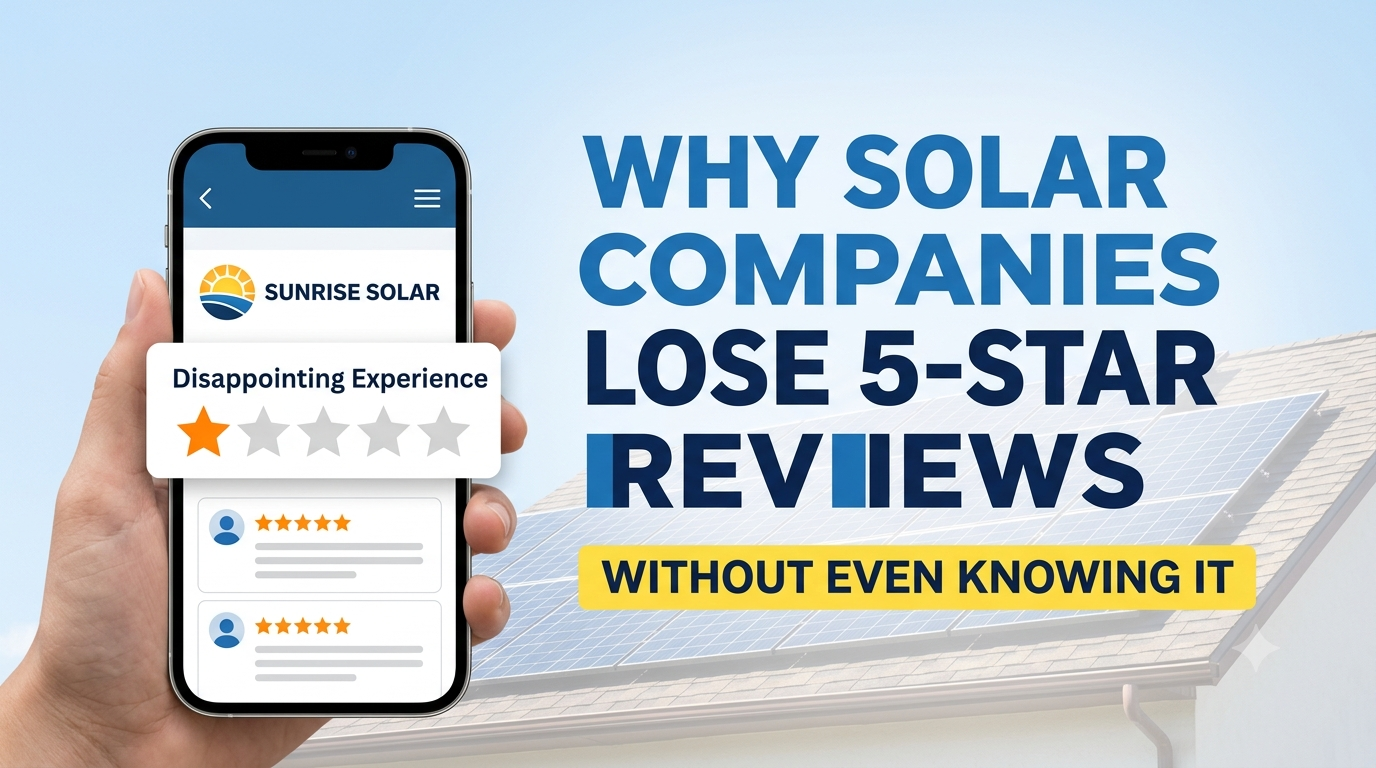
Most solar companies assume their review count reflects how good their work is. It doesn’t. It reflects how good their work is multiplied by how consistently someone remembered to ask for a review afterward, and that second factor is a lot shakier than most owners realize. A company can run a genuinely excellent operation, with clean installs and happy customers, and still end up with a thin trickle of reviews simply because the ask never happens at the right moment, or doesn’t happen at all.
This is one of the more invisible problems in the industry, precisely because nothing about it looks broken. Jobs get completed. Customers are satisfied. The crew moves on to the next install. From the outside, everything is working. But underneath that smooth operation, a huge share of potential five-star reviews are quietly evaporating, and almost no one notices because there’s no obvious failure to point to. There’s just an absence, and absences are hard to see.
The Moment That Gets Missed
The best time to ask a customer for a review is right after their system goes live, when the excitement is fresh and the whole process is still top of mind. That window is short. Within a day or two, the novelty fades into normal life, and the same customer who would have happily left glowing feedback the day the panels started producing power is now just going about their week, no longer thinking about their solar company at all.
Most crews aren’t equipped to capture that window reliably, because asking for a review isn’t actually part of their job. Technicians are focused on finishing the install correctly, walking the customer through the system, and getting to the next appointment. Somewhere in the handoff between finishing that final walkthrough and the office closing out the paperwork, the review request either happens inconsistently, gets delayed until the moment has passed, or never happens at all. No one intends for this to happen. It’s simply what occurs when a task depends entirely on someone remembering to do it manually, across dozens of jobs a month.
Why This Costs More Than It Seems
The immediate cost is obvious: fewer reviews than the company’s actual customer satisfaction would justify. But the downstream cost is bigger. Reviews are one of the primary ways new customers evaluate a solar company before ever picking up the phone. A company that’s doing excellent work but under-reflecting that in its review count is losing leads to competitors with a similar or even lesser track record, purely because those competitors happen to be capturing feedback more consistently.
There’s also a compounding effect. Review platforms tend to reward consistency and recency, not just total volume. A company with a steady stream of new reviews reads as active and trustworthy. A company with a pile of old reviews and a long gap since the last one can look stagnant, even if the actual quality of work hasn’t changed at all. Missing the ask isn’t just a missed opportunity for one review. It’s a slow erosion of how current and active the business appears to anyone doing research before hiring a solar installer.
Why This Keeps Happening Even at Good Companies
It would be easy to assume this is a training problem, solvable by telling technicians to remember to ask. In practice, that rarely works for long. Crews are busy, jobs vary in how they end, and a habit that depends on a person remembering under real-world pressure will always be inconsistent no matter how well-intentioned the team is. The problem isn’t effort or care. It’s that the task sits outside the actual workflow the technician is following to close out a job.
The companies that consistently capture reviews tend to be the ones where the request isn’t a separate task at all. It’s built into the same action that already happens when a job is marked complete, so it goes out automatically, at the right moment, without depending on anyone’s memory. That single shift, moving the review request from a manual habit to an automatic part of the job-closing process, is usually the difference between a company that’s quietly losing reviews it earned and one that’s actually capturing the reputation its work deserves.