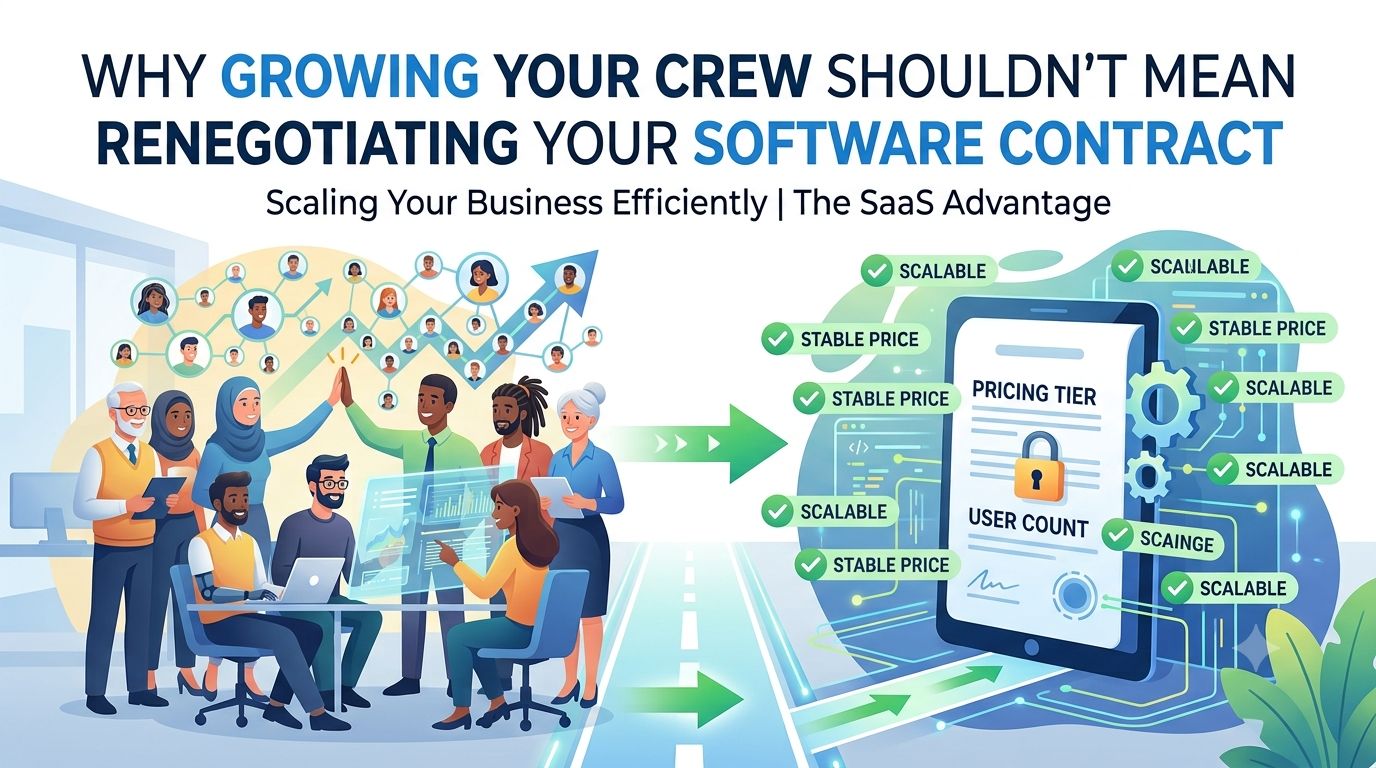
Hiring is supposed to be a good problem. A company brings on another technician because there’s more work than the current crew can handle, which usually means business is going well. But for a lot of field service companies, that moment of growth comes with an unwelcome side effect: a call to the software vendor, a new line item on the invoice, and sometimes a renegotiation of the entire contract just to add one more person to the system everyone already uses.
This is such a normal part of running a field service business that most owners don’t question it. Of course adding a user costs more. That’s just how the software works. But it’s worth pausing on how strange this arrangement actually is. The tool a company uses to run its operations becomes more expensive at the exact moment the company is investing in its own growth, which means the software is, in a very literal sense, working against the decision to expand.
What Per-Seat Pricing Actually Does to a Growing Company
Per-seat pricing feels reasonable in the abstract. More users, more cost, seems fair on its face. But it changes the calculation behind every hiring decision in a way that has nothing to do with whether the new hire is a good idea. A company deciding whether to bring on a third or fourth technician now has to factor in not just the new employee’s wage, but an ongoing monthly increase in software costs that will persist for as long as that employee is with the company. This is a permanent, compounding cost, not a one-time expense, and it applies to every future hire the same way.For a company that’s actively growing, this adds up faster than it might seem. A crew that goes from eight to fifteen technicians over a couple of years isn’t just paying nearly double in wages for those additional hires. Depending on the platform, it might be paying close to double in software costs as well, on top of everything else that comes with scaling a team. The software bill becomes a second, quieter cost of growth that rarely gets factored into hiring decisions until it’s already been paid for months.
The Renegotiation Problem
Beyond the per-seat cost itself, there’s the practical friction of actually adding users under a lot of these contracts. Depending on the platform and the terms a company originally signed, adding several new users at once can mean a call to a sales representative, a review of the current contract tier, or a push toward an upgraded plan that includes features the company doesn’t necessarily need but has to pay for anyway to get the additional seats. What should be a simple operational task, adding a new employee to the system they’ll use every day, turns into an administrative process that takes time and sometimes leverage away from the company doing the hiring.This friction is easy to underestimate until a company is in the middle of a hiring push and discovers that scaling the team also means scaling the software negotiation. It’s an odd position to be in: growing the business successfully, only to find the tools meant to support that growth becoming a bottleneck in themselves.
What a Flat-Fee Model Changes
A flat-fee, unlimited-user pricing model removes this dynamic entirely. Adding a new technician becomes purely an operational decision, based on whether the business needs the person and can support their wage, without a parallel calculation about what it will do to the software bill. The cost of the platform stays the same whether the crew is at ten people or twenty, which means the software genuinely scales alongside the business instead of scaling against it.
This also removes the administrative friction that often comes with per-seat systems. Adding a user is a matter of creating an account, not a contract conversation. For a company that’s hiring in bursts, whether that’s a seasonal push or a sudden jump in demand after landing a new contract, that difference matters. The software stops being something that has to be managed alongside the hiring process and becomes something that simply supports it.
Software should make growth easier, not introduce a hidden cost every time a company does the thing it’s actually trying to do. A pricing model that charges more with every hire is, whether intentionally or not, treating growth as a cost center rather than what it actually is: a sign that the business is working. Choosing a system that doesn’t penalize that growth isn’t just about saving money, though it usually does save real money over time. It’s about making sure the tools running the business are actually aligned with what the business is trying to do, instead of quietly working against it.