Managed IT companies are, by nature, run by people who like clear numbers and predictable systems. So it’s no surprise that one of the first questions an MSP owner asks about SEO is the most reasonable one in the world: how long until this actually pays for itself? It’s a fair question, and it deserves a real answer instead of the vague reassurance that “SEO takes time” that a lot of agencies lean on to avoid being pinned down.
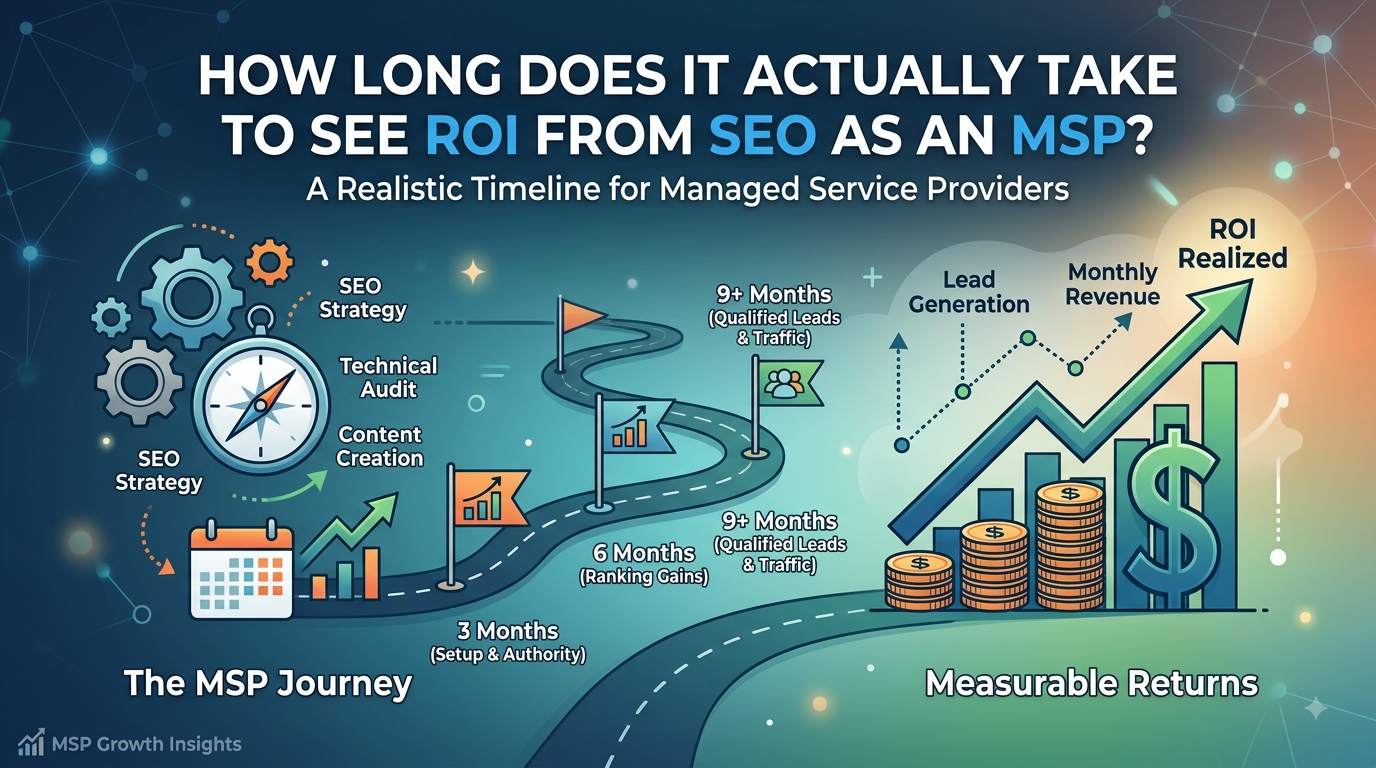
The honest answer is that it depends heavily on where a company is starting from, but the data across B2B industries points to a fairly consistent range. Research on B2B SEO performance generally finds that established businesses with existing domain authority and a reasonable base of content tend to see meaningful, attributable results in something like six to nine months, while newer domains or companies competing in more contested niches are often looking at nine to twelve months or more before the picture becomes clear. One widely cited case study of a B2B SaaS company found it took roughly nine months of consistent SEO work to grow organic traffic by twenty percent, with positive return on that investment showing up around month eleven. Multiple independent analyses of B2B SEO investment converge on a similar range, generally landing SEO ROI somewhere between six and twelve months for meaningful results, with some putting substantial payoff even further out, closer to the twelve to twenty-four month mark for companies in slower-moving or highly competitive categories.
That range can sound discouraging next to the promise of paid ads, which can generate a lead within days of turning a campaign on. But the comparison isn’t really apples to apples, and MSPs in particular have reason to care about the difference. Paid traffic disappears the moment the budget stops. Content and rankings built through SEO keep generating inquiries long after the initial investment, which is part of why studies on B2B content marketing report cumulative returns well into the hundreds of percent over a multi-year period, with the break-even point often landing well before the one-year mark. For an MSP thinking in terms of client lifetime value rather than a single transaction, that compounding effect matters more than how fast the first lead shows up.
There’s also a second clock running underneath the SEO timeline that MSPs need to account for separately: their own sales cycle. Even once a piece of content starts ranking and attracting the right kind of visitor, that visitor still has to move through discovery, a technical evaluation, security or compliance questions, and often a multi-stakeholder decision before a contract gets signed. It’s entirely possible for organic traffic and even qualified leads to show up within the first few months while revenue attributable to that traffic doesn’t materialize for several months after that, simply because the deal itself takes that long to close. MSP owners who track only the earliest metrics, like traffic or keyword rankings, can end up making a premature call on whether SEO is working, when in reality the leads are already in the pipeline and just haven’t converted to signed revenue yet.
The practical takeaway is that both patience and specific milestones matter here, and the two aren’t in tension. A reasonable timeline should show attributable organic inquiries within roughly the first four to six months, a clearer picture of ranking and traffic growth by six to nine months, and a full ROI picture, incorporating actual closed deals and their value, by the ten-to-twelve-month mark. An agency that can’t point to any of those intermediate signals and instead asks for blind faith for a year is not being appropriately cautious, it’s avoiding accountability. But an MSP owner who expects a three-month payback and walks away before month six is very likely quitting right before the investment was about to start showing up in the numbers that actually matter.