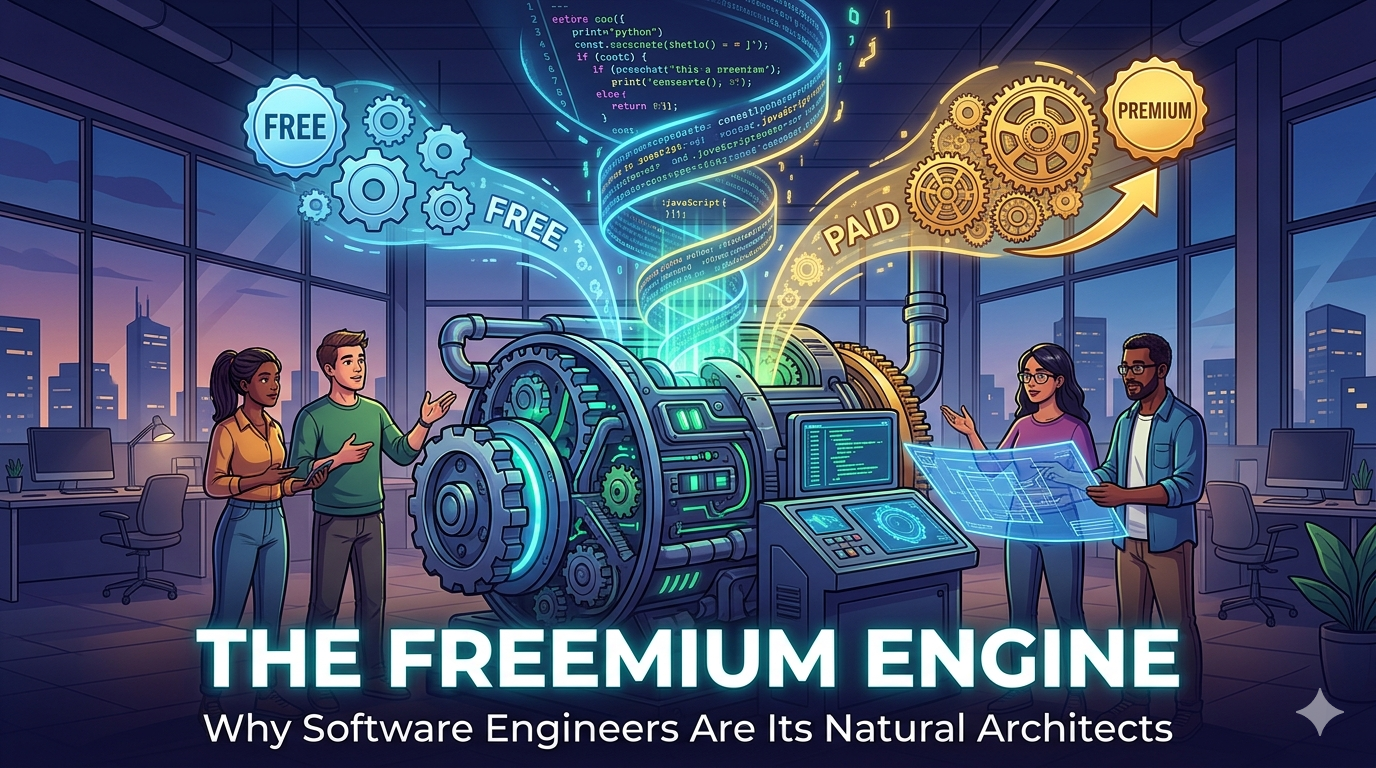
There is a peculiar tension at the heart of modern software. Engineers spend months—or years—crafting systems of elegant complexity, only to give away the product to millions of users who will never pay a cent. On the surface, this seems like a failure of capitalism, or at least a failure of nerve. But the freemium model is not charity disguised as business. It is, in fact, one of the most sophisticated alignment mechanisms ever devised between creator and customer, and software engineers are uniquely positioned to exploit it.
The freemium model rests on a psychological insight that predates the internet but found its perfect expression in software: the endowment effect. Users who have invested time, data, or social capital into a product begin to value it more than its objective worth. A developer who has configured a CI/CD pipeline, uploaded repositories, or invited team members to a project is no longer evaluating the tool as a shopper compares prices in a supermarket. They are evaluating it as a homeowner evaluates renovations. The cost of switching—retraining, migrating data, disrupting workflows—becomes a powerful retention force. The free tier is not a sample; it is a foundation. Once laid, it is psychologically and practically expensive to demolish.
For software engineers specifically, this dynamic is amplified by the nature of their work. Engineers are builders. They do not merely use tools; they extend them, script against them, and integrate them into larger systems. A free API with generous rate limits invites experimentation. An open-core platform with a plugin architecture invites contribution. The engineer who writes a custom integration for a freemium product has, in a very real sense, become a co-creator. This creates a bond that transcends the transactional. The product becomes part of their professional identity, mentioned in conference talks and listed on resumes. When the time comes to upgrade—for team features, for higher limits, for compliance certifications—the decision is not made by a procurement committee weighing alternatives. It is made by a practitioner who has already decided that this tool is theirs.
The economics of software make this model viable in ways that would be impossible for physical goods. The marginal cost of an additional user approaches zero. A server instance, once provisioned, does not care whether it serves one request or one million. This means the free tier can be genuinely useful, not a crippled demo. Engineers have an acute intuition for this because they understand the underlying architecture. They can sense when a free tier is artificially constrained—when features are withheld not because of cost, but because of strategy—and they resent it. Conversely, they reward generosity with loyalty. A database service that offers a genuinely functional free tier for side projects will find those side projects growing into startups, and those startups growing into enterprise accounts. The engineer remembers who trusted them when they had no budget.
There is also a network effect that engineers are particularly adept at engineering—pun intended. The freemium model thrives on viral loops, and viral loops are, at their core, systems problems. Referral credits, collaborative features, and public-by-default workflows are all mechanisms that convert individual usage into collective adoption. An engineer who understands how to design these loops from first principles—who can model user behavior, optimize conversion funnels, and instrument analytics—has a structural advantage over traditional business strategists who treat growth as a marketing function rather than a systems design challenge. The best freemium products do not acquire users through advertising; they acquire users through the product itself, and engineers are the ones who build that machinery.
Critics of freemium often point to low conversion rates, typically in the single digits, as evidence of failure. But this misunderstands the model. The free users are not failed conversions; they are the marketing department, the QA team, and the talent pipeline. They write blog posts, report bugs, and eventually take jobs at companies with budgets. A freemium product with a million free users and a two percent conversion rate is not a product with a ninety-eight percent failure rate. It is a product with a marketing reach that would cost tens of millions of dollars to replicate through traditional channels, and a sales funnel that self-selects for the most engaged and invested prospects.
For the software engineer considering entrepreneurship, freemium offers something rare: the ability to compete with incumbents without capital. A solo developer or a small team can build a product, release it to the world, and iterate based on real usage data from day one. There is no need for a sales team, no need for retail partnerships, no need to manufacture inventory. The free tier is the demo, the documentation is the onboarding, and the community is the support channel. This democratization of distribution is why so many successful developer tools—version control systems, container platforms, monitoring solutions—emerged from freemium roots.
The model is not without risk. The cost of supporting free users can become unsustainable if the product attracts the wrong audience or if the conversion mechanism is poorly designed. Engineers must be disciplined about unit economics, ruthless about feature segmentation, and vigilant about preventing the free tier from cannibalizing paid revenue. But these are engineering problems, not business mysteries. They yield to the same analytical thinking that engineers apply to distributed systems or algorithmic optimization.
Ultimately, freemium works for software engineers because it mirrors how engineers themselves engage with the world: through experimentation, through building, through gradual commitment that deepens over time. It respects the engineer’s skepticism of sales pitches by replacing them with lived experience. It leverages the engineer’s network effects by making the product itself the growth engine. And it aligns the engineer’s zero-marginal-cost reality with a pricing strategy that scales from the individual hobbyist to the Fortune 500. The freemium model is not a trick to extract money from users. It is a recognition that in software, the best way to sell is often to stop selling—and start building.