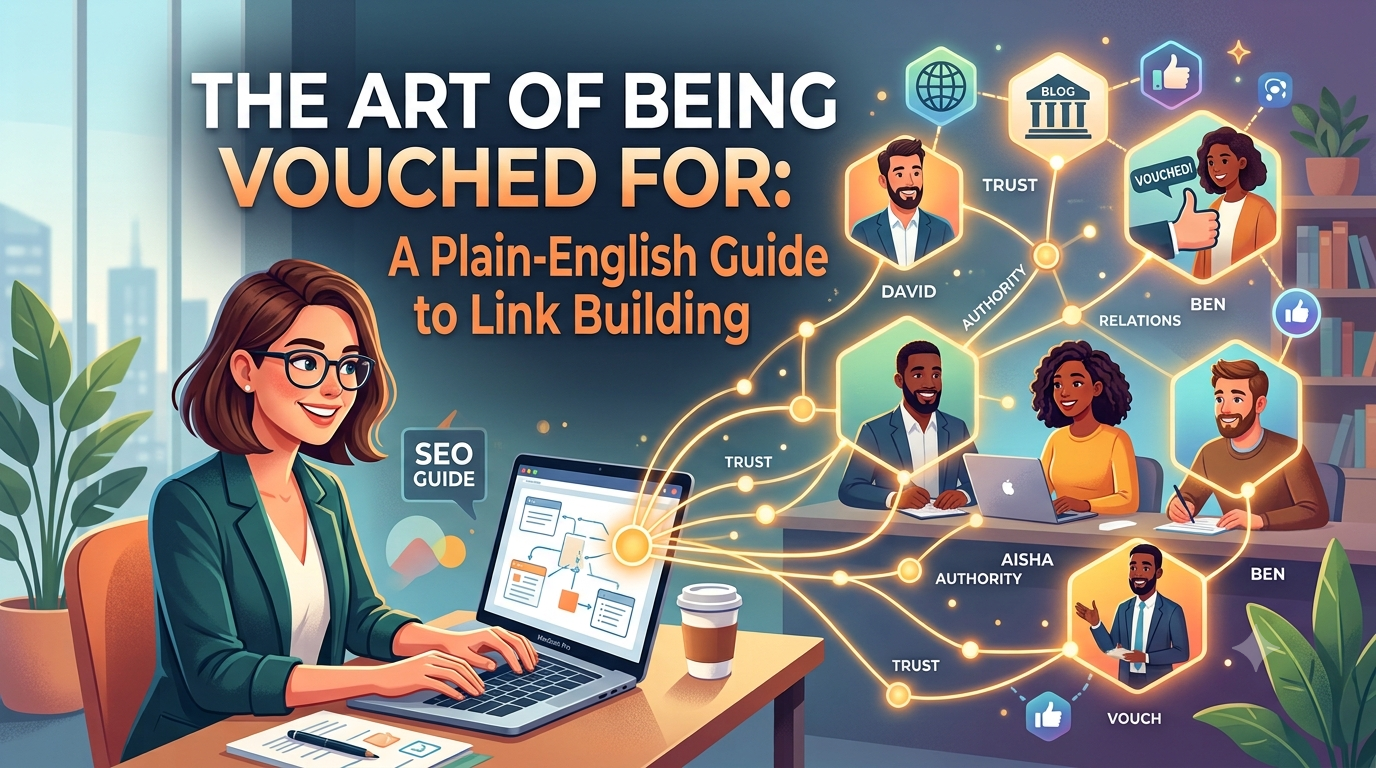
Imagine you’ve just moved to a new city and you’re looking for a good dentist. You could scroll through a directory of every practice in town, or you could ask three people you trust for a recommendation. Most of us would choose the recommendation. A trusted person vouching for someone else carries more weight than any self-description could. Link building is, at its heart, the digital version of that same process. Understanding it could be one of the most valuable things you do for your business.
What Link Building Actually Is
When another website includes a hyperlink that points to your website, that link is called a backlink. Link building is the practice of earning, cultivating, and sometimes pursuing those backlinks from other sites across the internet.
Search engines like Google have treated these incoming links as votes of confidence. The reasoning is straightforward: if a reputable website links to your page, it is implicitly telling its own readers that your content is worth their time. The more of these votes you accumulate, particularly from sources that are themselves trusted and authoritative, the more credible your own site appears in the eyes of the algorithm.
This credibility directly influences where your website appears in search results. A business with many high-quality backlinks will, all else being equal, rank higher for relevant search terms than a business with few or none. And higher rankings mean more people finding you when they’re actively looking for what you sell.
Why It Matters If You’re Selling Something
If you’re promoting a product or a service, visibility is everything. You could have the finest product in your category, priced fairly, presented beautifully. It means nothing if the people who want it can’t find you. Most people begin their search for a product or service with a search engine, and most of those people click on results from the first page. If you’re not there, you’re invisible to a vast portion of your potential customers.
This is why businesses invest in search engine optimisation, and link building is one of the most powerful levers within that discipline. It’s the difference between a shop on a busy high street and the same shop tucked down an alley with no signs. The product might be identical. The foot traffic won’t be.
Beyond raw search rankings, links from respected websites carry their own direct value. When a well-known industry publication, a popular blog, or a trusted review site links to your business, their audience follows. Those readers arrive at your site already primed to take you seriously, because a source they already trust has pointed them your way. That warm introduction is something paid advertising rarely achieves as naturally.
The Difference Between a Good Link and a Bad One
Not all backlinks are created equal, and this is where many businesses go wrong. A link from a major newspaper, a respected trade journal, or a widely-read blog in your industry is worth far more than a hundred links from obscure, low-quality directories that exist purely to host links. Search engines are sophisticated enough to tell the difference, and they reward accordingly.
Worse, certain link-building practices can actively harm your rankings. Buying links in bulk, participating in link schemes, or stuffing your brand into irrelevant comment sections are tactics that search engines have become adept at detecting and penalising. What looks like a shortcut often turns out to be a trap. The businesses that build lasting search presence do so through links they earned. They did it by producing content worth referencing, by building relationships with people in their industry, and by offering real value that others want to share.
How Businesses Actually Build Links
The most durable link-building strategy is also the most intuitive: create things that deserve to be linked to. This means writing articles that answer questions your customers are genuinely asking. It means publishing research or data that other people in your field will want to cite. It means producing guides, tools, or resources useful enough that bloggers and journalists naturally reach out to them when writing about your topic.
Beyond content, relationships matter enormously. Guest writing for industry publications, being quoted as an expert source in relevant articles, collaborating with complementary businesses on shared projects, and earning coverage through public relations work are all ways that links accumulate organically over time. None of it is fast, and none of it is guaranteed. All of it compounds. Every quality link you earn makes the next one slightly easier to get, because your site becomes more credible with each one.
Link building is not a campaign with a start and end date. It’s an ongoing commitment to building your reputation on the internet the same way you’d build it anywhere else: doing good work, being visible in the right conversations, and earning the trust of people whose trust is worth having.
For anyone serious about promoting a product or service in the long term, this is not optional background noise. It is one of the keys to being findable by the people who are looking for what you offer. The businesses that treat it seriously tend to find that search becomes one of their most reliable and cost-effective sources of new customers. The ones that ignore it often find themselves dependent on paid advertising.
The internet is not so different from real life. People follow recommendations. Authority is earned. And the businesses that others point to with confidence are the ones that thrive.