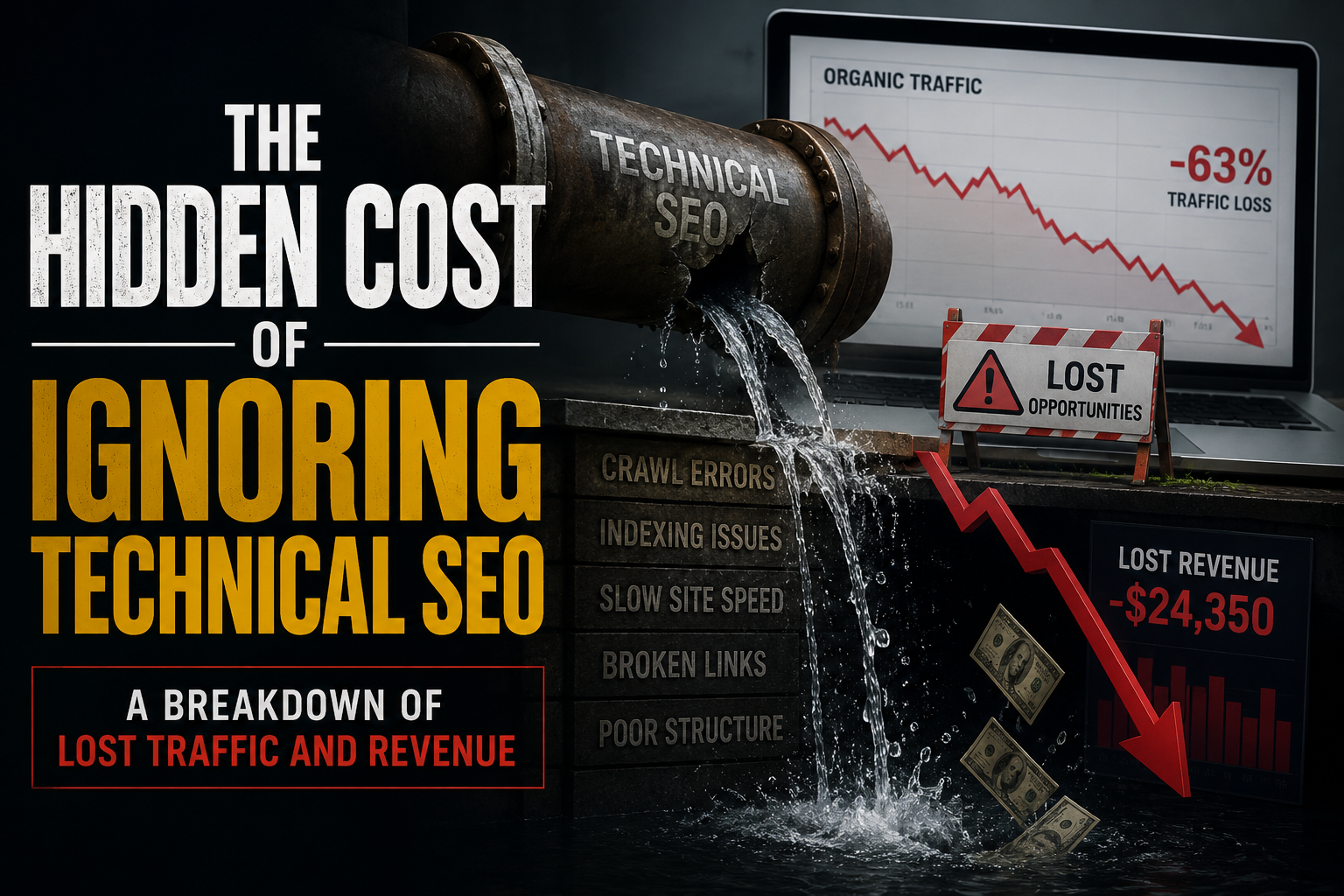
Most businesses pour their energy into content creation, social media campaigns, and paid advertising while quietly overlooking the foundation that makes all of that effort visible in the first place. Technical SEO sits beneath the surface of your website like the plumbing in a house, and when it fails, everything above it starts to rot. The problem is that technical issues rarely announce themselves with flashing red lights. They accumulate in silence, slowly draining your organic traffic, eroding your search rankings, and costing you revenue that you will never even know you lost.
Search engines have evolved dramatically over the past decade. Google no longer simply counts keywords and backlinks to determine where your site deserves to rank. It crawls, renders, and evaluates how fast your pages load, how well they perform on mobile devices, whether your site architecture makes sense, and whether your content can actually be discovered and understood by its algorithms. When technical SEO is neglected, you are not just missing out on marginal gains. You are building an invisible wall between your business and the people who are actively searching for exactly what you offer.
Consider page speed for a moment. A website that takes more than three seconds to load loses roughly forty percent of its visitors before they even see a single word of content. Google has made speed a confirmed ranking factor, which means slow load times do not just frustrate users, they actively push your pages down the search results. Every position you drop on the first page of Google represents a significant percentage of lost clicks. The difference between ranking first and ranking fifth can easily mean thousands of missed visitors per month for a moderately competitive keyword. Those are not abstract numbers. They represent real people who needed a solution, found your competitor instead, and never knew your business existed.
Mobile usability compounds the problem further. With more than sixty percent of global web traffic now coming from mobile devices, a site that performs poorly on smartphones is effectively turning away the majority of its potential audience. Responsive design is no longer a nice-to-have feature. It is a baseline expectation, and Google indexes the mobile version of your site first. If your buttons are too small to tap, your text requires pinching and zooming to read, or your layout breaks on smaller screens, you are signaling to both users and search engines that your site is not worth their time. The traffic you lose here does not go to a void. It goes to competitors who invested in a seamless mobile experience.
Crawlability and indexability represent another silent killer. Search engines use automated bots to navigate your website, following links from page to page and deciding what to include in their massive indexes. If your site has broken links, redirect chains, orphaned pages with no internal links pointing to them, or a poorly configured robots.txt file, those bots will either fail to reach your content or choose not to index it. You could publish the most brilliant article in your industry, but if search engines cannot find it or do not deem it worthy of indexing, it might as well not exist. The tragedy is that many businesses produce outstanding content that never sees the light of day because their technical infrastructure is broken.
Duplicate content is another issue that quietly sabotages rankings. When multiple pages on your site contain substantially similar content, search engines struggle to determine which version deserves to rank. Rather than rewarding you with multiple positions, they often dilute the ranking potential across all versions or choose to rank none of them prominently. This commonly happens with e-commerce sites that use manufacturer descriptions across hundreds of product pages, or with websites that create separate URLs for mobile and desktop versions of the same page without proper canonical tags. The result is a scattered, weakened presence in search results that leaves traffic and revenue on the table.
Structured data, though it sounds intimidating to the uninitiated, is another technical element that carries enormous weight. By implementing schema markup, you help search engines understand the context of your content, which can unlock rich results like star ratings, product prices, event dates, and FAQ dropdowns directly in the search results. These enhanced listings dramatically improve click-through rates because they occupy more visual space and provide immediate value to searchers. Businesses that ignore structured data are essentially showing up to a job interview in casual clothes while their competitors arrive in tailored suits. Both candidates might have the same qualifications, but one makes a far stronger first impression.
Core Web Vitals have brought technical performance into the spotlight in ways that cannot be ignored. These metrics measure real-world user experience across three dimensions: how fast the largest content element loads, how long it takes for the page to become interactive, and how much the layout shifts unexpectedly as elements load. Google has explicitly stated that these metrics influence rankings, and poor scores are now a direct competitive disadvantage. The businesses that treat Core Web Vitals as a priority gain a measurable edge, while those that dismiss them as technical minutiae find themselves sliding down the rankings without understanding why.
The revenue impact of all these technical failures is staggering. Organic search remains one of the highest-intent, most cost-effective marketing channels available. Visitors who find you through search are actively looking for solutions, which makes them significantly more likely to convert than someone who stumbles across a social media post. When technical SEO issues suppress your organic visibility, you are forced to compensate by spending more on paid advertising to maintain traffic levels. This creates a vicious cycle where rising acquisition costs eat into your margins while your competitors enjoy free, compounding organic traffic. Over months and years, the difference between a technically sound website and a neglected one can amount to hundreds of thousands or even millions of dollars in lost revenue.
Security also plays a role that many overlook. An SSL certificate, indicated by HTTPS in your URL, is not optional. Browsers now warn users away from non-secure sites, and Google has confirmed HTTPS as a ranking signal. A site without proper security measures loses trust before a visitor even arrives, and the technical penalty in search rankings only deepens the wound. In an era of increasing data privacy concerns, appearing insecure is a fast track to irrelevance.
Perhaps the most insidious aspect of ignoring technical SEO is that the damage compounds over time. A single broken page might seem insignificant today, but as your site grows, those broken pages multiply. As algorithms evolve, the technical standards rise. What was acceptable five years ago is now a liability. The businesses that treat technical SEO as an ongoing discipline rather than a one-time checklist build a foundation that strengthens with age. Those that ignore it find themselves facing a mountain of technical debt that becomes increasingly expensive and complex to resolve.
Fixing these issues is not about chasing algorithm updates or engaging in technical perfectionism for its own sake. It is about removing the invisible barriers that prevent your best work from reaching the people who need it. A technically sound website ensures that your content, your products, and your brand get the visibility they deserve. It protects the investment you have already made in design, copywriting, and marketing. It creates a user experience that builds trust and encourages conversions.
The hidden cost of ignoring technical SEO is not just lost traffic. It is lost trust, lost opportunity, and lost revenue that you will never see on a balance sheet because it was never there to begin with. The businesses that understand this and act on it consistently are the ones that dominate search results year after year. The ones that do not are left wondering why their competitors always seem to be one step ahead, never realizing that the answer was hiding in plain sight, buried in the code they never bothered to fix.