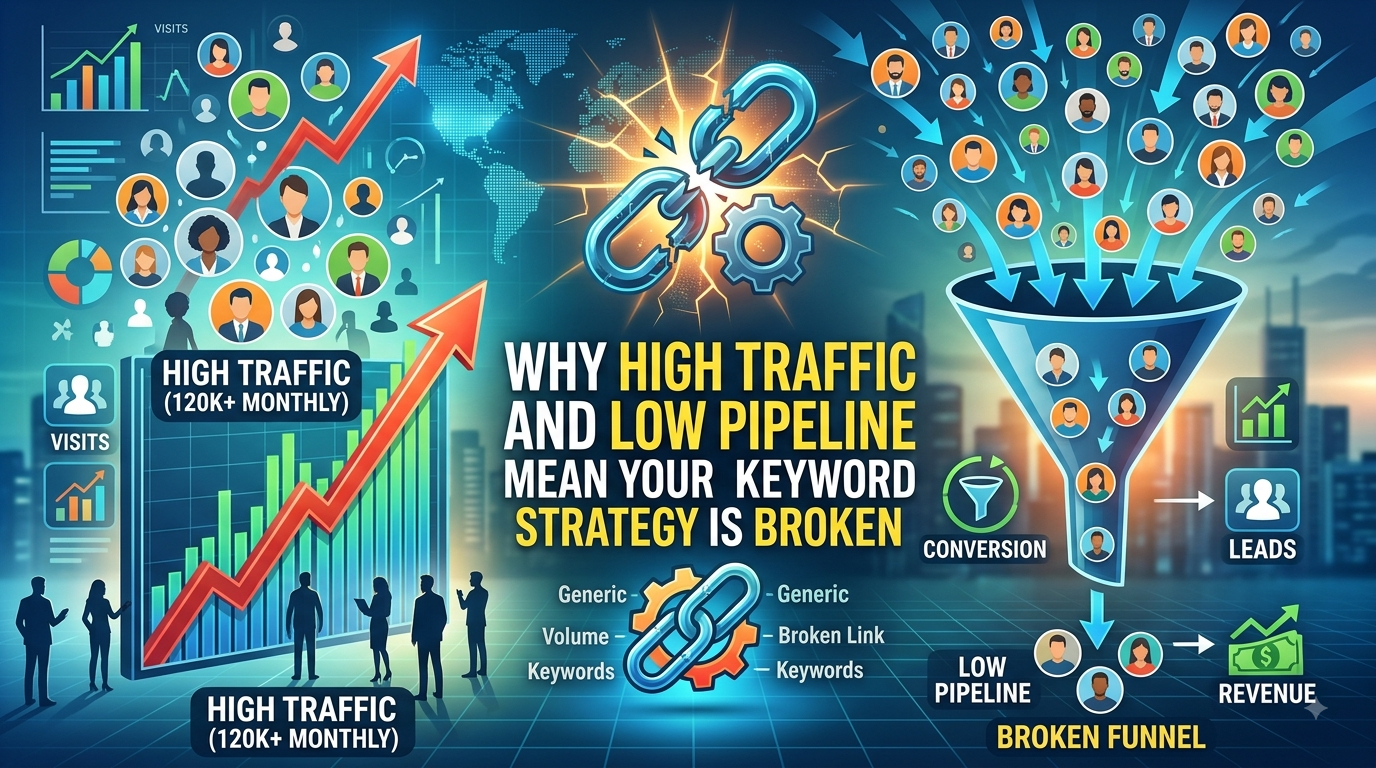
There is a particular kind of silence that falls over a marketing team when the monthly analytics report goes live. The numbers look spectacular. Traffic is up forty percent. Organic sessions are climbing steadily. The line on the graph points optimistically toward the ceiling. And yet, when the sales team is asked how many qualified opportunities came through the website, the answer is a shrug. Maybe a few. Maybe none. The pipeline is a desert, and all that traffic is just wind blowing through it.This is not a conversion problem. It is not a landing page problem, or a checkout flow problem, or a call-to-action color problem. When you have high traffic and low pipeline, the issue is deeper. It lives in the foundation of how you chose to show up in search in the first place. Your keyword strategy is broken, and the traffic you are celebrating is largely worthless.
Most broken keyword strategies share the same origin story. A team sits down with a keyword research tool, sorts by search volume, and begins building content around the terms that promise the biggest audience. They see a phrase with fifty thousand monthly searches and imagine the floodgates opening. They write the definitive guide, the ultimate list, the comprehensive resource. The content ranks. The clicks come. And nobody buys anything, because the people clicking were never going to buy. They were looking for an answer, not a solution. They were researching, not purchasing. They were early in their journey, or perhaps not on a buying journey at all.
The modern search landscape has made this trap even easier to fall into. Large language models and AI overviews are swallowing informational queries whole. If someone searches for “what is customer relationship management,” they are increasingly likely to get a synthesized answer without ever clicking through to your beautifully crafted blog post. But even when they do click, that visitor is in learning mode. They are not evaluating vendors. They are not comparing pricing. They are not ready to talk to sales, and no amount of pop-up chat widgets or aggressive demo request buttons will change that fundamental intent.
A healthy keyword strategy understands that not all searches are created equal, and not all traffic is good traffic. It distinguishes between educational intent and commercial intent, between someone who wants to understand a concept and someone who is actively trying to solve a problem with a purchase. The former drives volume. The latter drives revenue. And when a strategy optimizes exclusively for volume, it inevitably starves the pipeline.The disconnect often starts with how success is measured. When marketing teams are evaluated on traffic metrics, on rankings for high-volume terms, on domain authority scores that rise with each backlink, they naturally gravitate toward keywords that deliver those numbers. The incentives are misaligned with the business goal. A keyword that brings in five hundred visitors who read and leave is celebrated, while a keyword that brings in five visitors, one of whom becomes a qualified opportunity, is ignored because it does not look impressive in a monthly report. Over time, this skews the entire content ecosystem toward the top of the funnel, creating a vast library of articles that rank well but convert poorly.
Fixing this requires a shift in how keywords are selected and how content is conceived. Instead of starting with search volume, the process should begin with the sales conversation. What problems are your best customers trying to solve when they first consider a product like yours? What language do they use when they are frustrated enough to spend money? What questions do they ask when they are comparing options, not when they are writing a research paper? These are the terms that matter, and they are rarely the ones with the highest search volume. They are often specific, sometimes awkward, occasionally technical, and they signal intent because they reflect the vocabulary of someone who is already in the market.
This does not mean abandoning educational content entirely. Thought leadership and awareness-building have their place in a mature strategy. But they must be connected to a logical path toward commercial intent. A reader who learns about a problem from your content should be able to find, within the same ecosystem, content that helps them evaluate solutions, including yours. The keyword strategy needs to map to the full journey, not just the beginning of it. When every piece of content exists in isolation, optimized for a single high-volume term without consideration of what comes next, the journey dead-ends. The visitor learns what they came to learn and leaves.
Another symptom of a broken strategy is the over-reliance on broad, competitive head terms at the expense of the long tail. A company selling enterprise accounting software might pour resources into ranking for “accounting software,” a term dominated by massive comparison sites and consumer-grade products. The traffic is enormous and generic. Meanwhile, searches like “accounting software for multi-entity construction companies” or “ERP integration with project accounting” carry almost no weight in the strategy because their volume looks insignificant in a spreadsheet. Yet those are the searches made by people who know exactly what they need, who have budget, and who are actively looking for a specific answer. The long tail is where pipeline lives, because specificity is the signature of intent.The fix also demands honesty about who you are actually competing against for a given query. If you search a target keyword and the results page is dominated by Wikipedia, Investopedia, major news outlets, or massive industry publications with decades of authority, you are not just competing for traffic. You are competing for traffic that those results indicate is primarily seeking information. The search engine has already classified that intent based on behavior, and it has decided that the best answer is an encyclopedia entry or a news article, not a vendor page. Chasing those rankings is not just difficult; it is strategically foolish for a company trying to generate pipeline. You are fighting to be the best answer to a question that your ideal customer asks when they are not interested in buying.
A revenue-aligned keyword strategy treats search as a channel for customer acquisition, not audience accumulation. It asks, before any content is created, whether ranking for this term would put us in front of someone who could realistically become a customer within a reasonable timeframe. If the answer is no, the keyword is discarded, no matter how tempting the volume. This discipline feels counterintuitive because it means walking away from big numbers. It means accepting smaller traffic totals in exchange for traffic that actually matters. It means retraining stakeholders who have learned to cheer for graphs that go up and to the right.
The content itself must also change. When keywords are chosen for their commercial intent, the content can be direct. It can speak to buyers, not browsers. It can address pricing, implementation, comparison, and return on investment without fear of scaring away the casual reader, because the casual reader was never the target. This kind of content often feels riskier to publish. It is less universally appealing. It will not be shared as widely on social media. But it will be read by the right people at the right moment, and that is the only audience that builds a pipeline.
If your analytics show a flood of visitors and your CRM shows a trickle of opportunities, do not look first at your forms or your follow-up speed. Look at the front door. Look at the searches that brought them there. Ask whether those people were looking to buy, or merely looking to know. If it is the latter, you have built a magnificent library in a town where nobody is shopping. You can admire the architecture, but you cannot pay the bills with foot traffic. The keyword strategy is the architecture of your digital presence, and when it is designed for spectators rather than buyers, the result is inevitable. You will have all the traffic in the world, and none of the business to show for it.
The path forward is not more content. It is better intent. It is the hard work of understanding your customer so deeply that you know the exact moment their search shifts from curiosity to commitment, and being there with exactly what they need when that shift happens. That is where the pipeline begins. Everything else is just noise.