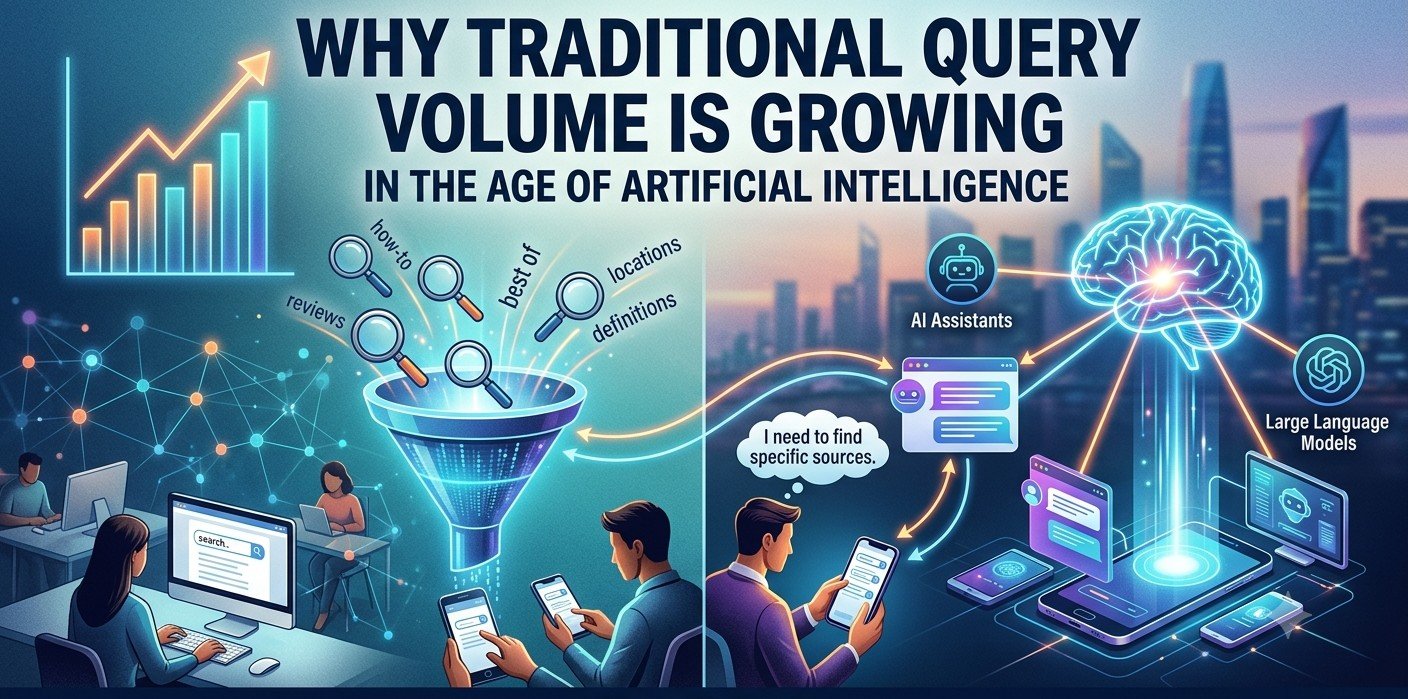
The prevailing narrative in contemporary technology circles often suggests that the rise of generative artificial intelligence signifies the inevitable obsolescence of traditional search engines. Pundits frequently argue that conversational interfaces, such as ChatGPT and Perplexity, will fundamentally cannibalize the market share of established players like Google and Bing by providing direct answers rather than a list of links. However, empirical data and recent market analysis from high-authority business and academic sources reveal a far more nuanced reality. Despite the rapid adoption of large language models, traditional search volume is not merely sustaining itself; it is experiencing significant year-over-year growth, driven by a phenomenon that researchers are beginning to identify as search task expansion.
Quantitative analysis of global search trends indicates that the total volume of traditional queries has reached historic highs even as AI usage surges. According to research conducted by SparkToro in collaboration with Datos, Google’s search volume grew by an estimated 21.6% between 2023 and 2024 [1]. This remarkable growth in a mature product category contradicts the early predictions of a rapid decline in search engine utility. While generative AI tools have certainly captured a portion of informational intent, they appear to be functioning as a supplementary layer rather than a wholesale replacement. The scale of this disparity is significant; as of mid-2025, traditional search engines still handle approximately 373 times more daily queries than the leading conversational AI platforms [1].
This counterintuitive growth can be explained through the lens of behavioral economics and information science. A recent study by Gartner found that generative AI features, such as AI Overviews, are actually lengthening the consumer research journey rather than shortening it [2]. Their survey revealed that 31% of consumers spend more time searching for information after interacting with an AI summary, compared to only 16% who spend less time [2]. This suggests that AI often acts as a catalyst for deeper investigation, prompting users to verify claims, compare sources, or explore nuanced sub-topics that the initial AI response may have oversimplified. Furthermore, Gartner reports that 31% of consumers consider a broader set of product options due to AI-generated insights, signaling that these tools are expanding the scope of search behavior rather than narrowing it to a single definitive answer [2].
Academic research supports the idea that search engines and AI chatbots serve distinct cognitive functions. A 2026 study published in the Journal of Librarianship and Information Science observed that while university students utilize AI for brainstorming and summarization, they consistently return to traditional search engines for authoritative verification and deep-source retrieval [3]. This “dual-track” information seeking behavior suggests that as AI makes the initial stage of information gathering more efficient, it lowers the barrier to entry for complex queries, thereby increasing the total number of subsequent searches performed to validate and refine those initial findings. This is a digital manifestation of the Jevons Paradox, where technological efficiency in one area leads to increased consumption across the broader system.
From a strategic business perspective, the resilience of traditional search is reflected in the financial performance of major search providers. Alphabet’s recent earnings reports continue to show robust growth in search advertising revenue, a direct proxy for sustained user engagement and query volume. While Harvard Business Review notes that AI is indeed “upending marketing on two fronts” by compressing certain customer journeys, it also emphasizes that traditional search remains the primary “front door to the internet” for the vast majority of transactional and branded intent [4]. The rise of “zero-click” searches—where users find answers directly on the results page—has changed the nature of website traffic, but it has not diminished the underlying volume of search activity itself.
In conclusion, the emergence of generative artificial intelligence has not heralded the end of the search engine era but has instead inaugurated a more complex and high-volume information ecosystem. The growth of traditional search volume alongside AI adoption demonstrates that human curiosity and the need for verifiable information are not finite resources that can be easily exhausted. Rather than a zero-sum game, the relationship between AI and traditional search is becoming increasingly symbiotic, where each tool enhances the utility of the other. For businesses and researchers alike, the challenge is no longer choosing between these platforms, but understanding how to navigate a landscape where the total demand for information is higher than ever before.References
[1] Fishkin, R. (2025). “New Research: Google Search Grew 20%+ in 2024; receives ~373X more searches than ChatGPT.” SparkToro. https://sparktoro.com/blog/new-research-google-search-grew-20-in-2024-receives-373x-more-searches-than-chatgpt/
[2] Gartner, Inc. (2026). “Gartner Survey Finds Only One-Third of Consumers Say GenAI Rivals Search Engines.” Gartner Press Release. https://www.gartner.com/en/newsroom/press-releases/gartner-survey-finds-only-one-third-of-consumers-say-genai-rivals-search-engines-marketers-must-optimize-for-both-ai-driven-and-traditional-search
[3] Lund, B. D., et al. (2026). “Artificial intelligence (AI) and information seeking: A comparative exploration of AI chatbots, search engines, and library resources.” Journal of Librarianship and Information Science.
https://journals.sagepub.com/doi/abs/10.1177/09610006261438484[4] Harvard Business Review. (2026). “AI Is Upending Marketing on Two Fronts.” HBR.org. https://hbr.org/2026/02/ai-is-upending-marketing-on-two-fronts