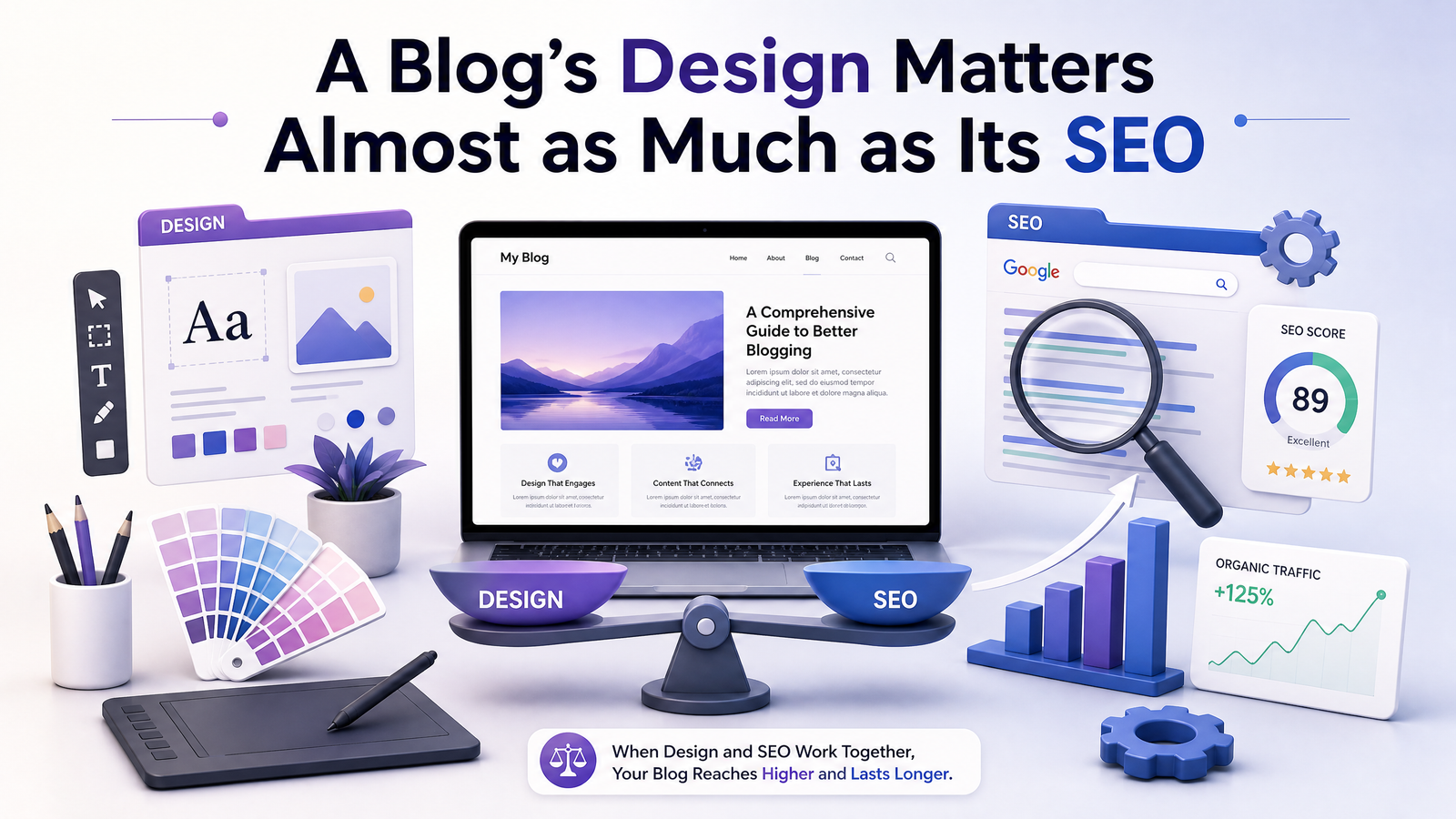
Search engine optimization gets nearly all the attention in conversations about blog growth. Keywords, backlinks, and site structure are measurable, teachable, and easy to turn into checklists. Design, by comparison, feels subjective and hard to quantify. But treating design as a secondary concern is a mistake. A blog’s design is one of the mechanisms that determines whether all your hard SEO work pays off.
Start with the most basic reality of how search traffic actually converts into value. Ranking well on a search engine only gets a visitor to the page. What happens after that click is entirely a design question. If the page is cluttered, slow to load, or hard to read on a phone, visitors leave within seconds. Search engines track exactly this kind of behavior. When people click a result and immediately bounce back to the search page, that signals the page failed to satisfy the search intent, and rankings tend to drift downward over time as a result. In this sense, poor design doesn’t just cost a blog readers, it actively undermines the SEO metrics that were supposed to attract those readers in the first place.
Page speed is a clear example of design and SEO becoming the same thing rather than separate disciplines. A bloated, image-heavy layout with unoptimized code will load slowly regardless of how well the surrounding content is written or how carefully the keywords were chosen. Search engines factor loading speed directly into ranking decisions, particularly for mobile users. A beautifully designed page that loads slowly is, from a technical standpoint, a poorly designed page. Good design and good technical SEO overlap almost completely at this layer.
Readability is another place where the two disciplines merge. Clear heading structure, generous white space, legible font sizing, and sensible paragraph length aren’t just aesthetic choices, they are what allow both human readers and automated systems to understand what a page is actually about. A well-organized page with descriptive subheadings makes it far easier for a reader to scan and decide whether to keep reading. That same structure also makes it easier for search engines and AI systems to parse the page’s content, identify its main topics, and represent it accurately in search results or generated answers. Design decisions that improve human comprehension tend to improve machine comprehension at the same time, because both are ultimately trying to extract meaning using the same framework.
This overlap matters even more now that a growing share of discovery happens through AI systems that summarize or cite web content directly. These systems favor pages with clean structure, clearly labeled sections, and content that is easy to extract. A page that buries its actual answer inside dense, unbroken paragraphs or inconsistent formatting is harder for an AI system to summarize correctly, which means it’s less likely to be cited or referenced. A page that states its key points clearly gives these systems an easier, more accurate structure to work from. Good design, in other words, is quickly becoming a form of AI visibility optimization in its own right, not just a courtesy.
Trust signals round out the picture. Visitors and algorithms alike use visual cues to judge credibility. A dated layout, intrusive ads, or inconsistent formatting can make even accurate, well-researched content feel untrustworthy at a glance. Search engines have increasingly incorporated signals related to user trust and page experience into their ranking systems, meaning that a blog’s poor visual credibility can influence its search performance negatively even when the underlying writing is excellent.
None of this means SEO fundamentals like keyword research, internal linking, and content depth stop mattering. But design should be understood as sitting alongside them. A well-optimized page with poor design will struggle to hold the traffic it earns and may struggle to keep the rankings it achieves. A well-designed page with weak SEO will struggle to be found at all. The two disciplines succeed or fail together, and any blog strategy that treats design as an afterthought is leaving a significant part of its growth potential unaddressed.
Digital assets are the best way to make money long-term. Learn how here.