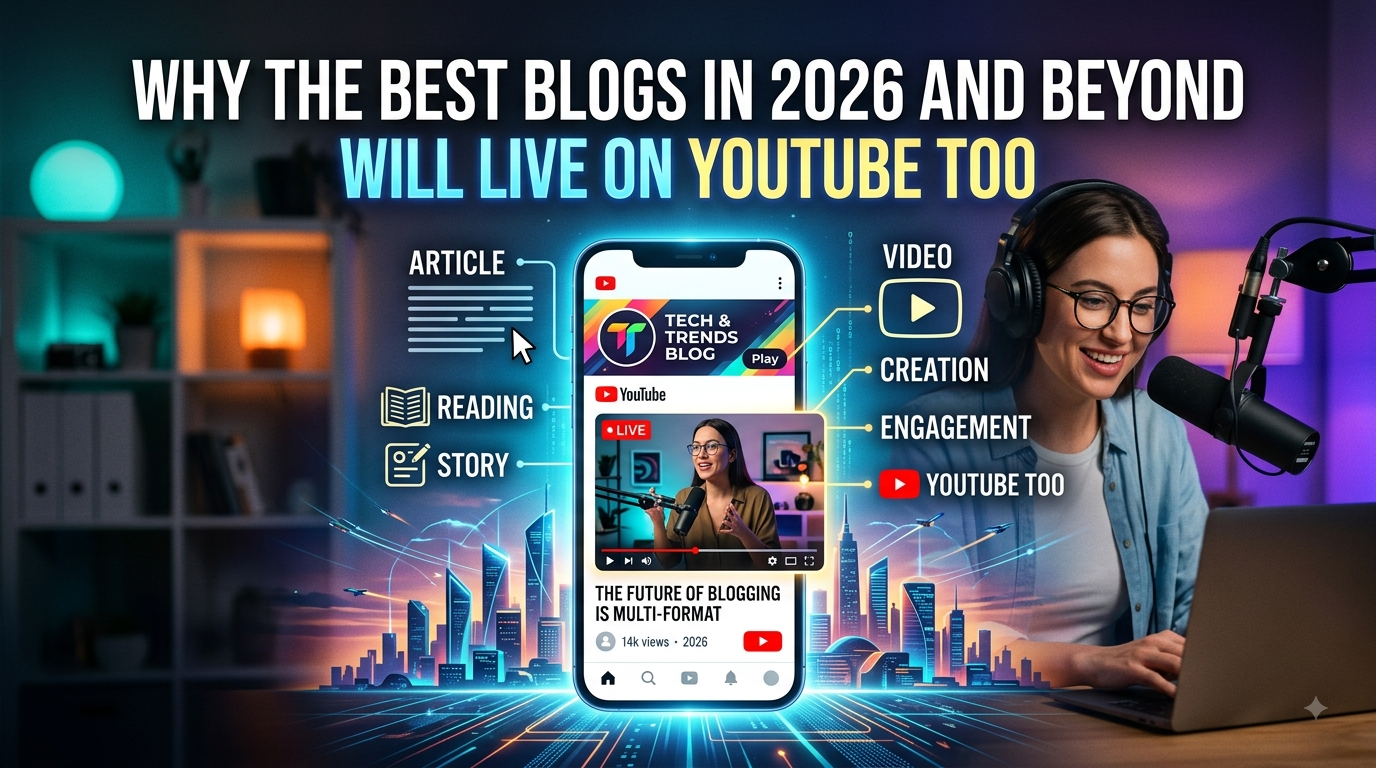
For twenty years, blogging and video lived in separate worlds. You either wrote or you filmed. That separation is now gone, and the blogs that keep pretending otherwise are going to fade into irrelevance. The reason is simple and structural: Google owns YouTube, and Google’s search results increasingly favor content that comes from, or connects to, its own video platform. A written blog that ignores this reality is competing with one hand tied behind its back.
The Search Landscape Has Quietly Changed
Google has spent years blending video directly into search results. Type almost any how-to question, product comparison, or explainer topic into Google, and you’ll see video thumbnails sitting above or alongside the traditional blue links. Those thumbnails almost always pull from YouTube. This isn’t an accident or a side experiment. It reflects how Google’s ranking systems have evolved to reward multimedia relevance, and YouTube is the single largest source of video content Google can draw from with full confidence in its metadata, watch time, and engagement signals. A blogger who never touches video is voluntarily giving up one of the most visible slots on the search results page.
Google and YouTube Are Not Two Companies Working Together, They Are One System
It helps to stop thinking of YouTube as a separate platform that happens to be Google-owned and start thinking of it as an extension of Google’s search infrastructure. Watch history, search history, click behavior, and channel authority all feed into a shared understanding of what a creator or brand is about. When a blog and a YouTube channel are linked, consistently branded, and reinforcing the same expertise, Google can build a much richer picture of that creator’s authority than it can from text alone. This matters enormously for topical authority, which has become one of the more durable ranking factors as Google’s algorithms have grown better at understanding entities rather than just keywords.
Video Solves the Trust Problem That Text Alone Cannot
Readers today, especially younger ones, are more skeptical of pure text than they were a decade ago. Anyone can generate a wall of confident-sounding prose in seconds now, and audiences know it. A face on camera, a real voice, a demonstration that clearly happened in real time, these are much harder to fake convincingly and much easier for a reader to trust. A blog paired with a YouTube channel gives the audience a way to verify that a real, knowledgeable person is behind the content. That trust signal translates into loyalty, return visits, and the kind of engagement that both readers and search algorithms reward.
Repurposing Content Multiplies Its Reach Without Multiplying the Work
The smartest blogs in 2026 are not treating YouTube as an entirely separate content operation requiring double the effort. They are treating it as a second format for the same underlying research and expertise. An article becomes a script outline. A tutorial becomes a screen recording. A roundup becomes a talking-head video with the same points delivered conversationally. This repurposing lets a single piece of research or expertise show up in two different discovery channels, the traditional web search results and YouTube’s own massive internal search engine, which is itself one of the largest search engines in the world independent of Google.com.
Embedded Video Improves the Blog Itself
There is also a direct, practical benefit that has nothing to do with algorithms. A blog post with an embedded video tends to keep visitors on the page longer, and dwell time remains a meaningful quality signal. A written guide paired with a short video walkthrough serves readers who prefer to watch and readers who prefer to read, without forcing a choice. This dual-format approach respects that people consume information differently, and it turns a single blog post into a more complete resource than either format could be alone.
Building the Channel Does Not Require a Film Studio
The barrier here is lower than most writers assume. A blogger does not need professional lighting, an expensive camera, or a scripted production pipeline to start building a connected YouTube presence. A phone, decent audio, and the same expertise that already goes into the writing is enough to begin. What matters more than production value is consistency and clear alignment between what the blog covers and what the channel covers, so that Google’s systems and human readers alike see one coherent body of expertise rather than two disconnected projects.
Blogging has not been replaced by video, and it will not be. But the blogs that thrive from here forward will be the ones that stop treating text and video as competitors and start treating them as two expressions of the same authority. Because Google and YouTube are fundamentally one connected system, a blog with no video footprint is invisible in an entire layer of search results that increasingly matters. The blogs that adapt now, by building even a modest, consistent YouTube presence alongside their writing, will be the ones still growing in 2026 and beyond.