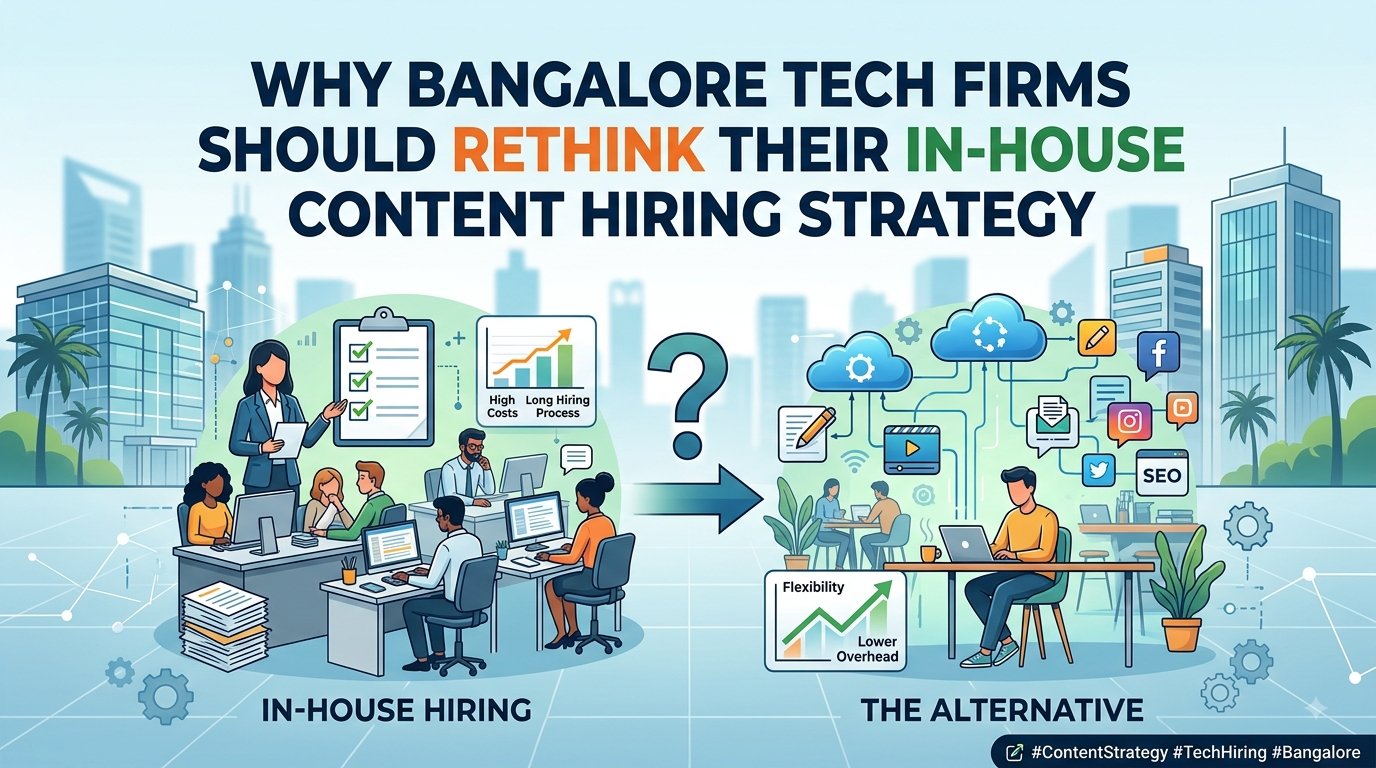
Bangalore’s startup ecosystem has reached a level of maturity where content marketing is no longer an afterthought relegated to an intern with a laptop and a vague mandate to write blogs. Founders in Koramangala, HSR Layout, and the glass towers of Manyata Tech Park now understand that organic search, technical authority, and thought leadership are foundational to B2B sales cycles in a market where buyers research extensively before ever speaking to sales. The natural response is to hire. Bring on a writer who can sit in the office, absorb the product, interview the engineering team over chai, and produce articles that position the company as a category leader. Given Bangalore’s reputation as a talent hub with lower costs than Western markets, this seems like an obvious and efficient win. But the economics of building an in-house content team in India’s Silicon Valley are more complicated than they first appear, and the hidden costs often erode the apparent salary savings faster than founders anticipate.
A competent content writer with two to three years of experience in Bangalore earns between five and nine lakhs per annum. A senior writer or content manager capable of handling technical B2B narratives for SaaS, fintech, or healthtech audiences commands eight to fifteen lakhs. A head of content with genuine strategic vision, someone who can align editorial calendars with revenue targets, buyer psychology, and search strategy, might reach eighteen to twenty-five lakhs. These numbers seem modest when converted to dollars, and indeed the base salary expense is a fraction of what a San Francisco startup would pay for equivalent roles. But salaries are only the visible part of the ledger. Employer contributions to provident fund, group health insurance policies, gratuity provisions, and the software tools required for modern content operations such as SEO platforms, design tools, and project management software add roughly twenty percent on top of base compensation. Office space in Bangalore ranges from forty-five rupees per square foot in emerging corridors to one hundred twenty rupees in premium Grade A buildings along Outer Ring Road and MG Road. While cheaper than the Bay Area, it is not negligible, and the trend is upward as the city’s commercial real estate market tightens and traffic congestion pushes companies toward more expensive but accessible locations. A content team of three in a respectable office still represents a meaningful monthly outflow that competes with other operational priorities.
Recruitment in Bangalore moves faster than in many global markets, which is both a blessing and a subtle curse. The city’s extraordinary density of English-speaking graduates and mid-career professionals means a founder or HR lead can often fill a content role within three to four weeks. The talent pool is deep, and technical literacy is widespread. A writer in Bangalore is likely comfortable with basic engineering concepts, familiar with startup culture, and able to ramp faster than their counterparts in less tech-centric cities. But this speed masks a quality gap that becomes apparent only after the first few articles are published. The writers available at entry-level salaries often lack the specialized expertise to write compellingly about Kubernetes orchestration, zero-trust security architectures, embedded finance compliance, or API gateway optimization without extensive coaching and multiple revision cycles. They can write grammatically correct sentences, but they cannot yet write with the authority that convinces a skeptical CTO to book a demo or a procurement committee to shortlist your solution. Bridging that gap requires investment. It requires time from your senior engineers to explain concepts, time from your marketing lead to review drafts and correct technical inaccuracies, and time from your founder to ensure the narrative aligns with positioning and competitive differentiation. That time is rarely accounted for in the hiring budget, but it is a real cost paid in opportunity lost elsewhere in the business.
The management tax is particularly acute in Bangalore’s startup environment, where teams run lean and every senior leader is stretched across multiple functions from investor relations to product decisions. A founder who hires an in-house writer must now become an editor, a content strategist, a career coach, and occasionally a dispute resolver. They must define voice, establish publishing cadence, set quality benchmarks, and troubleshoot why the blog traffic is not growing despite consistent output. For a company still searching for product-market fit or scaling its sales organization, this is a dangerous distraction. The hours spent mentoring a junior content team are hours not spent on enterprise deal negotiations, product roadmap decisions, or fundraising conversations. The in-house writer may cost less in direct salary than an outsourced alternative appears to, but the fully loaded cost includes the most expensive resource in any early-stage company: founder attention and senior leadership bandwidth.
This is where the outsourced model reveals its strength in the Bangalore context. A specialized content agency operating within the city, serving both local startups and global clients, offers a compelling hybrid. You gain access to writers who have already absorbed domain expertise across DevOps, cybersecurity, healthtech, fintech, and enterprise SaaS. They understand the difference between writing for a developer advocate seeking implementation details and writing for a procurement committee evaluating vendor stability. They bring editorial workflows, SEO research capabilities, technical review processes, and publishing discipline that would require multiple hires to replicate internally. The cost structure is deliverable-based and transparent. You might pay two to eight rupees per word for a deeply researched technical article, or a monthly retainer between fifty thousand and two lakhs for a sustained content program with defined output commitments. For many Bangalore startups, this is less than the fully loaded cost of a single junior in-house hire, and it comes without the management overhead, recruitment cycles, training investment, or long-term employment obligations.
There is also a flexibility argument that resonates deeply in Bangalore’s volatile funding environment. A startup that raises a bridge round, faces a delayed Series A, or navigates a market downturn cannot easily reverse an in-house hiring decision without damaging morale, employer brand, and team cohesion. An agency relationship, by contrast, scales naturally with your cash flow and strategic priorities. You increase output when the product launch demands a burst of awareness and thought leadership, and you pause or reduce scope when budgets tighten without the trauma of layoffs. The variable cost structure preserves optionality at a stage in your company’s life when optionality is everything and runway determines survival.
None of this suggests that in-house content teams are inherently flawed or that outsourcing is a permanent replacement for internal capability. There comes a point in every company’s journey when owning the narrative function makes strategic sense, particularly as brand maturity demands tighter control over messaging and faster response to market events. But for the majority of Bangalore tech firms navigating the precarious gap between seed funding and sustainable revenue, the question is not whether you can afford to hire a writer. It is whether you can afford the hidden costs that accompany that hire. The salary is just the down payment. The real expense is the time, the management bandwidth, the quality ramp, the revision cycles, and the opportunity cost of building an internal publishing operation before you have fully validated your market message and product positioning. In a city that moves as fast as Bangalore, where competitors launch features overnight and funding windows close without warning, outsourcing your content is not a compromise or a sign of weakness. It is a way to move faster, speak with established authority, and keep your team focused on what they do best while specialists handle the story you tell the world.