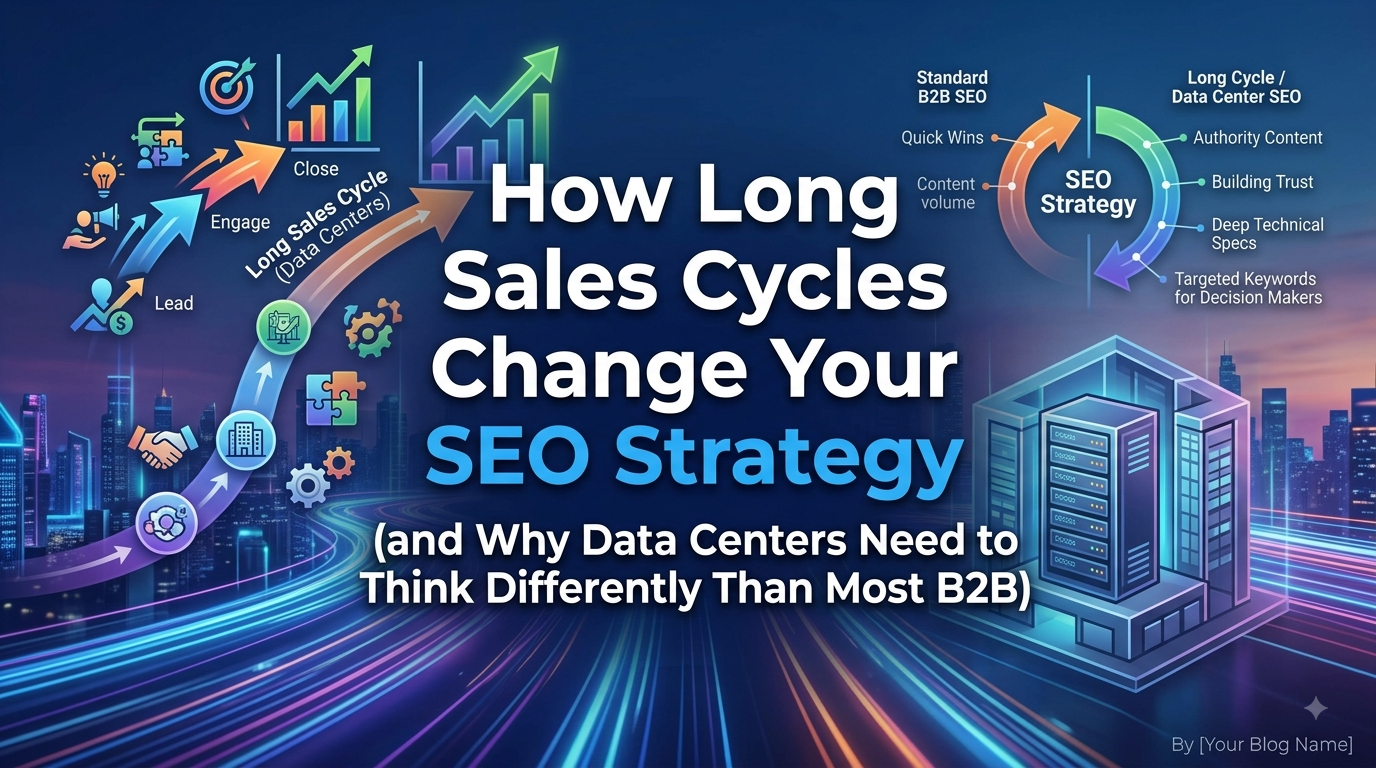
Most SEO advice is written with a fairly short buying journey in mind. Someone searches a problem, lands on a piece of content, maybe reads a comparison page a few days later, and converts within a few weeks. That model works reasonably well for software subscriptions, marketing tools, and plenty of other B2B categories where the sales cycle runs measured in days or a couple of months. It works much less well for data centers, where a single deal can take the better part of a year to close and involves a legal review, a facility tour, a security audit, and sign-off from people who were never part of the initial online research at all. Applying a short-cycle SEO playbook to a long-cycle business is one of the most common ways operators end up disappointed with their content investment.
The first thing that changes is what “conversion” even means. In a fast sales cycle, a lot of SEO strategy is built around driving a visitor straight to a demo request or a free trial signup, because the gap between interest and purchase is small enough that you can ask for commitment early. In data centers, asking a first-time visitor to request a facility tour is often asking for far more commitment than that visitor is ready to give. Someone in the early research phase might just be trying to understand what kW density their AI workloads will require, or whether a given market has enough available power to support growth over the next five years. Content aimed at that stage needs a different kind of conversion goal entirely, something closer to building trust and getting remembered than closing a lead on the spot. An SEO strategy that only measures success by tour requests or contact form fills will systematically undervalue all of the content doing real work earlier in a much longer journey.
The second change is about how long content needs to keep paying off. A blog post written to catch a trend in a fast-moving B2B category might have a useful life of a year before it needs a rewrite. Data center buying decisions unfold slowly enough that the same prospect may return to a piece of content multiple times over many months, comparing it against what they’re learning from other providers and from their own internal planning process. That means data center content needs to be built for durability rather than novelty. A well-built page explaining how a market’s power and fiber infrastructure supports long-term growth is doing work every time a buyer revisits their shortlist, not just the day it was published. Content strategy has to account for the fact that the same reader might be encountering the site for the third or fourth time, months apart, and still be in research mode.
The third change is about who actually needs to be reached, and when. A software purchase might have one or two decision-makers. A data center contract usually involves a buying committee that grows as the deal advances, pulling in finance, legal, and compliance stakeholders who weren’t part of the original technical evaluation and who often arrive with none of the context the lead researcher has already built up. Because the sales cycle is long enough for new people to join partway through, content needs to work for someone encountering the company for the first time in month seven of a deal, not just for the technical buyer who found the site in month one. That means keeping content that answers foundational, credibility-establishing questions just as current and easy to find as the more technical material aimed at engineers, because a long sales cycle means both audiences are searching at different points in the same deal.
Put together, these differences mean a data center SEO strategy has to be built around patience and depth rather than speed and volume of leads. The value of ranking well isn’t that it produces a fast conversion. It’s that it keeps a company visible and credible across a research process that can stretch for the better part of a year, across a growing set of people, most of whom the sales team will never meet until very late in the process. Strategies borrowed from faster-moving B2B categories tend to underinvest in exactly the kind of durable, broadly aimed content that a business with a nine-month sales cycle actually needs.