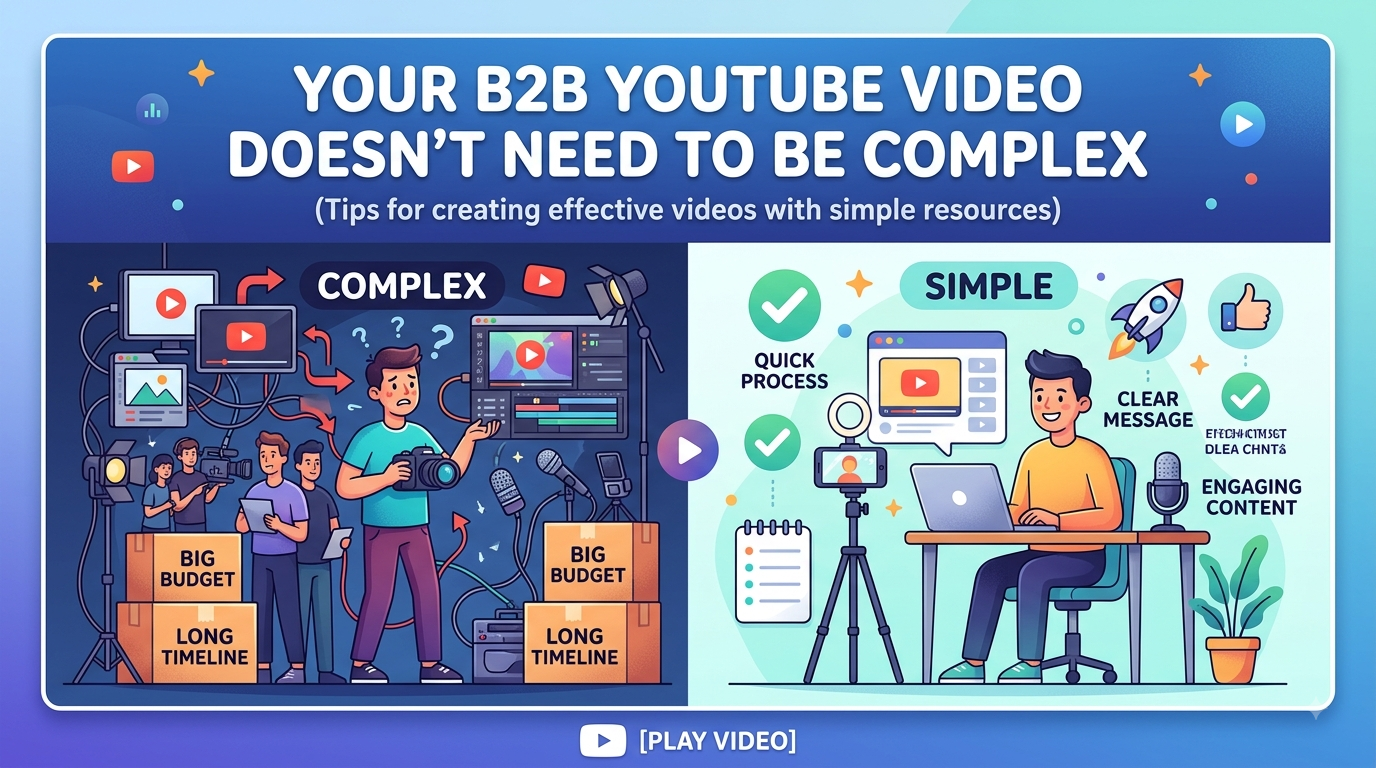
If you’ve been putting off making video content because you’re picturing a studio, a script team, and a week of editing — stop. That version of “video” is exactly what’s keeping most B2B companies out of a channel where their buyers are already spending time.The complexity mythSomewhere along the way, B2B marketers decided that video meant cinematic. High production value, motion graphics, a hired crew, maybe a jingle. That standard makes sense for a Super Bowl ad. It makes no sense for a video explaining how your onboarding flow works, or why a prospect should care about your pricing model.
B2B buyers aren’t watching your video for entertainment. They’re watching because they have a question, a problem, or a decision to make. A founder walking through a whiteboard, a product manager screen-sharing a demo, a customer support lead answering the five questions every prospect asks — none of that requires a production budget. It requires clarity.What actually worksSome of the most effective B2B YouTube content looks almost embarrassingly simple:Screen recordings with a voiceover. Someone narrates their way through a tool, a workflow, or a comparison. No editing wizardry, just a clear explanation.
Talking-head answers to real questions. Pull the top questions from your sales calls or support tickets and answer each one in its own short video.Whiteboard or slide walkthroughs. A person explaining a concept with a marker or a few slides often builds more trust than a polished animation, because it feels like a real person teaching you something.
Customer conversations. A candid interview with a happy customer, lightly edited, usually outperforms a scripted case study video.None of these need a studio. Most can be shot on a laptop webcam or a phone, with free or cheap editing software to trim the start and end.Why simple often winsThere’s a practical reason simple works so well in B2B: your audience is evaluating substance, not style. A CFO deciding whether your software is worth the spend cares about accuracy and usefulness, not lighting. Over-producing a video can even work against you — it starts to feel like marketing instead of information, and B2B buyers are quick to tune out anything that feels like a pitch.
Simple videos are also faster to make, which means you can make more of them. A single well-produced video takes weeks. A dozen straightforward, useful ones can be shot and published in the same time — and volume matters on YouTube, where the algorithm rewards a steady stream of content that answers real search queries.Where to startIf you’re stuck, don’t start with “let’s make a video.” Start with “what do people ask us constantly?” Then answer that question on camera, as plainly as you would in a sales call. Publish it. Watch what resonates. Do it again.You can always add production polish later, once you know which topics and formats your audience actually responds to. But the barrier to starting should be a webcam and something useful to say — not a production budget you don’t have yet.