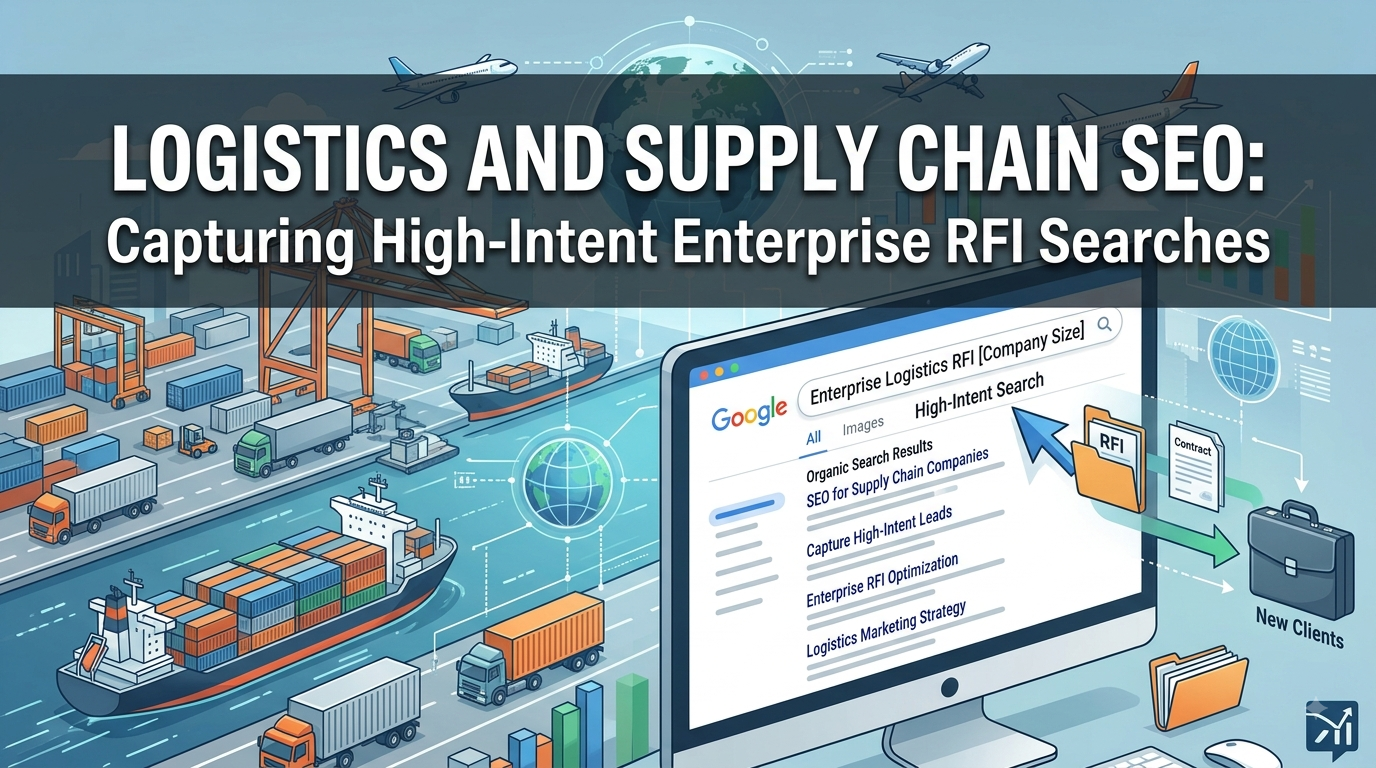
Logistics and supply chain companies sell into some of the longest, most deliberate buying cycles in B2B. A shipper evaluating a new 3PL partner, a manufacturer researching warehouse automation, or a retailer vetting freight brokers doesn’t make that decision on impulse — they run a formal evaluation process, often starting with a Request for Information (RFI) before ever picking up the phone. For logistics providers, this means the SEO game isn’t about ranking for broad terms like “freight shipping” or “supply chain software.” It’s about being visible at the exact moment a buying committee starts researching who belongs on their shortlist.
Why Logistics SEO Is Different
Most SEO playbooks are built around consumer-style funnels: awareness, consideration, decision, with content mapped loosely to each stage. Enterprise logistics buying doesn’t work that way. It’s committee-driven, procurement-gated, and often starts with internal requirements documents before a single search is ever typed. By the time someone searches, they usually already know what capability they need, whether that’s cold chain, cross-docking, last-mile delivery, or EDI integration. They generally know roughly what scale they operate at, in terms of parcel count, SKU volume, or number of distribution centers, and they often already understand which compliance or geographic constraints apply to their business, along with which broad category of vendor they’re evaluating. This means the highest-value searches in logistics are narrow, technical, and specific — not the high-volume generic terms most keyword tools surface first.
What RFI-Stage Search Intent Looks Like
RFI-stage searches sit later in the funnel than most SEO content targets. They tend to combine a category with a specific capability, such as “3PL providers with temperature-controlled warehousing,” or use comparison language like “top freight brokers for the Pacific Northwest.” Compliance and certification terms show up often too, as in “FDA-compliant cold chain logistics providers,” alongside integration-specific queries such as “TMS with SAP integration” or “WMS API for Shopify.” Scale-qualifying language is common as well, with searches like “enterprise fleet management software” or “high-volume parcel carrier” signaling a buyer who already knows their own size and needs a vendor who can match it. There’s also a category of RFP- and RFI-adjacent phrasing itself worth noting, since searches like “logistics RFP template” or “how to evaluate a 3PL” are often overlooked but represent gold-standard intent: companies typing these queries are actively building their evaluation criteria, and whoever’s content shapes those criteria has a natural advantage once the RFI actually goes out.
Auditing Your Current Content Against RFI Intent
A useful audit starts by mapping your existing pages to buyer roles rather than just topics. Enterprise logistics decisions typically involve procurement, operations, and IT or compliance stakeholders, and each of these groups asks different questions, so a single generic “services” page can’t realistically serve all three. From there, check whether you actually have capability-specific landing pages. If your only warehousing page is a general overview, you’re invisible to the buyer searching “bonded warehouse Los Angeles” or “multi-client 3PL Midwest,” since specificity is exactly what RFI-stage searchers are looking for.It’s also worth looking for evaluation and comparison content on your site. Do you have anything that helps a buyer build an RFI checklist, compare provider types, or understand different pricing models? If competitors own this kind of content, they’re effectively shaping the criteria buyers use to evaluate everyone, including you. Trust and qualification signals matter too during this audit — case studies with real volume and scale numbers, named client logos where permitted, certifications, and integration partner logos do far more work at this stage than generic marketing copy. Finally, review how visible your technical and integration documentation actually is. IT and operations stakeholders often search for very specific technical compatibility questions, and if that information is buried in a PDF or missing entirely, you may be filtered out of consideration before a human ever reads a pitch.
Building an SEO Strategy Around the RFI Moment
The core of an RFI-focused strategy is targeting long-tail, role-specific keywords deliberately rather than competing head-on for broad terms like “supply chain management.” That means building out pages around the specific combinations real buyers search, pairing capability, industry, region, and scale rather than trying to win a single generic phrase. Alongside this, structured comparison and evaluation content — guides like “How to evaluate a freight broker” or “3PL vs. 4PL: which model fits your business” — position a company as a resource during the criteria-building phase rather than just a vendor pitching at the end of the process.
Case studies deserve particular attention here, since generic success stories tend to underperform in this space. A case study that states the volume handled, the SLA performance achieved, and the specific integrations involved speaks directly to a procurement team’s checklist in a way that vague testimonials never will. It’s also worth optimizing for schema and structured data around service area, certifications, and organizational details, since this helps a company surface in more specific, filtered search results — which matters when buyers are searching with precise, qualifying language rather than generic terms.
Content should also be aligned with the criteria that actually show up in RFIs and RFPs in your vertical. Reviewing real templates common in your industry and making sure your site directly addresses what they typically request — capacity, uptime, compliance, security, integration options, and references — closes the gap between what a buyer needs to know and what your site actually tells them. Finally, don’t neglect bottom-of-funnel technical pages. API documentation, integration guides, and compliance certification pages are frequently skipped in SEO planning, yet they are exactly what a technical stakeholder searches for during vendor screening.
Measuring What Matters
Traffic volume is a weak signal in this space, so it’s worth tracking better indicators of RFI-stage SEO performance instead. Form fills or RFI submissions attributed to organic search are a much more direct measure of impact than raw visits, as is the time on page and depth of engagement seen on capability and comparison pages specifically. Branded search lift following the publication of unbranded, capability-specific content is another useful signal, since it often indicates that a piece of content introduced a company to a buyer who then went on to research them by name. Sales-reported attribution — reps noting that a prospect said they found the company through search during a discovery call — rounds this picture out, alongside tracking rankings for long-tail, role-specific query clusters rather than fixating on head terms alone.
In logistics and supply chain, the buyers who matter most are searching narrowly, deliberately, and with a checklist already forming in their heads. Winning that moment isn’t about ranking for the biggest keyword in the category — it’s about having the specific, technical, evaluation-ready content that shows up exactly when a committee starts building its shortlist. SEO in this space is less about traffic and more about being present, credible, and specific at the one moment that actually predicts revenue: the RFI.